Categories
Corporate

Angel One Q3 profit dips to ₹269 crore

Angel One, one of India’s leading retail brokerage firms, reported a decline in net profit for the third quarter ending December 31, 2025. The company’s consolidated profit after tax (PAT) fell 4.5 per cent to ₹269 crore, compared with ₹281.5 crore in the same period last year. The drop was mainly due to rising operating costs, including higher employee expenses and charges from employee stock ownership plans (ESOPs).

Despite the dip in profit, Angel One posted growth in its overall revenue. Total income for the quarter rose about 5.8 per cent to ₹1,338 crore from ₹1,264 crore a year earlier. The revenue increase was driven by higher interest income as well as fees and commission earnings from its brokerage and related services.

Sequentially, the company showed strong performance. Compared with the previous quarter, PAT rose by around 27 per cent, reflecting improved operational efficiency and better cost management. Earnings before depreciation, amortisation, and taxes (EBDAT) also increased to ₹405 crore, signalling the company’s underlying business strength.

In addition to the quarterly results, the board approved key measures aimed at benefiting shareholders. Angel One announced an interim dividend of ₹23 per share. It also sanctioned a stock split in a 1:10 ratio, meaning each existing equity share of ₹10 face value will be divided into ten shares of ₹1 each. These steps are intended to make shares more affordable and improve liquidity, helping attract a wider base of investors.

Following the announcements, Angel One’s stock saw positive movement in the market, as investors welcomed the combination of revenue growth, sequential profit improvement, and shareholder-friendly corporate actions.

The company continues to expand its client base while strengthening its non-broking businesses, which are expected to support long-term growth. Analysts say Angel One’s efforts to diversify its services, combined with strong market presence, could help the firm navigate challenges in India’s financial markets and maintain steady growth in the coming quarters.

Also Read: Oil drops 3% after Trump remarks on Iran

Categories
Corporate

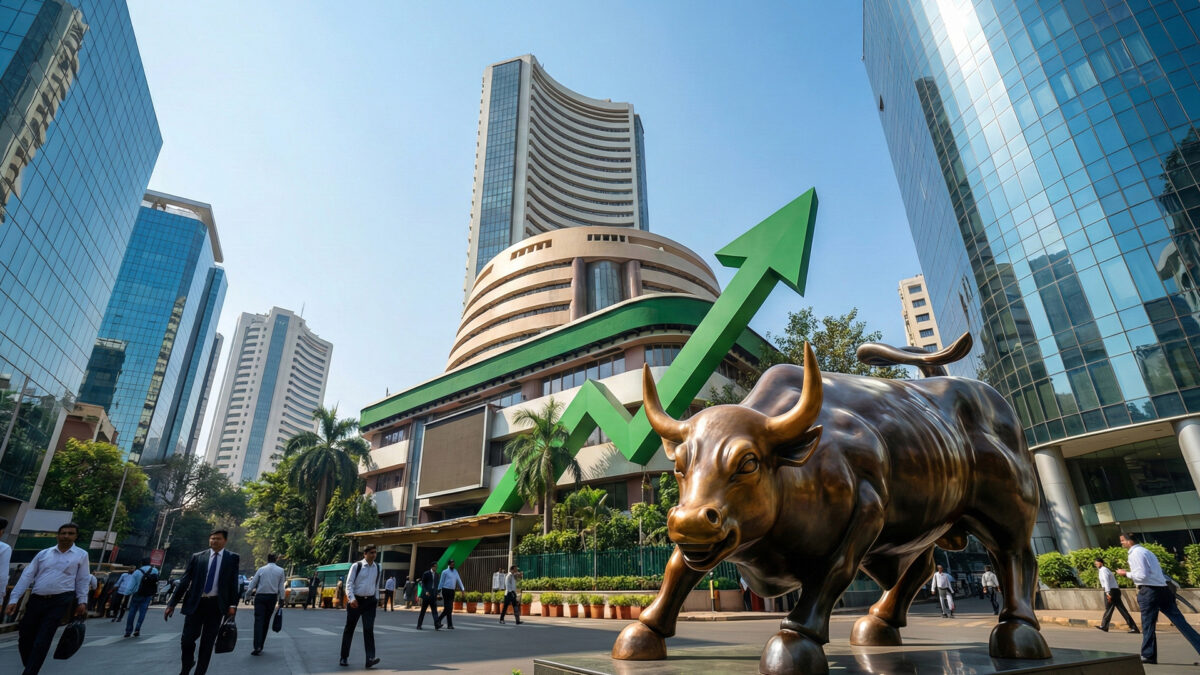
Sensex surges over 700 points, Nifty tops 25,850

On Thursday, the BSE Sensex surged more than 700 points, while the Nifty50 moved above the 25,850 mark, reflecting improved investor sentiment in early trade.

IT stocks led the gains after upbeat quarterly earnings and guidance from Infosys, which sparked a rally across the sector. Shares of Wipro also traded higher, while buying interest was seen in metal and PSU stocks, with Hindalco and NTPC among the notable gainers. Banking and financial stocks provided additional support to the broader market.

In contrast, healthcare stocks underperformed. Cipla and Apollo Hospitals Enterprise were among the top losers, facing selling pressure amid stock-specific concerns. Some defensive stocks also lagged the broader market trend.

Overall market breadth remained positive, with advances outnumbering declines on the BSE. Analysts said the rally was driven by earnings optimism, steady foreign fund inflows, and expectations of policy continuity, though they cautioned that volatility could persist as investors track global developments and upcoming corporate results.

Also Read: Shadowfax technologies IPO to raise ₹1,907 crore

Categories
Corporate

IHG targets 400+ hotels in India in 5 years

IHG Hotels & Resorts has announced an ambitious plan to significantly scale up its presence in India, targeting more than 400 hotels that are open or under development within the next five years. The move highlights the company’s strong confidence in India as one of its most important growth markets globally.

At present, IHG operates over 50 hotels in India and has around 80 properties in the pipeline, together accounting for nearly 12,000 rooms. The proposed expansion will more than triple its existing footprint, driven by rising domestic travel, growing demand for branded accommodation, and increasing interest from hotel owners and developers.

IHG currently operates eight brands in India, covering the luxury, premium and mid-scale segments. These include Six Senses, InterContinental, Crowne Plaza, voco, Holiday Inn, Holiday Inn Express, Garner and Staybridge Suites. As part of its next growth phase, the company plans to introduce its Vignette Collection, a luxury and lifestyle brand, in India in early 2026.

Elie Maalouf, Global Chief Executive Officer of IHG Hotels & Resorts, said India continues to be a key growth driver for the group. He pointed to strong economic fundamentals, favourable demographics and robust domestic travel demand as factors supporting long-term expansion. According to the company, hotel owners in India are increasingly confident in globally recognised brands that offer strong distribution systems and loyalty programmes.

Sudeep Jain, Managing Director for South West Asia at IHG, noted that India remains an under-penetrated market for branded hotels, creating significant opportunities across both business and leisure destinations. He added that Holiday Inn and Holiday Inn Express together make up more than 70 per cent of IHG’s current and planned hotels in India, reflecting strong demand in the mid-scale segment.

In recent developments, IHG opened Crowne Plaza Lucknow in May 2025, marking its 50th operational hotel in the country. The group has also signed several new properties under its Garner mid-scale brand in states such as Uttar Pradesh, Jammu & Kashmir, Gujarat and Rajasthan. Expansion of the InterContinental brand is underway in key urban and leisure locations, including Bengaluru, Hyderabad, Mahabalipuram, Kasauli and Kodaikanal.

Also Read: Infosys takes Rs 1,289 crore labour code hit in Q3

Categories
Corporate

Infosys takes Rs 1,289 crore labour code hit in Q3

Infosys Ltd reported a one-time financial hit of Rs 1,289 crore in the third quarter of FY26 due to provisions made under India’s new labour codes, impacting its quarterly profit despite steady revenue growth.

The country’s second-largest IT services company said the charge was linked to changes required after the government notified the new labour codes in November 2025. These codes combine several existing labour laws and require companies to reassess employee-related benefits such as gratuity and leave encashment. Infosys accounted for higher gratuity liabilities arising from past service costs and revised benefit obligations, resulting in the exceptional expense.

For the quarter ended December 31, 2025, Infosys reported a consolidated net profit of Rs 6,654 crore, down 2.2 per cent year-on-year. On a sequential basis, profit declined more sharply due to the one-off provision. However, revenue from operations rose 8.9 per cent year-on-year to Rs 45,479 crore, reflecting stable demand across key markets.

The company said its underlying business performance remained healthy. Infosys recorded strong large deal wins during the quarter, with total contract value of about $4.8 billion. Financial services, manufacturing, and energy and utilities were among the key sectors contributing to growth. Digital and artificial intelligence-led services continued to see traction as clients focused on efficiency and transformation.

Encouraged by better-than-expected execution and deal momentum, Infosys raised its revenue growth guidance for FY26. The company now expects constant currency revenue growth of 3.0–3.5 per cent for the full year, compared with its earlier forecast of 2.0–3.0 per cent.

Infosys said operating margins were impacted by the labour code provision but added that margins remain stable when the one-time cost is excluded. The company maintained its margin guidance for the year, supported by cost control measures and improved utilisation.

Management said it continues to invest in upskilling employees, especially in AI and digital technologies, to stay competitive in a changing business environment. The labour code impact is also being seen across the IT sector, as companies adjust their balance sheets to align with the new regulatory framework.

Infosys stated that the provision is a one-time adjustment and does not affect its long-term growth strategy or financial strength.

Also Read: Trump pushes Microsoft on data centre costs

Categories
Corporate

Sensex falls 245 pts, Nifty below 25,700

Markets ended lower on Wednesday, as selling pressure dominated trading amid cautious investor sentiment. The BSE Sensex fell 245 points to close at 86,150, while the Nifty 50 slipped 85 points to end at 25,666, extending the recent trend of volatility.

Sector-wise, IT and realty stocks were the biggest drag, with TCS and Asian Paints among the top losers, dropping nearly 2% each. Profit-booking and sector rotation contributed to the decline in these large-cap names. Other IT and real estate shares also underperformed, keeping the benchmarks under pressure throughout the session.

On the other hand, metal and PSU stocks outperformed, providing selective support to the indices. Tata Steel and Axis Bank were notable gainers, rising on domestic demand optimism and sector-specific interest. Energy and industrial shares also saw modest gains, partially offsetting losses in IT and realty.

Market analysts noted that foreign institutional selling added to the downward pressure, while firm crude oil prices and geopolitical concerns limited risk appetite. Investors appeared cautious ahead of upcoming corporate earnings and macroeconomic updates, keeping markets range-bound.

Trading activity showed a mixed picture, with defensive and industrial sectors attracting interest even as broader market sentiment remained subdued. Experts suggest that a sustained rebound may require clear triggers from earnings surprises or macroeconomic cues, particularly in IT, banking, and metals sectors.

Also Read: Sensex down 150 Points, Nifty below 25,700

Categories
Corporate

Bharat Coking Coal IPO subscribed 147 times on last day

The initial public offering (IPO) of Bharat Coking Coal Limited (BCCL), a subsidiary of state-owned Coal India Limited, received an overwhelming response from investors, with the issue being subscribed 146.81 times on the final day of bidding on Tuesday.

According to stock exchange data, the IPO attracted bids for more than 5,095 crore shares, against 34.7 crore shares on offer. The strong demand came from all investor categories, led by institutional buyers.

The Qualified Institutional Buyers (QIBs) segment was subscribed over 300 times, reflecting strong interest from domestic and foreign institutions. The Non-Institutional Investors (NIIs) category also saw heavy participation, with subscriptions exceeding 250 times, while Retail Individual Investors (RIIs) subscribed the issue nearly 49 times. Employee and shareholder portions were also fully subscribed.

The IPO, priced in the range of Rs 21 to Rs 23 per share, was entirely an offer for sale (OFS) by Coal India. As a result, the company itself will not receive any fresh capital from the issue, and the proceeds will go to the parent company. At the upper end of the price band, the IPO values Bharat Coking Coal at over Rs 10,700 crore.

Ahead of the public issue, the company had raised around Rs 273 crore from anchor investors, signalling early confidence in the offering. Market participants said the anchor book and the company’s strong position in the coking coal segment helped boost investor sentiment.

Bharat Coking Coal is one of India’s key producers of coking coal, which is an essential raw material for the steel industry. The company’s mining operations are largely concentrated in Jharkhand and West Bengal, regions known for high-quality coking coal reserves.

Analysts attributed the exceptional subscription to multiple factors, including the company’s strategic importance, steady demand from the steel sector, reasonable valuation, and expectations of listing gains. Reports suggest the IPO received applications from over 90 lakh investors, making it one of the most subscribed public sector offerings in recent years.

Also Read: Sergey Brin becomes World’s No. 3 richest

Categories
Beyond Corporate

Gold at ₹1.42 lakh, Silver at ₹2.75 lakh after fresh rise

Gold and silver prices edged higher in early trade on Wednesday, staying close to record levels amid firm global cues and steady domestic demand.

24-carat gold rose by ₹10 to trade at ₹1,42,540 per 10 grams in Mumbai and Kolkata. In Delhi, gold was priced at ₹1,42,690, while Chennai saw higher rates at ₹1,43,690 per 10 grams. 22-carat gold was quoted at around ₹1,30,660 per 10 grams across major markets.

Silver prices also increased by ₹100, trading at ₹2,75,100 per kilogram in Delhi, Mumbai, and Kolkata. Chennai continued to command a premium, with silver priced at around ₹2,92,100 per kg.

Market experts said bullion prices are being supported by positive global trends, including expectations of lower interest rates and sustained safe-haven demand. Seasonal buying and investor interest have also contributed to the firmness in domestic prices.

Both gold and silver are currently hovering near their recent highs, with further movement likely to depend on global economic cues and currency trends.

Also Read: Sensex down 150 Points, Nifty below 25,700

Categories
Corporate

Sensex down 150 Points, Nifty below 25,700

Indian stock markets opened on a weak note on Wednesday, where the BSE Sensex fell over 100 points in early trade, while the Nifty50 slipped below the 25,700 level. Signals from GIFT Nifty had already suggested a muted start for the domestic markets.

Global markets provided limited support, with Asian stocks trading mixed to weak. This, along with continued selling by foreign institutional investors (FIIs), kept pressure on Indian equities. However, buying by domestic institutional investors (DIIs) helped prevent a sharper decline.

Among key stocks, Infosys traded lower as investors remained cautious ahead of its quarterly results. Shares of HDFC AMC and Groww were also among the early losers due to stock-specific concerns.

On the positive side, ICICI Lombard gained in early trade, supported by buying interest after recent business updates. Waaree Renewable also saw some buying interest, bucking the broader weak trend.

Market analysts said the Nifty is facing resistance at higher levels and may remain volatile in the short term. They advised investors to stay cautious and focus on stock-specific opportunities rather than broad market buying.

Also Read: Bajaj Housing raises ₹509 cr via bonds

Categories
Corporate

Bajaj Housing raises ₹509 cr via bonds

Bajaj Housing Finance Limited has raised ₹509 crore through the issuance of non‑convertible debentures (NCDs) at a 7.10 per cent annual coupon rate. The bonds were offered via private placement to select institutional and high‑net‑worth investors, and they will mature on October 16, 2028. This step provides Bajaj Housing with long-term funding to support its lending operations and expansion plans.

The successful fundraising reflects investor confidence in Bajaj Housing’s strong business performance. The company has seen steady growth in its assets under management (AUM), which reached ₹1.33 lakh crore as of December 31, 2025,  a 23 per cent increase from the previous year. This growth highlights the company’s expanding housing loan portfolio and deepening market presence.

During the third quarter of the current fiscal year, Bajaj Housing disbursed approximately ₹16,500 crore in loans, up from ₹12,600 crore in the same period last year. This increase demonstrates the company’s ability to scale its lending operations even in a competitive market.

Analysts view this capital raising positively, noting that it strengthens the company’s balance sheet and enhances its capacity to meet growing demand for housing finance in India. The NCD proceeds will be used to support ongoing loan disbursements and fuel future growth, ensuring the company maintains financial flexibility.

The privately placed NCDs offer fixed returns to investors over a medium-to-long-term period. With a 7.10 per cent coupon rate, the bonds provide predictable interest income, while the company benefits from diversifying its funding sources and reducing reliance on short-term borrowings.

Also Read: Rupee slips 5 Paise to 90.22 against US dollar

Categories
Corporate

$200 mn Shriram‑MUFG non‑compete fee under review

Japan’s Mitsubishi UFJ Financial Group (MUFG) Bank is set to invest $4.4 billion in Chennai‑based non‑bank lender Shriram Finance Ltd (SFL), acquiring a 20 per cent stake. While the deal is one of the largest inbound investments in India’s financial sector, a separate $200 million non‑compete fee for the Shriram promoter trust has sparked debate among regulators, shareholders, and advisory firms.

The non‑compete fee is intended to prevent the Shriram Ownership Trust (SOT), the promoter entity, from starting a competing business under the Shriram brand or any other name. Typically, non‑compete fees are paid when promoters exit a company, but in this case, SOT will remain a major shareholder and retain management control even after receiving the payment.

India’s market regulator, the Securities and Exchange Board of India (Sebi), requires fair treatment for all shareholders. Sebi rules say promoters cannot get extra compensation in securities transactions without board and shareholder approval. If such a fee is paid, it usually needs to be included in the open offer price for public shareholders. Here, however, MUFG is acquiring its stake through new share issuance, not a direct share purchase, making the rules less clear.

Investor advisory firms are split on the deal. Some, like IiAS and SES, have advised shareholders to reject the non‑compete payment, citing fairness concerns. Others, including InGovern and ISS, have supported it, highlighting different interpretations of the arrangement’s purpose.

The non‑compete period is also unusually long, lasting until MUFG’s stake drops below 10 per cent, which could effectively be permanent since MUFG is a long-term strategic investor. Experts say this raises questions about whether the fee is meant to secure promoter agreement rather than a genuine business need.

The Shriram‑MUFG case could set a precedent for how promoter non‑compete fees are treated under Indian law, influencing future large investments and corporate governance practices.

Also Read: India’s retail inflation hits 1.33% in December