Categories
Corporate

Nifty 50 Crosses 26,000 Amid India-US Trade Optimism

The Nifty 50 breached the 26,000 mark for the first time in over a year on Thursday, signalling renewed investor confidence amid a wave of positive developments on both domestic and global fronts.

The rally was fuelled by optimism over a potential India–US trade agreement, sustained foreign fund inflows, strong buying in information technology stocks, and a strengthening rupee.

As of 10:21 a.m. IST, the benchmark Sensex was up 786 points, or 0.93 percent, at 85,212, while the Nifty 50 advanced 218 points, or 0.85 percent, to 26,087.

The milestone marked a significant comeback for the broader market, which has been gaining steadily on the back of easing global uncertainty and improving macroeconomic indicators.

Market sentiment improved sharply after reports suggested that India and the US were narrowing differences over tariff terms, with discussions focusing on reducing duties on certain goods to about 15–16 percent.

The prospect of a deal that could expand trade volumes between the two economies has sparked optimism among investors, particularly in export-oriented sectors.

Analysts observed that such an agreement could significantly improve India’s trade balance and boost market confidence ahead of the festive season.

Foreign institutional investors continued their buying streak for the fifth straight session, purchasing shares worth nearly ₹100 crore during the special one-hour Diwali trading window earlier in the week.

The steady inflows are being seen as a vote of confidence in India’s economic outlook, underpinned by solid macroeconomic fundamentals and robust corporate earnings.

The technology sector led the gains, with the Nifty IT index rising over 2 percent.

Stocks such as Infosys, HCL Technologies, Tech Mahindra, and Tata Consultancy Services advanced strongly after the US administration clarified that existing H-1B visa holders and certain international graduates would be exempt from a new $100,000 visa fee.

The clarification eased concerns about higher operating costs for Indian IT firms with significant exposure to the US market.

The rupee also strengthened, appreciating by 13 paise to 87.80 against the US dollar in early trade. Analysts attributed the movement to upbeat domestic equity sentiment, foreign inflows, and expectations of progress in trade negotiations.

From a technical standpoint, market experts noted that the Nifty’s strong momentum has kept it close to its upper Bollinger band, indicating continued bullishness.

Also Read: Walmart Pauses H-1B Hiring Amid Impact of $100,000 U.S. Visa Fee
Categories
Corporate

Meesho Grapples with ₹127 Crore Arbitration Dispute with AWS

E-commerce unicorn Meesho has become embroiled in a legal dispute with its key technology partner, Amazon Web Services India Private Limited (AWS), as revealed in the company’s draft red-herring prospectus (DRHP).

The dispute centres on alleged unpaid cloud service dues amounting to ₹127.45 crore (approximately US $14.44 million) claimed by AWS under a Private Pricing Addendum (PPA) signed in February 2022.

According to the DRHP, AWS initiated arbitration proceedings under the Arbitration and Conciliation Act, 1996, before a three-member arbitral tribunal in New Delhi.

The claim covers “spend commitment shortfall payment amount, pending service fees, interest on the respective payments and the cost of arbitration” tied to the special pricing agreement that Meesho entered into for cloud infrastructure and services.

Meesho has contested AWS’s claim, disputing the invoices and challenging the enforceability of the minimum-commitment clause in the PPA.

The company has alleged “deficiencies in the services provided by AWS” and argued that the contractual minimum spend commitment should not bind it under the terms of the addendum.

In a counter-move, Meesho filed a counterclaim on January 31 2025 for ₹86.49 crore, attributing the amount to business losses “due to disruption of business and inadequate support provided by AWS, salary costs incurred due to migration from services procured from AWS, along with interest and costs.”

AWS responded with its reply in March 2025, and the proceedings before the arbitral tribunal remain pending.

The arbitration dispute occurs at a critical juncture for Meesho, which is gearing up for one of India’s most anticipated tech initial public offerings (IPO) in 2026.

The DRHP indicates that the company plans to raise fresh funds of about ₹4,250 crore, of which approximately ₹1,390 crore is earmarked for strengthening technology and cloud infrastructure, among other strategic investments.

Beyond the AWS arbitration, the DRHP outlines a broader portfolio of legal and financial challenges for Meesho.

The company faces tax and vendor disputes aggregating more than ₹710 crore, including a tax demand of ₹572 crore. These proceedings are cited in its filing as key diligence points for investors.

Meesho processes a large volume of transactions — it recorded 1.59 billion orders in the financial year ended March 2025 — and its business model relies heavily on cloud-based systems for operations, payments, recommendation engines, and fulfilment services.

The arbitration dispute thus underscores both the company’s operational dependence on AWS and the potential cost and risk implications of a conflict with a major cloud provider.

While Meesho remains cash-flow positive and among India’s fastest-growing e-commerce platforms, the arbitration with AWS and its broader litigation exposure are likely to feature prominently in investor disclosures and regulatory scrutiny as the IPO process advances.

The company acknowledges in its DRHP that any adverse outcome of the AWS dispute could have a material impact on its business and operating model.

Also Read: Walmart Pauses H-1B Hiring Amid Impact of $100,000 U.S. Visa Fee

Categories
Corporate

NCLT Admits Insolvency Plea Against Bhilai Jaypee Cement Over ₹45 Crore Default

The National Company Law Tribunal (NCLT) has admitted an insolvency petition against Bhilai Jaypee Cement, a subsidiary of Jaiprakash Associates Limited (JAL), for a default amounting to ₹45 crore.

The order was issued by the Cuttack bench of the tribunal, following a plea filed by the company’s operational creditor, Sidhgiri Holdings Pvt. Ltd., which had supplied coal to Bhilai Jaypee Cement.

In its ruling, the two-member bench comprising Judicial Member Deep Chandra Joshi and Technical Member Banwari Lal Meena held that the company had defaulted on an operational debt under Section 9 of the Insolvency and Bankruptcy Code (IBC).

The tribunal consequently directed the initiation of the Corporate Insolvency Resolution Process (CIRP) against Bhilai Jaypee Cement and appointed an interim resolution professional (IRP) to take charge of the company’s management.

The NCLT also imposed a moratorium, protecting the company from asset sales, debt recovery actions, or legal proceedings during the resolution process.

“We are inclined to hold that there exists an outstanding operational debt, a default and accordingly the present application under Section 9 of the Code read with Rule 6 of the Insolvency & Bankruptcy Rules, 2016 for initiating CIRP of Bhilai Jaypee Cement is allowed and the corporate debtor is admitted,” the bench stated in its order.

The insolvency petition was triggered after Bhilai Jaypee Cement allegedly failed to clear dues worth ₹45.40 crore owed to Sidhgiri Holdings against coal supplies made between September 2021 and June 2022.

The operational creditor claimed that the cement company had placed three purchase orders for 2,000 metric tonnes of coal each, amounting to 6,000 metric tonnes in total. As per the agreement, payment was to be made within 15 days of each delivery.

However, the company reportedly made only part payments and failed to settle the full amount despite repeated reminders.

On June 22, 2024, Sidhgiri Holdings issued a statutory demand notice under the IBC for the unpaid dues, which included ₹30.08 crore as the principal amount and ₹15.32 crore as accrued interest at 24 percent.

Receiving no response, the company subsequently moved NCLT to initiate insolvency proceedings.

In its defense, Bhilai Jaypee Cement argued that the petition was filed with the intent of recovering dues rather than resolving insolvency and that it was financially solvent.

The company also contended that the petition lacked supporting documentation, such as bank confirmations and ledger details.

However, the tribunal rejected these arguments, noting that Bhilai Jaypee Cement had neither disputed the coal supply nor the genuineness of the invoices.

The tribunal further added that the debt’s existence was established through the invoices and supporting GST documentation submitted by Sidhgiri Holdings.

Bhilai Jaypee Cement is a joint venture between Jaiprakash Associates Limited and Steel Authority of India Limited (SAIL), formed to operate a cement manufacturing unit in Chhattisgarh.

Its parent entity, JAL, is already undergoing insolvency proceedings under IBC. Vedanta Group has reportedly submitted the winning resolution plan worth ₹17,000 crore for JAL, outbidding the Adani Group.

The admission of Bhilai Jaypee Cement into insolvency adds another layer of complexity to the Jaiprakash Group’s ongoing financial distress, as multiple subsidiaries continue to face legal and debt resolution proceedings.

Also Read: Apple Nears $4 Trillion Valuation Upon iPhone 17 Success

Categories
Corporate

Apple Nears $4 Trillion Valuation Upon iPhone 17 Success

Apple Inc. (AAPL) hit an all-time high on Tuesday, bringing its market capitalization close to $3.9 trillion. The rally follows strong early sales of the iPhone 17 series, which have significantly outpaced expectations in major markets, including the U.S. and China.

Data from Counterpoint Research shows the iPhone 17 outsold its predecessor by 14% during the first ten days of launch. In China, sales of the base model nearly doubled compared with the iPhone 16’s launch period, highlighting robust consumer demand for the new lineup. Analysts attribute the surge to innovative features, strategic marketing, and growth in the global smartphone market.

The stock rally has also propelled Apple past Microsoft, reclaiming its position as the world’s second-most-valuable company, behind only Nvidia. Investors have reacted positively, viewing the iPhone 17’s success as a sign of Apple’s enduring brand strength and market leadership.

Evercore ISI recently added Apple to its Tactical Outperform List, citing continued strong demand and optimistic earnings forecasts. Apple is scheduled to announce its quarterly results on October 30, a report expected to further influence the stock’s trajectory.

The iPhone 17 series, featuring upgraded camera systems, longer battery life, and advanced software tools, has resonated with consumers seeking premium smartphones. Analysts predict that continued demand for the iPhone 17, coupled with Apple’s broader product ecosystem, could sustain the company’s upward momentum in the coming quarters.

On Wednesday, Apple shares traded at $262.77, hitting intraday highs of $265.16 and lows of $260.77. The company’s price-to-earnings ratio stands at 30.28, with earnings per share (EPS) of 6.59, reflecting sustained investor confidence.

With strong sales and resilient stock performance, Apple reinforces its position as a global technology leader, demonstrating its ability to innovate, capture market share, and maintain investor trust in a competitive market.

Also Read: WeWork India Issues Detailed Response to InGovern Critique

Categories
Corporate

Walmart Pauses H-1B Hiring Amid Impact of $100,000 U.S. Visa Fee

Walmart Inc. has paused making job offers to candidates requiring H-1B visa sponsorship, following sweeping changes introduced by the U.S. government that dramatically raise visa application costs, according to a Bloomberg report.

The decision comes in response to a new $100,000 fee for H-1B visa applications imposed by the Trump administration in September.

The measure, part of a broader overhaul aimed at tightening the program, is designed to discourage what the administration describes as overuse of foreign skilled workers.

The change has reverberated across technology, retail, and consulting industries that depend heavily on such visas.

Walmart is among the largest users of H-1B visas in the U.S. retail sector, employing around 2,390 H-1B holders out of its total workforce of about 1.6 million.

While that represents a small portion of its overall headcount, it underscores the company’s reliance on global talent in specialized corporate and technology roles.

A Walmart spokeswoman said the retailer remains “committed to hiring and investing in the best talent to serve our customers, while remaining thoughtful about our H-1B hiring approach.”

The new visa fee policy has drawn sharp criticism from industry groups and legal experts. The U.S. Chamber of Commerce recently filed a lawsuit challenging the legality of the $100,000 fee, calling it a “cost-prohibitive barrier” for employers, particularly start-ups and mid-sized businesses.

The Chamber argued that the rule undermines the purpose of the H-1B program, which was created by Congress in 1990 to allow American firms to access skilled foreign professionals when domestic shortages exist.

According to guidance from the U.S. Citizenship and Immigration Services (USCIS), the fee applies to new H-1B applications filed after September 21, 2025, but exempts current visa holders changing employers or status within the U.S.

Despite these clarifications, companies across sectors continue to express uncertainty about implementation timelines and compliance requirements.

Economists and education experts have cautioned that the new fee could significantly reduce the number of skilled foreign workers entering the U.S., particularly in STEM fields.

Universities and hospitals, which also rely on H-1B visas to recruit researchers and lecturers, have warned that the cost increase could strain their hiring pipelines.

Walmart’s decision adds to growing signs that the policy shift is reshaping corporate hiring practices across industries.

As reported by Bloomberg, the company’s pause illustrates how even major employers are reassessing recruitment strategies amid escalating visa costs and regulatory unpredictability.

Also Read: WeWork India Issues Detailed Response to InGovern Critique

Categories
Corporate

WeWork India Issues Detailed Response to InGovern Critique

WeWork India Management Ltd has responded comprehensively to a governance-watch report released by proxy advisory firm InGovern Research Services, issuing extensive clarifications on concerns raised ahead of its ₹3,000 crore initial public offering.

The company reaffirmed that it has complied with all regulatory disclosure norms and emphasised strong operational performance, countering InGovern’s earlier warnings over profitability path, promoter pledges, and the structure of the IPO.

InGovern had flagged several issues in its original note, pointing to a sole offer-for-sale structure for the IPO, meaning no fresh capital infusion into the company, and a negative net worth of around ₹437 crore as of 31 March 2024.

The advisory firm also cited heavy lease obligations consuming over 43 per cent of revenue and significant promoter share pledging, which it said posed risks to minority investors and raised governance concerns.

In its rebuttal, WeWork India said that its operations have generated positive cash flows since FY23, citing net cash from operations of ₹942 crore in FY23, ₹1,162 crore in FY24, and ₹1,290 crore in FY25.

It reported an adjusted EBITDA margin of 21.61 per cent in FY25 — among the highest in the industry — with occupancy for the quarter ended June 2025 at 81.23 per cent.

The company asserted that the absence of fresh capital in the IPO structure was deliberate, given its strong cash-generative position.

Addressing governance queries, WeWork India stated that all legal proceedings involving its promoters had been disclosed in the “Outstanding Litigation and Other Material Developments” section of its draft red-herring prospectus in line with Securities and Exchange Board of India norms.

The company added that the promoter share-pledge issue had been substantially addressed: the shares were unpledged prior to listing, and the remaining pledge stands at a nominal 15 per cent, significantly reducing any control-related risk.

On its brand-licensing arrangement with the U.S. parent firm WeWork Inc., WeWork India reassured the market that the long-term, exclusive agreement with real-estate group Embassy Group for the Indian market is stable and aligned with industry practice.

The company maintained that risks flagged by InGovern around brand continuity and licensing exposure are mitigated by contractual safeguards.

In an addendum to its earlier note, InGovern acknowledged that WeWork India executives had provided detailed clarifications and noted that the IPO listing on 10 October, and the associated disclosures, marked a positive step toward transparency and enhanced oversight.

The advisory firm, however, maintained that the company’s governance structure, promoter pledges, and debt exposure warrant close post-listing monitoring.

Also Read: Warner Bros. Discovery Opens Strategic Review After Multiple Buyout Approaches

Categories
Corporate

LTIMindtree President Nachiket Deshpande Steps Down

India’s sixth-largest IT services firm LTIMindtree Limited announced on Tuesday that Nachiket Deshpande will resign from his role as Whole-time Director and President, with his last working day set as 31 October 2025.

He will leave the company to “explore new opportunities beyond LTIMindtree,” the company said in a regulatory filing.

Deshpande had been a key member of the leadership team at LTIMindtree, first joining the entity in November 2022 following the merger of Larsen & Toubro Infotech (LTI) and Mindtree, and transitioning from his earlier role as Chief Operating Officer to become President.

In March 2025, Deshpande was reassigned to lead the newly formed global AI services business, strategic deals and partnerships at the firm.

In its formal communication to the stock exchanges, LTIMindtree said that it placed “on record its appreciation for the contributions made by Mr Deshpande during his association with the Company.”

The company’s Chairman, S N Subrahmanyan, remarked that Deshpande’s leadership and steadfast commitment had been “pivotal in shaping the foundation for the next phase of growth for LTIMindtree.”

Deshpande’s departure comes against a backdrop of senior-level exits and a broader leadership transition at LTIMindtree. In January 2025, the company’s President of Global Markets, Sudhir Chaturvedi, resigned ahead of being considered for the CEO role.

Meanwhile, the Chief Executive Officer and Managing Director, Debashis Chatterjee, opted for early retirement in May 2025 and was succeeded by Venu Lambu.

Deshpande, in his resignation letter, described LTIMindtree as “a remarkable organisation” and said he was proud of the transformative initiatives he had been able to lead.

He noted his decision after “seven remarkable years” with the company would allow him to pursue new personal growth and career opportunities.

The company did not announce any immediate successor for the President role.

Analysts said that the exit adds to the governance and leadership change narrative at LTIMindtree, even as the firm works to execute its growth strategy and consolidate its position among global IT service providers.

Also Read: Warner Bros. Discovery Opens Strategic Review After Multiple Buyout Approaches

Categories
Corporate

Warner Bros. Discovery Opens Strategic Review After Multiple Buyout Approaches

Warner Bros. Discovery said on Tuesday that its board has launched a formal review of strategic alternatives after receiving unsolicited interest from multiple parties, opening the possibility that the company or parts of it could be sold.

In a statement, the company said it will evaluate a range of options intended to “maximize shareholder value,” while continuing to advance a previously announced plan to separate Warner Bros. (the studio and streaming assets) from Discovery Global (the cable networks).

The disclosure follows media reports that at least one significant offer was made and rebuffed.

According to Reuters, the board turned down a near-$60 billion approach led by Paramount Skydance and had earlier rejected lower bids. Warner Bros.

Discovery’s assets include major film and television franchises as well as news and streaming businesses, and industry observers say potential suitors could include other streamers and media conglomerates that have been refreshing their content portfolios.

The company has substantial debt on its balance sheet, a factor analysts say would shape any transaction.

Market reaction was swift. Shares in Warner Bros. Discovery rose sharply on the news as investors priced in the prospect of a strategic change or outright sale.

Analysts cautioned that a sale of the entire company would be complex and likely invite regulatory scrutiny, particularly around high-profile news and entertainment assets.

News organizations and trade publications reported that names mentioned as potential bidders include both legacy media companies and deep-pocketed technology platforms; however, the company emphasized that the process is in an early stage and there is no certainty any transaction will occur.

Legal and antitrust experts have noted that any deal involving sizeable news outlets or major studio libraries would prompt detailed review by regulators.

Warner Bros. Discovery was formed through the 2022 merger of WarnerMedia and Discovery Inc. It has since pursued cost reductions and strategic realignments while carrying a significant debt burden—moves that executives have said were aimed at stabilizing the business and increasing flexibility.

The board’s review is expected to include consideration of selling the company in whole, divesting one of its segments, or altering the planned separation to facilitate different combinations of assets. Company officials have not provided a timetable for the review and said they have retained advisers to assist in the process.

Also Read: Midwest IPO Fully Subscribed, Listing Set for October 24

Categories
Corporate

Samvat 2082 Opens on a High with Muhurat Trading

As Diwali ushers in Samvat 2082, Indian equity markets are looking forward to a brighter year after a period of consolidation. Samvat is the traditional Hindu calendar year, with Samvat 2082 corresponding roughly to 2025–26 in the Gregorian calendar.

Indian equity markets kicked off Samvat 2082 on a positive note with a vibrant Muhurat trading session on Diwali, reflecting investor optimism for the new financial year. The one-hour session, held between 1:45 PM and 2:45 PM IST, saw the BSE Sensex touch a high of 84,600 points, while the Nifty50 reached 25,850, closing in positive territory despite intraday fluctuations. Broader indices, including the Nifty Midcap 100 and Smallcap 100, also ended with gains, signaling a resilient market start.

During the session, DCB Bank emerged as the top gainer, surging 9.4% following a strong quarterly profit report. Tata Investment Corporation and Bajaj Finserv recorded notable gains, with Bajaj Finserv hitting a 52-week high of ₹2,155.30. Bajaj Finance and Bharti Airtel also touched 52-week highs, reflecting robust market sentiment. Other significant gainers included Styrenix Performance Materials, Supreme Petrochem, Bajaj Hindusthan Sugar, and Dish TV India.

On the other hand, several stocks underperformed, with Ujjivan Small Finance Bank, JM Financial, Shoppers Stop, HealthCare Global Enterprises, MTAR Technologies, and JK Paper recording losses.

Analysts remain cautiously optimistic for Samvat 2082, highlighting Banking, Financial Services & Insurance (BFSI), automobiles, and infrastructure as key growth sectors. Rising credit, supportive government policies, and strong consumer demand are expected to fuel momentum.

Promising stocks with strong fundamentals include Royal Orchid Hotels, Adani Green Energy, Paytm, Ambuja Cement, and V-Mart Retail. The auto sector is expected to benefit from GST reductions and rising consumer spending, while infrastructure firms with healthy order books may gain from government projects. BFSI players could see improved profitability through steady credit growth. Analysts forecast that the Nifty50 could reach 26,500–28,000 and Bank Nifty touch 62,500 by next Diwali, though they caution investors to monitor global market swings, inflation, and interest rate trends.

The Muhurat trading session, though brief, seamlessly combined festive tradition with market strategy, signaling a positive start to Samvat 2082 for investors.

Also Read: South Indian Bank Gains 19% on Q2 Profit

Categories
Corporate

South Indian Bank Gains 19% on Q2 Profit

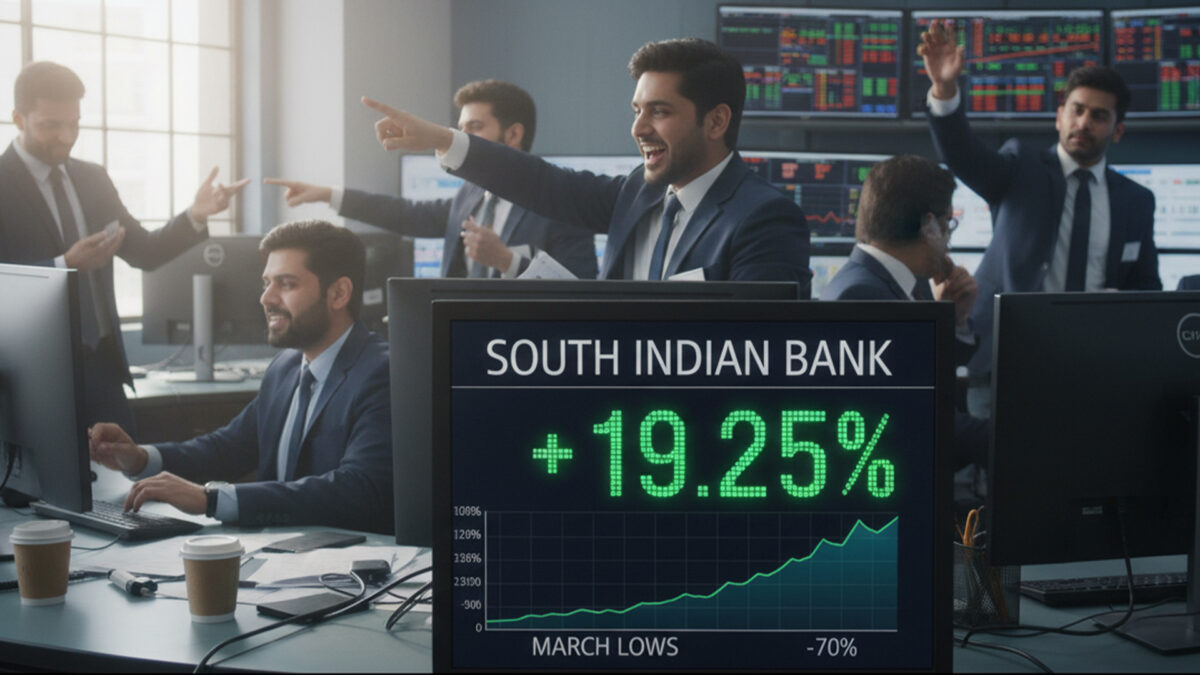
Shares of South Indian Bank (SIB) jumped nearly 19% on Monday to hit a 52-week high, driven by strong investor sentiment following the bank’s second-quarter results. The stock has now recovered about 70% from its March lows, supported by robust trading volumes and improved fundamentals.

The Kerala-based private lender reported an 8% rise in net profit to ₹351 crore for the quarter ended September 2025, compared with ₹325 crore a year earlier. While net interest income remained steady, the bank’s non-interest income and lower provisioning helped boost profitability.

Notably, the bank’s asset quality strengthened, with gross non-performing assets (GNPA) improving to 2.93%, down from 4.40% a year ago. However, net interest margins (NIM) slipped to 2.8%, reflecting some pressure on spreads.

Analysts said expectations of sustained profit growth, prudent lending, and renewed traction in retail and MSME segments underpinned the rally. Despite margin compression, the bank’s improving balance sheet and consistent earnings have bolstered investor confidence.

Also Read: Midwest IPO Fully Subscribed, Listing Set for October 24