Categories
Corporate

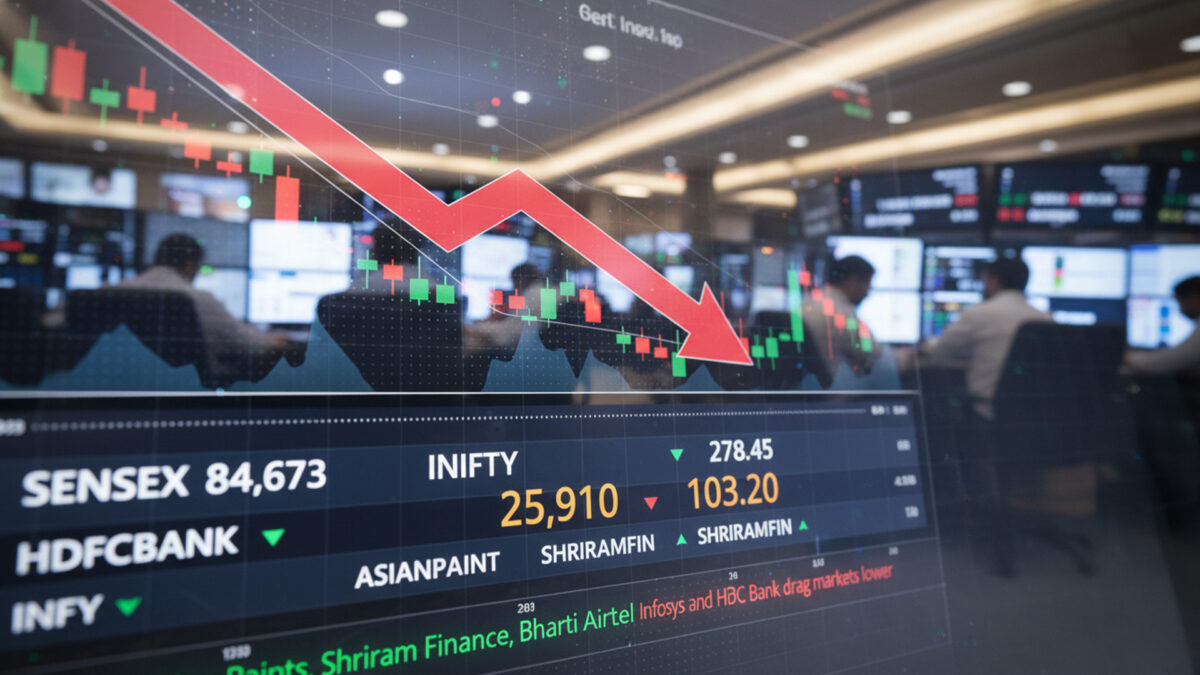
Sensex drops 278 Points, Nifty slips Below 25,950

The Indian stock markets paused their recent upward momentum on Tuesday, 18 November 2025, with benchmarks slipping as investors awaited key U.S. economic data.

The BSE Sensex fell about 278 points (0.33%), closing at 84,673, while the Nifty 50 dropped roughly 103 points (0.4%) to finish near 25,910. Broad‑based selling was seen across major sectors including IT, metals, and capital goods.

IT stocks declined about 1.1% due to exposure to U.S. revenues. Market experts said the pullback was influenced by reduced expectations of a U.S. rate cut in December and the usual volatility during the weekly expiry of futures and options.

Despite the dip, domestic fundamentals remain strong. Among stocks, Asian Paints, Shriram Finance, and Bharti Airtel were the top gainers, while Kaynes Technology, One97 Communications (Paytm), and Narayana Hrudayalaya were the top losers.

Also Read: Sensex slides over 200 pts, Nifty below 25,950

Categories
Corporate

Reliance enters pet food market with cheaper ‘Waggies’

Reliance Consumer Products is entering India’s growing pet food market with a new brand called Waggies.

The company plans to sell Waggies at prices 20–50% lower than big names like Nestlé, Mars, Godrej, and Emami. This strategy could start a price war in the industry.

Waggies will be available in neighborhood stores, especially in smaller cities and towns. Reliance aims to reach a large number of consumers, offering good trade margins to store owners to encourage sales.

The Indian pet care market is expanding quickly. Experts expect it to double to $7 billion by 2028, up from $3.5 billion now. Rising pet ownership is driving this growth — the number of pets in Indian homes has increased to 32 million in 2024 from 26 million in 2019.

Existing big brands like Pedigree, Purina, and Royal Canin may need to rethink their pricing as Reliance brings in this low-cost option.

Reliance has successfully used aggressive pricing in other markets before, and now it plans to do the same in the pet food sector.

Also Read: Bengaluru’s Sarla Aviation invests ₹1,300 cr in Andhra’s aerospace facility

Categories
Corporate

Danish pharmaceutical company, Novo Nordisk, cuts obesity drug price

Novo Nordisk, the Danish pharmaceutical giant, has announced a significant price reduction for its popular obesity drug, Wegovy, as it prepares to launch a pill version of the treatment. The move comes amid growing competition in the weight-loss market and aims to expand access for patients in the United States.

Starting immediately, cash-paying patients can buy Wegovy at $349 per month, down from the previous $499. For new users under select insurance plans, including Medicare and Medicaid, the company is offering the injection at $149 per month for a limited time. The price cuts are part of a broader effort to make weight-loss medications more affordable and widely available.

The company’s CEO, Mike Doustdar, emphasized that the new strategy reflects how weight-loss treatments are increasingly being used by consumers rather than traditional patients. “Patients behave like consumers,” he said, “and we need to ensure treatments are accessible, convenient, and affordable.”

Novo Nordisk is also preparing to introduce an oral version of Wegovy, currently under review by U.S. regulators and expected to be approved by the end of the year. Unlike the injectable version, the pill form could appeal to people who prefer taking tablets over weekly injections. The company says it has sufficient supply to support a full launch.

The price reduction is linked to a new agreement with the U.S. government, under which Medicare could start covering obesity drugs like Wegovy in 2026. While the company expects this deal to slightly reduce its global sales growth, it sees it as essential to expanding patient access.

Competition in the weight-loss market is intensifying, particularly from Eli Lilly, which has also introduced semaglutide-based drugs. By reducing prices and offering an oral alternative, Novo Nordisk aims to maintain its leadership position in the sector.

Also Read: India, Russia nearing key deals before Putin’s visit

Categories
Corporate

Tata Power commissions 300 MW solar plant for NHPC

Tata Power Renewable Energy Ltd (TPREL) has commissioned a 300 MW solar power project for NHPC Ltd in the desert region of Karnisar Bhatiyan in Bikaner, Rajasthan. The project adds significant renewable capacity to the national grid and strengthens NHPC’s presence in the solar energy space.

The plant has been built using fully India-made, DCR-compliant bifacial solar modules manufactured by Tata Power’s unit in Tirunelveli. These panels are designed to generate power from both sides, helping improve efficiency in the bright and reflective desert environment. More than seven lakh solar modules have been installed across the site.

Power from the project will be supplied to Punjab State Power Corporation Ltd under a long-term agreement. Over its operational life, the plant is expected to produce more than 17,000 million units of clean electricity. This output is projected to offset nearly 14 million tonnes of carbon emissions, making the project an important contributor to India’s climate goals.

The project faced tough conditions, from the remote desert site to extreme heat and difficult logistics. To ensure durability, the company used high-performance inverters, strong foundations and installation methods designed for harsh, sandy terrain.

With this commissioning, TPREL’s total renewable capacity has reached 11.6 GW. About half of this capacity is already operational, while the remaining projects are under various stages of development. The company continues to expand its footprint in large-scale solar as part of its clean-energy strategy.

In addition to its environmental impact, the project supported local development. More than 300 workers from nearby areas were employed during construction, and local vendors were engaged for supplies and services.

Also Read: PhysicsWallah shares surge 33% on market listing day

Categories
Corporate

PhysicsWallah shares surge 33% on market listing day

Ed-tech firm PhysicsWallah made a strong debut on the Indian stock market on 18 November 2025, with shares listing at ₹145 on the NSE and ₹143 on the BSE, roughly 33 % above its ₹109 IPO price.

The IPO raised a total of around ₹3,480 crore, comprising a fresh issue of 28.45 crore shares worth ₹3,100.7 crore and an offer-for-sale (OFS) of 3.49 crore shares worth ₹380 crore. The price band was ₹103–₹109 per share, and the IPO was open from 11–13 November.

Institutional investors showed strong interest, with the Qualified Institutional Buyers (QIB) segment subscribed 2.7 times. Retail investors subscribed 1.06 times, while non-institutional investors saw weaker demand at 0.48 times.

PhysicsWallah plans to use the IPO proceeds to fund expansion of offline “Vidyapeeth” and hybrid “Pathshala” learning centres, enhance cloud and technology infrastructure, cover lease costs for existing centres, boost marketing (₹710 crore), and pursue acquisitions (₹941 crore).

The company’s financials show rapid revenue growth from FY 23 to FY 25 at a CAGR of 96.9 %, reaching ₹2,886.6 crore, while adjusted EBITDA grew 90.3 % to ₹432 crore. However, net losses widened to ₹243.3 crore in FY 25 from ₹84.1 crore in FY 23, and EBITDA margins slipped slightly to 15 %.

Analysts note that while the strong listing reflects investor confidence, challenges remain, including heavy competition in the ed-tech sector, high operating costs, and the need to sustain student enrolments to achieve profitability.

PhysicsWallah’s IPO listing has set the tone for other ed-tech firms considering public offerings, showing that investors are willing to back high-growth companies even if they are not yet profitable.

Also Read: Kotak Mahindra Bank up 1% before Nov 21 split meet

Categories
Corporate

Sensex slides over 200 pts, Nifty below 25,950

On Tuesday, Indian equity markets paused their six-day winning streak. The BSE Sensex slipped 227 points to 84,758.64, while the Nifty 50 fell 65 points to 25,951.55.

Investors remained cautious ahead of key U.S. economic data that may influence the Federal Reserve’s next move on interest rates, while weak global cues, including losses in Asian markets and a soft Wall Street close, added to the downward pressure.

Among stocks, Tata Consumer Products, Max Healthcare, and Eicher Motors were top gainers, rising between 0.9–1.8 %, while Tata Steel, Hindalco, and Tech Mahindra dragged the indices lower, falling 0.6–1.05 %. All 16 major sectors opened in the red, with mid-cap and small-cap indices also showing broad-based weakness.

The market pullback is a temporary pause rather than a reversal. Investors are focusing on quality stocks and domestic triggers like corporate earnings and policy updates amid fading rate-cut expectations.

Also Read: Sensex closes 388 points up, Nifty tops 26,000

Categories
Corporate

Sensex closes 388 points up, Nifty tops 26,000

The stock markets ended Monday with solid gains, led by mid‑cap stocks and strong corporate earnings. The Sensex rose 388 points, while the Nifty 50 crossed the 26,000 mark. Investors cheered healthy Q2 results, signaling a recovery in corporate performance.

Among individual stocks, Eternal and Tata Consumer Products gained around 2% each, Hero MotoCorp jumped 3.3%, and Mahindra & Mahindra rose 1.1%. On the other hand, Tata Motors fell 4% after lowering FY26 margin guidance, Tata Steel slipped 0.6%, and Infosys saw a minor decline amid profit booking.

Banking, financials, and auto sectors drove the rally, while IT and metals stocks lagged. Global cues, including U.S. economic data, added some caution, but domestic earnings optimism kept the markets higher.

Also Read: Sensex climbs 200 pts, Nifty tops 25,950

Categories
Corporate

Kotak Mahindra Bank up 1% before Nov 21 split meet
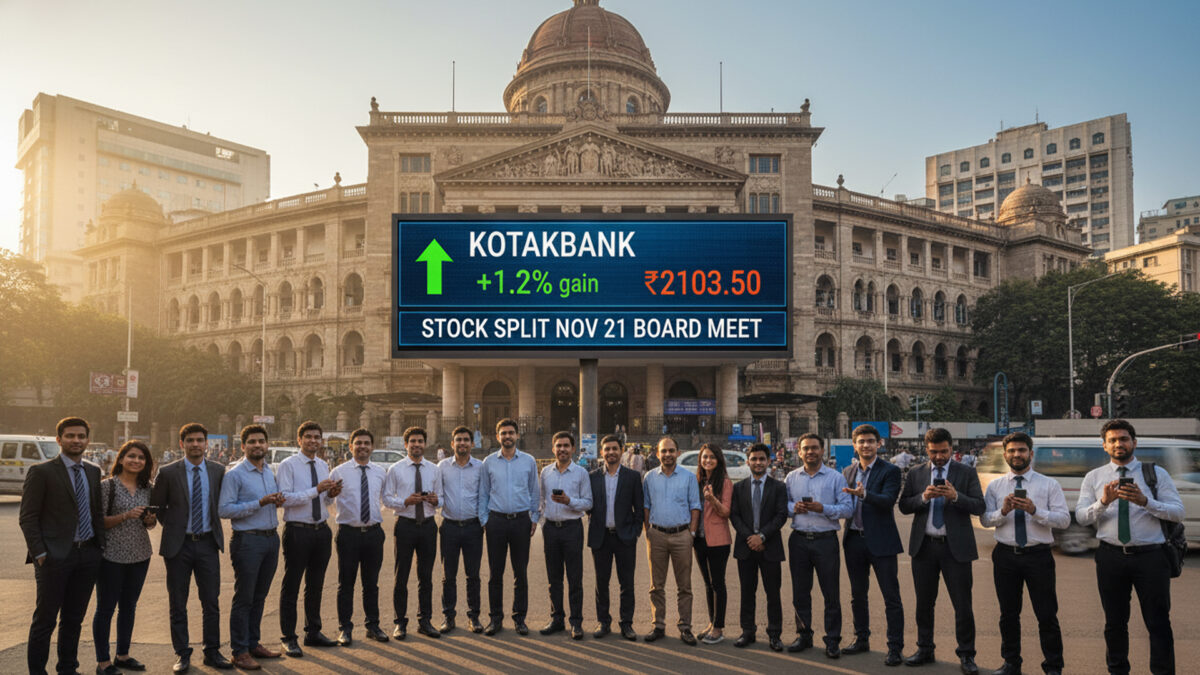
Kotak Mahindra Bank’s shares shifted higher on Monday as the market reacted to the lender’s announcement that its board will meet on November 21 to consider a stock split. The stock rose over 1% during the day and traded around ₹2,103, signalling strong investor interest ahead of the key decision.

The bank said the meeting will review a proposal to subdivide its fully paid-up equity shares, which currently carry a face value of ₹5 each. The exact ratio of the split will be decided by the board. If approved, the move will increase the number of outstanding shares while reducing the price per share, without altering the overall market value of the company.

This decision is significant because Kotak Mahindra Bank has not carried out a stock split for 15 years, with the last one taking place in 2010. Stock splits are generally used to make high-priced shares more affordable, encourage broader retail participation, and increase trading volumes. Market analysts believe the potential split could help improve liquidity in the stock, which has been trading at relatively higher price levels compared to some of its peers.

The announcement comes shortly after the bank reported mixed financial results for the second quarter of FY26. Kotak Mahindra Bank posted a 2.7% year-on-year decline in standalone net profit, which fell to ₹3,253 crore. The bank attributed this to higher operating expenses and softer growth in certain segments. However, not all indicators were weak. The bank’s loan book continued to show momentum, with advances rising 16% year-on-year to reach ₹4.63 lakh crore.

Despite the dip in profit, investor sentiment has remained broadly positive, supported by stable asset quality and confidence in the bank’s long-term strategy.

The market will now look for details such as the split ratio and the record date, both of which will be announced after the board meeting. Until then, Kotak Mahindra Bank is likely to remain in the spotlight as traders position themselves ahead of the November 21 announcement.

Also Read: Bitcoin falls 26% to $94,000, erases 2025 gains

Categories
Corporate

Bitcoin falls 26% to $94,000, erases 2025 gains

Bitcoin has dropped sharply over the past few days, completely erasing the gains it had made since January. The world’s largest cryptocurrency fell below $94,000, slipping under last year’s closing price and signalling a clear shift toward a bear market.

In early October, Bitcoin had touched a record high of $126,000, driven by strong investor excitement and heavy buying through crypto exchange-traded funds (ETFs). But the mood changed suddenly after political uncertainties in the US triggered fear across global financial markets. As investors became cautious, Bitcoin was one of the first assets to react, sliding faster than many stocks or commodities.

Analysts say one major reason for the fall is that big institutional investors,  who had supported Bitcoin through much of the year, have stepped back for now. Several Bitcoin ETFs, which had attracted billions earlier, have seen large withdrawals recently. Nearly $870 million left these funds in just a few days, removing an important source of steady demand.

Market liquidity has also weakened. Traders report that the number of active buyers and sellers in the market has dropped, which means even medium-sized trades can now push the price up or down very quickly. This makes the market more sensitive and increases volatility.

The decline has also affected companies that hold large amounts of Bitcoin. One major US-based firm, well known for building its business strategy around Bitcoin, has seen its own market value fall close to the value of the Bitcoin it owns. This suggests investors are becoming doubtful about companies heavily tied to crypto price movements.

For retail investors, the sudden drop has come as a shock. Many who joined the rally earlier this year are now worried about whether the slide will continue. Experts say Bitcoin’s price could remain unstable in the near future unless confidence returns and new buyers step in.

Also Read: Tata Motors PV shares fall 7% despite profit surge

Categories
Corporate

Tata Motors PV shares fall 7% despite profit surge

Shares of Tata Motors’ passenger-vehicle (PV) business fell around 7% even though the company reported a huge year-on-year profit increase of 2,110% for the September quarter.

The big profit came mostly from a one-time gain of about ₹82,616 crore. Without this, the PV business actually made a loss of around ₹6,368 crore. Revenue also fell by about 13% year-on-year.

Jaguar Land Rover (JLR), the luxury car arm, faced a cyber-attack that temporarily halted production and weak global demand. It posted a loss of £559 million and cut its margin forecast for FY26 to 0–2% from 5–7%. JLR also expects negative cash flow of up to £2.5 billion.

Analysts say the Indian PV business is stable and improving, but the problems at JLR are worrying investors. As a result, brokers have downgraded the PV business stock to “Reduce” or “Sell.”

Also Read: Sensex climbs 200 pts, Nifty tops 25,950