
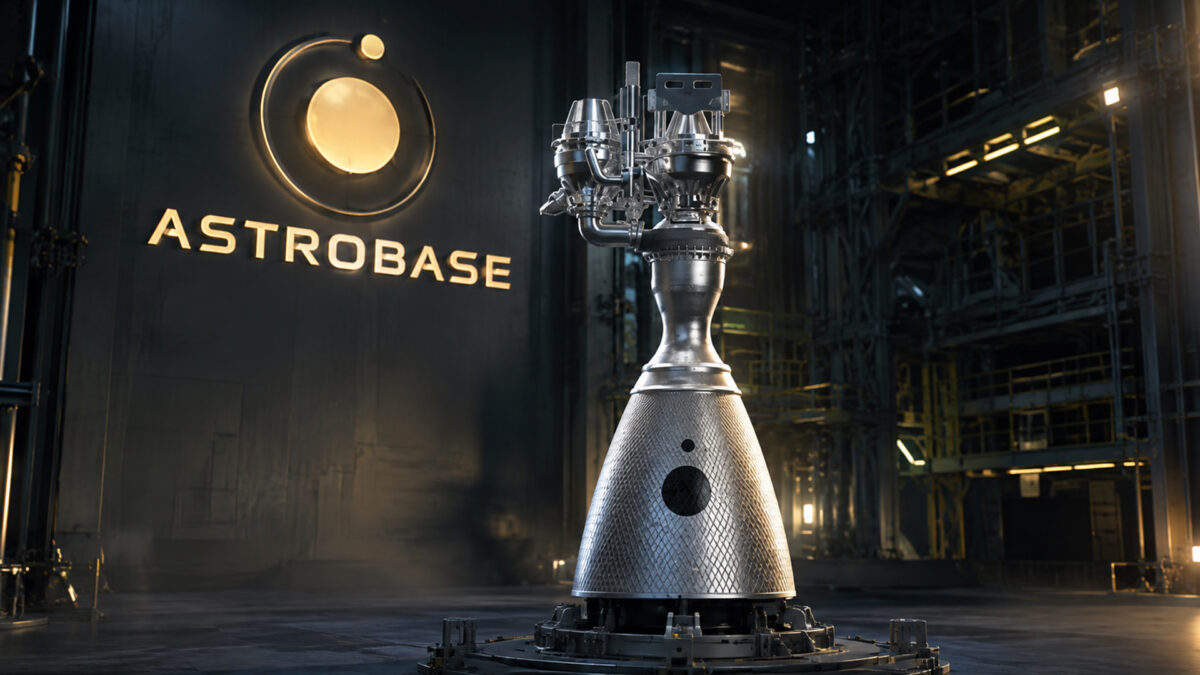
India’s private space sector has taken another major step into advanced rocket propulsion with Bengaluru-based startup Astrobase Space Technologies unveiling Everest, an 800 kN-class Full-Flow Staged Combustion (FFSC) rocket engine.
The company describes Everest as India’s first privately developed engine using the demanding FFSC architecture. Designed to run on liquid oxygen and methane, the engine is intended to power future reusable medium-lift launch vehicles and support a more frequent and commercially viable launch programme from India.
The unveiling comes as India’s space industry expands beyond government-led missions, with private companies increasingly developing rockets, propulsion systems, satellites and launch infrastructure. Everest is particularly significant because advanced rocket engines remain among the most technically challenging components of a launch vehicle.
Everest is an 80-tonne-class rocket engine designed to generate around 800 kilonewtons of thrust. It uses a Full-Flow Staged Combustion cycle, one of the most advanced propulsion architectures being developed for modern reusable rockets.
In an FFSC engine, both the fuel and oxidiser pass through separate preburners before entering the main combustion chamber. This arrangement can allow the engine to operate at high efficiency and chamber pressure while reducing some of the thermal stress on its turbomachinery.
The technology, however, is extremely complex. It requires two separate turbopump systems and precise management of fuel-rich and oxidiser-rich flows. The potential benefits include high efficiency, strong performance and suitability for repeated operation, making the architecture attractive for reusable launch vehicles.
Astrobase says Everest is designed with a 50 per cent to 110 per cent throttling range, allowing its thrust to be adjusted according to different flight requirements. Such control could be important for a reusable rocket, where engines need to operate differently during various stages of ascent and landing.
The engine uses liquid methane and liquid oxygen, commonly known as methalox propulsion. Methane has become an increasingly popular fuel for next-generation reusable rockets because of its performance characteristics and compatibility with repeated engine operations.
The choice of methane also places Everest in the same broad technological category as SpaceX’s Raptor engines, which power the company’s Starship launch system. Raptor also uses a methane-oxygen Full-Flow Staged Combustion cycle. However, Everest remains at an earlier stage of development and still needs extensive testing before it can be considered flight-ready.
That distinction is important because unveiling a rocket engine is only the beginning of a long development process. An engine intended for orbital flight must undergo repeated hot-fire tests to demonstrate that its combustion chamber, turbopumps, valves, cooling systems and other components can withstand extreme operating conditions.
Astrobase plans to begin hot-fire testing of Everest in the coming months. The company is targeting December 2028 for the first flight of its proposed reusable launch vehicle. It also plans to manufacture and test multiple engines before attempting its first orbital mission.
The Bengaluru startup’s broader objective is to develop a reusable medium-lift rocket capable of supporting commercial orbital missions. Reusability has become a major focus of the global launch industry because recovering and flying rocket hardware multiple times can reduce launch costs and improve launch frequency.
For Astrobase, Everest is therefore not an isolated engineering project. The engine is expected to form the propulsion backbone of a larger launch system designed around repeated use and faster turnaround.
The company is also looking at a future in which India can support more frequent commercial launches. Such a capability could benefit satellite operators and other space companies that need reliable access to orbit without depending entirely on a small number of launch opportunities.
The development of Everest comes as India’s private space ecosystem continues to grow. Startups are increasingly entering areas including launch vehicles, satellite manufacturing, propulsion, Earth observation and space-based communications.
Government reforms have also opened the sector to greater private participation, while institutions such as IN-SPACe have been created to facilitate and regulate the involvement of private companies in India’s space activities.
India already has considerable experience with advanced rocket propulsion through ISRO’s launch programmes, including liquid and cryogenic engines. The development of an 800 kN FFSC engine by a private company nevertheless represents a significant technical challenge because of the complexity of the propulsion cycle and the requirements of reusable flight.
The next major milestone for Astrobase will therefore be testing. Hot-fire trials will help engineers understand how Everest performs under actual operating conditions and identify areas that require redesign or refinement.
The company will need to demonstrate sustained engine operation, combustion stability, reliable turbopump performance, effective thermal management and consistent thrust before the engine can move towards flight qualification.
If those tests are successful, Everest could become an important component of India’s emerging private launch industry. It could also give Indian companies greater control over advanced propulsion technology needed for future reusable rockets.
For now, the unveiling marks the start of a demanding development journey rather than the completion of one. Everest has put private Indian rocket propulsion firmly in the spotlight, but its eventual importance will depend on how successfully Astrobase moves from an unveiled engine to a tested, qualified and repeatedly flown system.
With hot-fire testing expected to begin soon and the first reusable launch vehicle targeted for 2028, the coming years will determine whether Everest can help turn India’s growing private space ambitions into a competitive and regular commercial launch capability.