
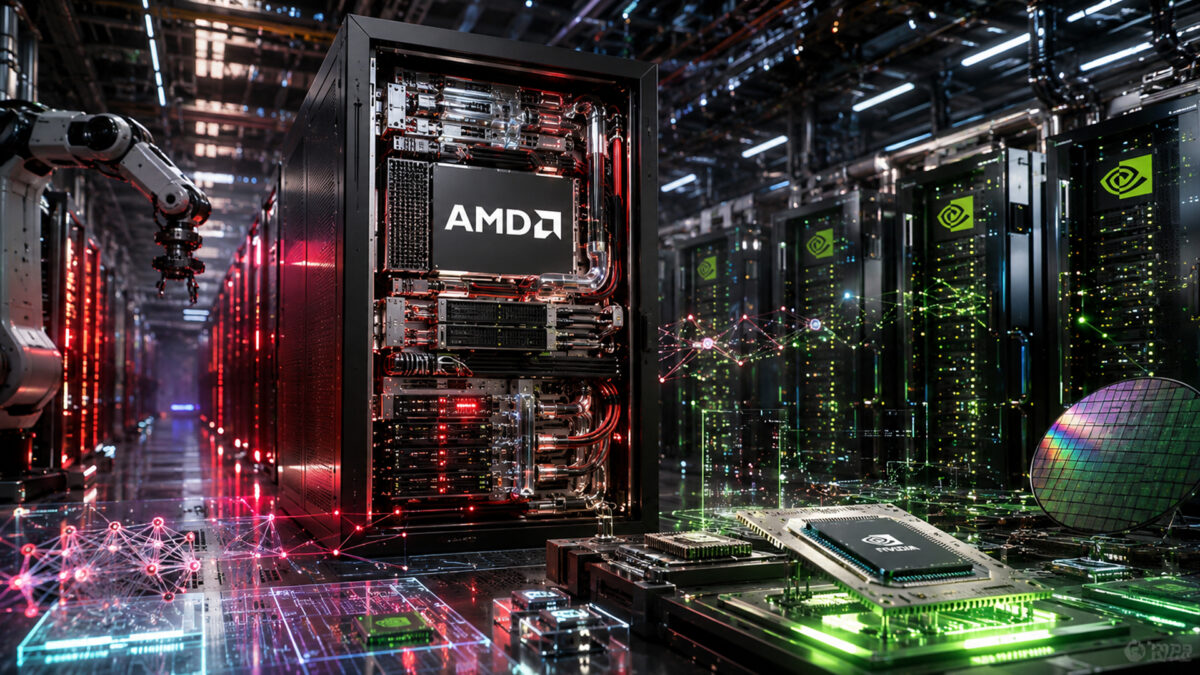
Advanced Micro Devices (AMD) has taken a major step in the artificial intelligence race by unveiling Helios, a next-generation AI infrastructure system designed to compete directly with Nvidia’s dominant AI computing platform. The announcement signals AMD’s biggest push yet to win a larger share of the rapidly expanding AI chip market, where demand for powerful hardware continues to surge as businesses invest heavily in generative AI.
The Helios system was introduced as part of AMD’s broader strategy to offer customers a complete AI computing platform instead of just standalone chips. By combining advanced AI accelerators, high-performance processors, networking technology and open software, AMD hopes to provide enterprises with an alternative to Nvidia’s widely used AI infrastructure.
At the heart of the new platform are AMD’s upcoming Instinct MI500-series AI accelerators, which are expected to power the Helios system when it launches in 2027. These next-generation chips will succeed the company’s MI350 series and are designed to deliver significantly higher performance for training and running large artificial intelligence models.
AMD says Helios has been built to meet the growing demand for AI data centres capable of handling increasingly complex workloads. As companies develop larger language models and AI-powered applications, they require faster processors, greater memory capacity and high-speed networking to support billions of calculations every second. Helios aims to address those requirements through a tightly integrated computing platform.
A major boost for AMD came from Microsoft, which confirmed its support for the Helios platform. Microsoft plans to continue working closely with AMD as it expands AI infrastructure across its cloud business. The partnership is seen as an important endorsement because Microsoft is one of the world’s largest buyers of AI chips and data centre hardware.
Microsoft executives said the company wants greater diversity in AI hardware suppliers as demand continues to grow rapidly. While Nvidia remains the market leader, cloud providers are increasingly looking for additional options to reduce costs, improve supply flexibility and encourage greater competition in the AI ecosystem.
AMD Chief Executive Officer Lisa Su said the artificial intelligence market is entering a new phase where customers need complete AI solutions rather than individual components. According to her, Helios combines AMD’s processors, GPUs, networking technologies and software into a unified platform capable of supporting the world’s most demanding AI workloads.
The announcement comes as competition in AI infrastructure intensifies. Nvidia currently dominates the AI accelerator market with its powerful GPUs and integrated AI systems, which are widely used by companies including OpenAI, Meta, Amazon and Microsoft. However, rivals such as AMD and Intel are investing billions of dollars to challenge Nvidia’s leadership as spending on AI hardware continues to accelerate.
Industry analysts believe AMD’s strategy of offering an open ecosystem could appeal to businesses seeking greater flexibility. Unlike proprietary platforms, AMD supports open software standards that allow developers to build AI applications without being tied to a single vendor. This approach may attract enterprises looking to diversify their AI infrastructure.
The company also highlighted advances in its AI software stack, which has become increasingly compatible with leading machine learning frameworks. Improving software support is considered critical because developers want AI applications to run efficiently regardless of the underlying hardware.
The AI chip industry has become one of the fastest-growing segments in global technology, driven by the explosive popularity of generative AI. Companies across healthcare, finance, manufacturing, retail and software are investing in AI-powered tools that require massive computing resources. This has fuelled unprecedented demand for AI processors and data centre infrastructure.
Despite AMD’s ambitious plans, Nvidia remains the benchmark in AI computing with its mature hardware ecosystem, extensive developer tools and long-standing relationships with major cloud providers. Analysts say Helios represents AMD’s strongest attempt yet to narrow that gap, but widespread adoption will depend on its real-world performance, software compatibility and customer confidence once the platform becomes available.
For businesses investing in artificial intelligence, increased competition could prove beneficial. More AI hardware choices are expected to drive innovation, improve performance and reduce costs over time. As AI becomes central to digital transformation strategies worldwide, technology companies are racing to build the infrastructure that will power the next generation of intelligent applications.
With Helios, AMD has made its intentions clear. Rather than competing only in AI chips, the company is positioning itself as a full-scale AI infrastructure provider. Backed by Microsoft and a roadmap of increasingly powerful AI accelerators, AMD is preparing for a long-term battle with Nvidia in one of the technology industry’s most valuable and strategically important markets.
Also Read: Fintechs oppose NPCI’s default UPI plan