
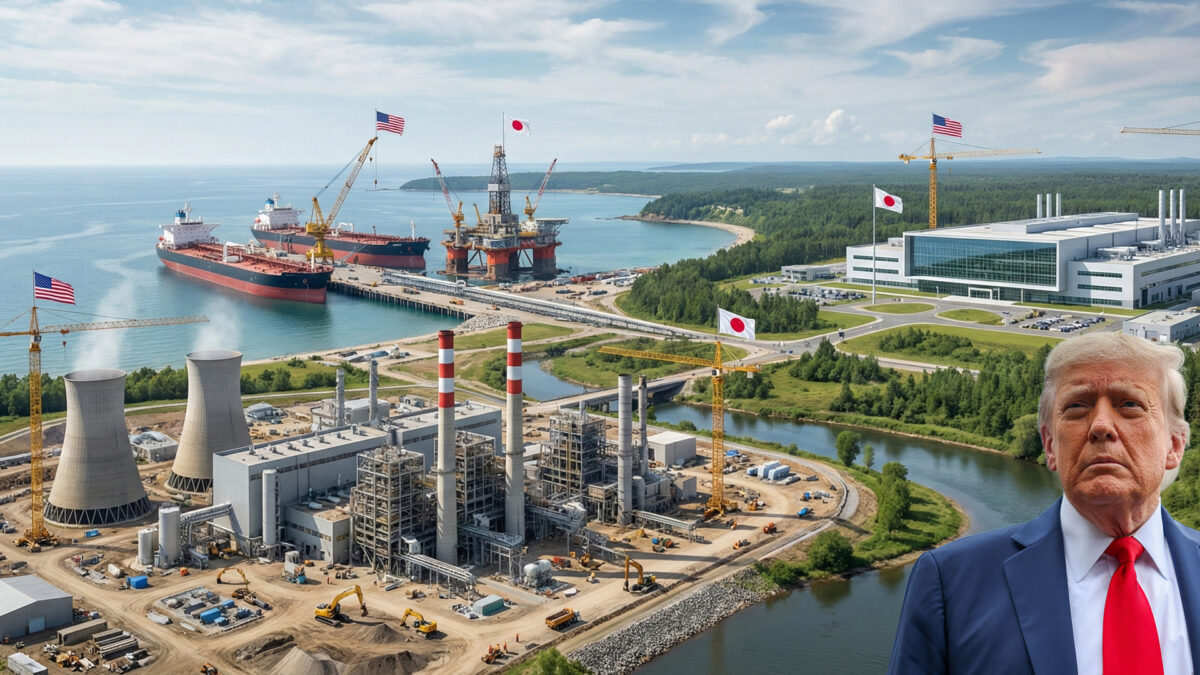
US President Donald Trump has unveiled the first set of Japanese investments in the United States under the recently signed bilateral trade pact, marking the operational rollout of Tokyo’s massive $550-billion financial commitment to the American economy.
The opening tranche, estimated at about $36 billion, is centred on energy, critical minerals and high-technology manufacturing—sectors that both countries consider crucial for economic security and resilient supply chains. The projects are expected to generate employment, strengthen industrial capacity and reduce dependence on imports in strategically important areas.
The largest investment is a $33-billion natural-gas-based power project in Ohio. The plant, to be developed by SB Energy, a unit backed by SoftBank Group, is designed to produce around 9.2 gigawatts of electricity. It is expected to support the fast-growing power demand from data centres and artificial-intelligence infrastructure in the United States.
Another key project is a $2.1-billion deep-water oil export terminal off the coast of Texas, which will expand the country’s energy export capability. In addition, a $600-million synthetic industrial diamond manufacturing facility will be set up in Georgia. The unit will produce critical materials used in semiconductors and advanced electronics, helping to cut reliance on overseas supplies.
Under the broader agreement, Washington has agreed to reduce tariffs on Japanese imports, while Japan will fund industrial and infrastructure projects through a combination of equity investments, loans and financial guarantees. The initiative is also aimed at giving Japanese companies greater access to the US market while reinforcing the strategic alliance between the two nations.
Japanese Prime Minister Sanae Takaichi said the investments would deepen economic cooperation and enhance long-term security for both countries. More projects are expected to be announced in phases as the two sides move to implement the full investment framework.
Also Read: Sarvam Kaze, India’s multilingual answer to Meta ray-ban