
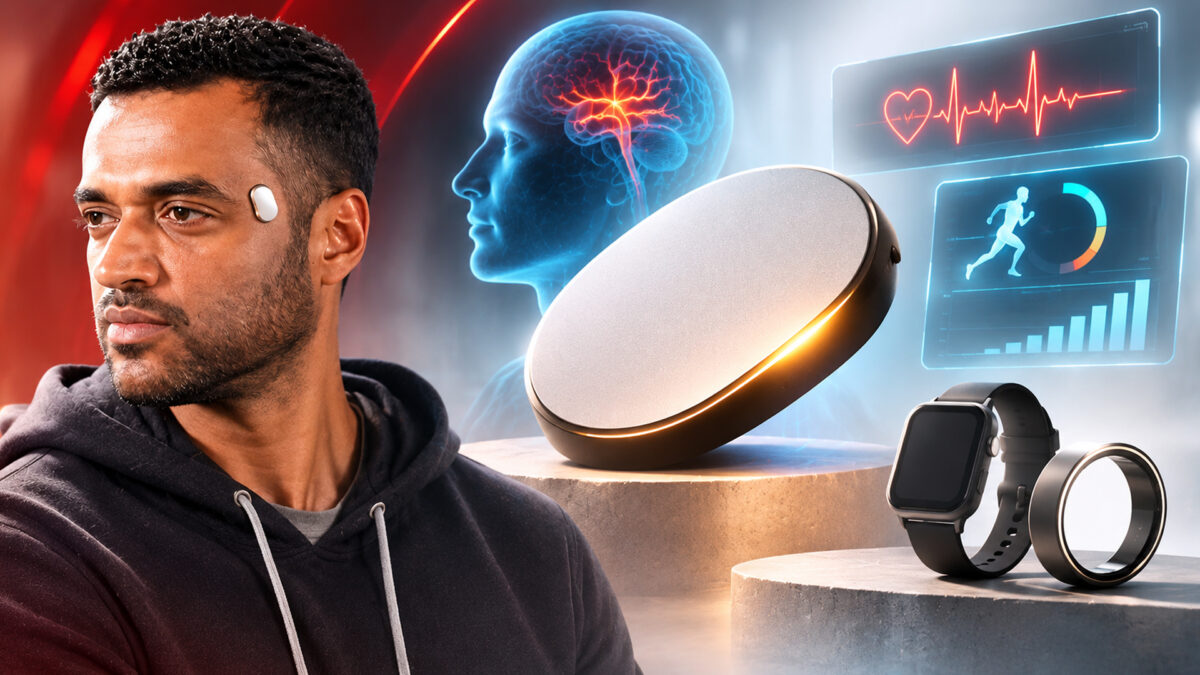
Deepinder Goyal’s latest venture, Temple, is seeking to make its mark in the competitive wearable technology market with a claim that could put it alongside some of the biggest names in fitness tracking. The device, developed by the Zomato founder, has reportedly recorded more accurate heart rate readings than the Apple Watch and other leading wearables in a company-funded study.
Goyal shared the findings of the study on social media, comparing Temple with five popular devices: Apple Watch Series 12, Fitbit Air, WHOOP MG, Garmin Forerunner 970 and Oura Ring 5. According to the results released by the company, Temple recorded the lowest average measurement error among the six devices.
The study measured heart rate accuracy using mean absolute error (MAE), which indicates the average difference between a device’s readings and those of a reference instrument. A lower figure suggests greater accuracy. Temple recorded an MAE of 1.18 beats per minute (bpm), compared with 1.94 bpm for the Apple Watch Series 12.
Fitbit Air recorded an error of 2.96 bpm, while WHOOP MG and Garmin Forerunner 970 registered 3.14 bpm and 3.18 bpm, respectively. Oura Ring 5 recorded the highest error among the devices tested, at 5.21 bpm.
The company also highlighted Temple’s performance during high-intensity exercise. Heart rate tracking becomes particularly challenging when people run, sprint or exercise at higher intensity, as movement and changes in skin contact can affect readings from wrist-based and finger-worn devices.
Temple recorded an average error of 1.16 bpm across exercise heart rate Zones 4 and 5, according to the study. In Zone 5, which represents the highest intensity level, its error fell to 0.95 bpm. The company said only 1.8% of its exercise readings had an error greater than 5 bpm. The corresponding share for competing devices ranged from 9% to 36.1%.
The research involved 43 healthy adults between the ages of 20 and 35. Participants completed treadmill sessions covering resting conditions and five different heart rate zones. A Polar H10 chest strap was used as the reference for checking the readings. The company said the strap was taped to the participants’ skin to prevent it from losing contact during intense movement and affecting the measurements.
Goyal attributed Temple’s reported performance to two factors: its adhesive-based design and the location where it is worn. Unlike conventional fitness trackers that sit on the wrist or finger, Temple is attached to the side of the head, close to the temple area and a major artery.
The company believes this placement allows its optical sensors to capture physiological signals more consistently, particularly during strenuous activity. It said it tested the same sensor at four different body locations and found the temple to be the most suitable for heart rate tracking.
However, the findings need to be viewed with some caution. Temple funded, conducted and analysed the study itself. The research was carried out at a single indoor location in Gurugram and involved one treadmill session per participant. It did not examine performance during outdoor running, cycling, strength training or regular everyday activities.
The white paper has also not been peer-reviewed. This means the findings have not yet undergone the independent scientific scrutiny that would help establish whether the results can be reproduced under different conditions.
Goyal has said that independent researchers are conducting an extended study. He has also invited other researchers to replicate the findings under additional conditions and offered to fund further testing. He has encouraged potential buyers to wait for independent validation before making a decision.
Temple is not just another wrist-based fitness tracker. The device is designed to monitor signals associated with cerebral blood flow and uses the company’s BrainFlow technology. It also provides an Entropy score, intended to indicate how hard the body is working to manage heat and physical demands. The company hopes these measurements will offer users a broader understanding of their response to exercise, sleep and stress.
The wearable has attracted attention from athletes as well. Olympic badminton medallist PV Sindhu has publicly praised the device, saying she has been using it and working with Goyal’s team to identify meaningful performance measurements for athletes. Her endorsement came as Temple opened pre-orders in India on November 1.
The device is priced at around ₹85,000, placing it in the premium segment of the wearable market. Its unusual design and focus on performance-related measurements have generated interest, but the price also raises expectations about accuracy, reliability and the practical value it can offer consumers.
Goyal has also addressed questions surrounding the company’s public image and promotional strategy. He has said that being widely recognised as the person behind Zomato can work against Temple because consumers may find it difficult to associate him with a hardware and science-led venture. He has denied claims that influencers received the device for free to promote it, saying recipients of beta units paid for them.