
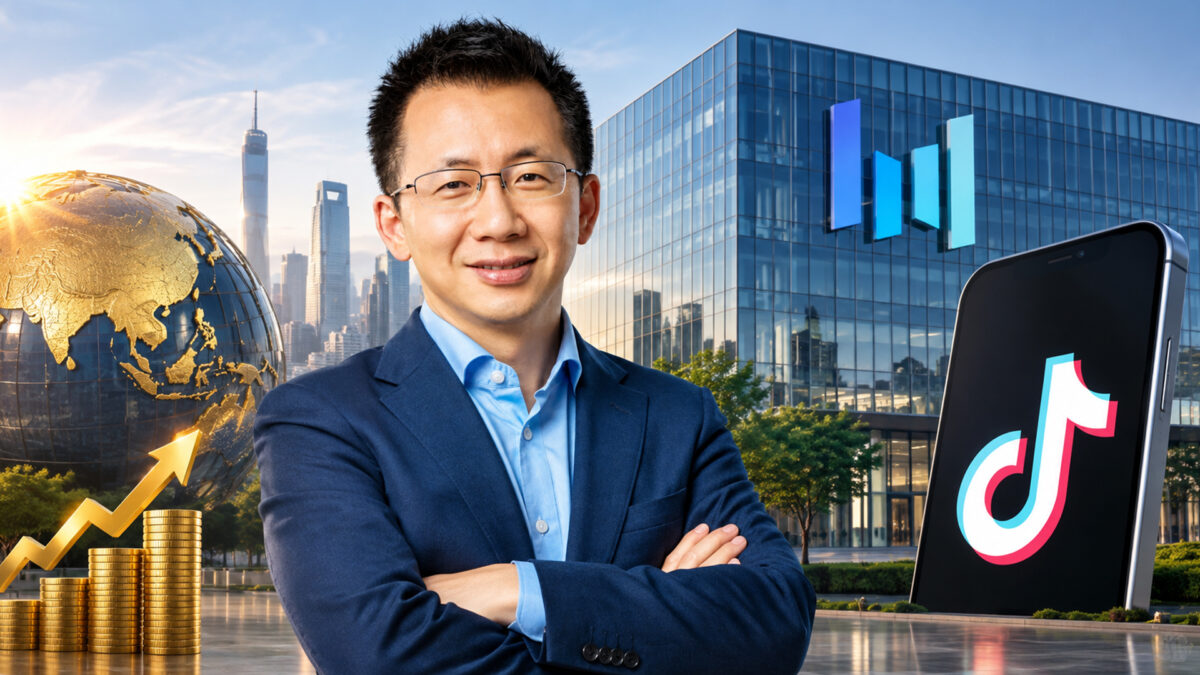
ByteDance founder Zhang Yiming has overtaken Indian industrialist Gautam Adani to become Asia’s richest person, according to the Bloomberg Billionaires Index. The 43-year-old technology entrepreneur’s fortune has crossed $105 billion, putting him at the top of the Asian wealth rankings for the first time.
Zhang’s rise comes as the valuation of ByteDance, the privately held Chinese technology company behind TikTok, continues to climb. The company has expanded beyond short-video platforms and is putting significant money into artificial intelligence, with products such as the Doubao AI chatbot and Seedance video-generation tool becoming important parts of its technology business.
Bloomberg’s latest calculation puts Zhang’s wealth at more than $105 billion. His fortune has increased by more than $12 billion this month alone, following updated valuations of ByteDance shares by investment firms including BlackRock, Fidelity Investments and T. Rowe Price.
The jump is particularly striking when compared with where Zhang stood several years ago. Bloomberg began tracking his wealth at around $13 billion in March 2019. His fortune has since increased more than eightfold, helped by ByteDance’s rapid expansion and the growing value assigned to its artificial intelligence operations.
Adani, meanwhile, has seen his fortune decline from its recent peak. His wealth had reached about $120 billion in June, but fell in the following months amid weakness in equities, changes to MSCI index weightings, higher oil prices and rising bond yields. The movement pushed him below Zhang in the latest Bloomberg ranking.
The change in the Asia richest person ranking also highlights the growing influence of technology and artificial intelligence on billionaire wealth. Adani’s fortune is linked largely to businesses spanning infrastructure, ports, airports, energy and commodities, while Zhang’s wealth is tied to a technology company whose businesses increasingly include AI.
ByteDance was founded by Zhang in 2012. The company initially became known for its recommendation algorithms and later built a global audience through TikTok. The platform has become one of the world’s biggest short-video services, giving ByteDance a huge international user base and a major advertising business.
Zhang stepped down as ByteDance’s chief executive in 2021 and later gave up his role as chairman. He has largely stayed away from the public spotlight, while continuing to hold a significant stake in the company. Forbes currently lists him as a major co-founder of ByteDance and identifies TikTok as his primary source of wealth.
Artificial intelligence has become an increasingly important part of ByteDance’s growth strategy. Its Doubao AI assistant has expanded rapidly in China, while Seedance focuses on generating images and videos using AI. The company is also investing in enterprise AI through its Volcano Engine platform.
ByteDance’s AI push has also influenced how investors value the company. Because ByteDance is not publicly listed, its valuation is based partly on private share transactions and assessments by investors. Bloomberg applies a 10% risk discount when calculating Zhang’s fortune because of the company’s private status.
That means the exact value of Zhang’s wealth can vary between billionaire rankings. Forbes’ real-time estimate put his fortune at about $84 billion on September 16, considerably below Bloomberg’s figure of more than $105 billion. The difference reflects the different methods used to value private companies such as ByteDance.
ByteDance has also faced significant challenges, particularly over TikTok’s operations in the United States. The company spent years dealing with regulatory pressure over the app’s ownership and data security. Earlier this year, control of TikTok’s US business was transferred to a consortium involving American investors, including Oracle and Silver Lake, easing some of the uncertainty surrounding the platform’s future in the country.
The company is now trying to build its next phase around AI while maintaining its established social-media and e-commerce businesses. That strategy comes with substantial costs. AI development requires expensive computing infrastructure, advanced chips and large amounts of data, meaning increased investment could also put pressure on profitability.
For Zhang, the latest wealth milestone reflects the changing value of ByteDance rather than a conventional rise in listed share prices. As the company remains private, movements in its estimated valuation can have a direct impact on his position in global billionaire rankings.
The development also places renewed attention on the changing Asian wealth landscape. Technology entrepreneurs are increasingly appearing alongside traditional industrial and business families as artificial intelligence, digital platforms and data become major sources of corporate value.
Zhang’s move above Adani does not necessarily represent a permanent change in the ranking. Private-company valuations can change, while listed-company fortunes can move daily with share prices and market conditions. For now, however, the Bloomberg Billionaires Index places the ByteDance founder at the top of Asia’s wealth rankings, with his fortune above the $105 billion mark.