
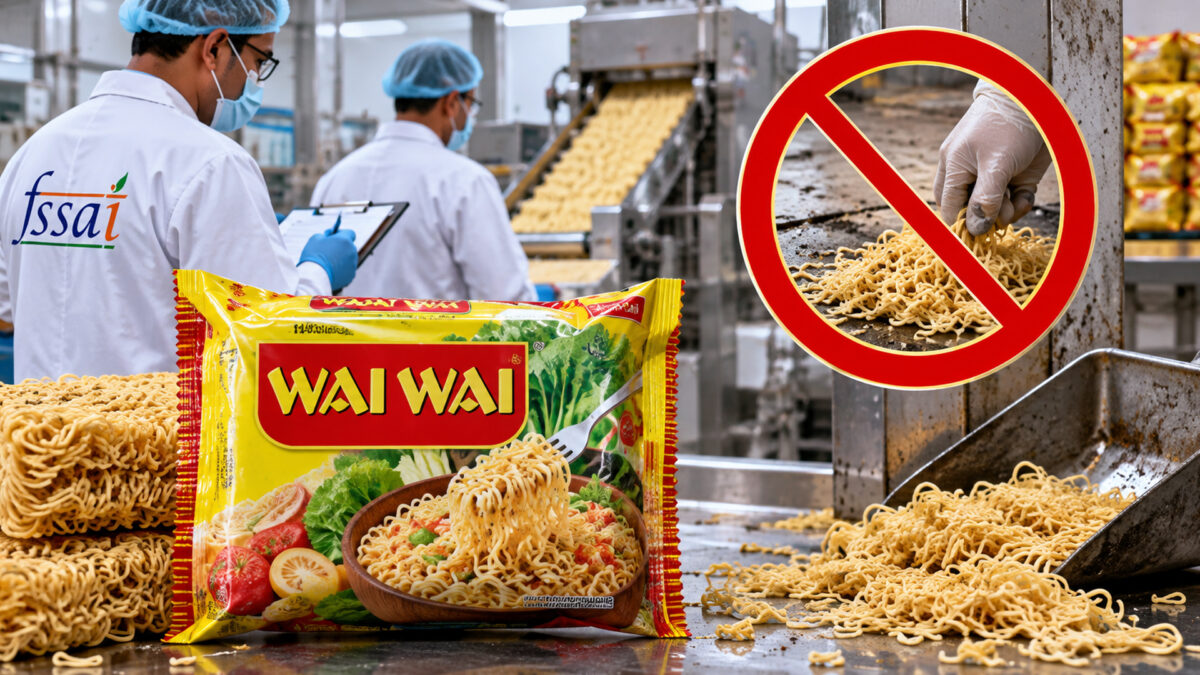
The Food Safety and Standards Authority of India (FSSAI) has ordered CG Foods India to stop making its Veg Bhujia Namkeen after an inspection at its factory in Roopangarh, Ajmer, Rajasthan, found several food safety and hygiene violations.
The regulator said inspectors found broken noodles collected from the factory floor being reused to make bhujia without heat treatment. The unit was also accused of using packaging with earlier dates and making two bhujia products without the required licence.
The products named by FSSAI are Wai-Wai MaMa and Wai-Wai Mama Punte. The regulator said their manufacture violated Section 31(1) of the Food Safety and Standards Act, 2006, which requires food businesses to have the necessary licence.
The inspection also found gaps in hygiene and records. FSSAI pointed to inadequate pest-control records and other shortcomings linked to food handling and safety.
Authorities seized 32,107.2 kg of stock, including loose and broken noodles, during the inspection. They also detained 1,925 boxes of expired finished products found at the facility. Samples of noodles, bhujia, cooking oil and ready-to-eat noodles have been sent for laboratory testing.
FSSAI has started legal proceedings against the food business operator and directed the company to stop production of the affected Veg Bhujia Namkeen products until the required approvals and safety measures are in place.
The regulator said further action will depend on the laboratory test results and findings from the inspection. This means the current action is focused on the products and practices identified at the Rajasthan facility, rather than a blanket ban on the entire Wai Wai range.
CG Foods India is part of CG Corp Global, the business group led by Nepalese billionaire Binod Chaudhary. The company is widely known for Wai Wai instant noodles, which have a strong presence in India and other markets.
The inspection has put the spotlight on a basic but important issue in the packaged food industry: what happens inside a factory before food reaches consumers.
Food manufacturers are expected to maintain clean production areas, properly handle ingredients, follow approved processes and keep accurate records. Licensing is also an important part of the system because it allows authorities to monitor what products are being made and under what conditions.
The discovery of floor-collected noodles being reused has raised particular concern because such material can come into contact with dirt and other contaminants. FSSAI’s finding that the noodles were reprocessed without heat treatment has therefore become a central part of the enforcement action.
The seizure of expired products has added another concern. While detention does not by itself mean the products were sold to consumers or were unsafe, it shows why proper stock management and expiry controls are important in food manufacturing.
The laboratory tests will now provide more information about the materials and products collected during the inspection. Until those results are available, the regulator has not said that the entire stock seized from the factory was unsafe.
The action also serves as a reminder that a familiar brand name does not remove the need for strict food safety controls. Large food companies operate through multiple factories and product lines, making regular inspections and compliance checks an important part of consumer protection.
The company will now have to address the concerns raised by the regulator and meet the required food safety and licensing conditions. Further action could follow once the laboratory reports and inspection findings are reviewed.
The episode has once again brought food safety, hygiene, expired food, licensing and quality control into focus, while putting greater attention on how packaged snacks are manufactured before they reach store shelves.