
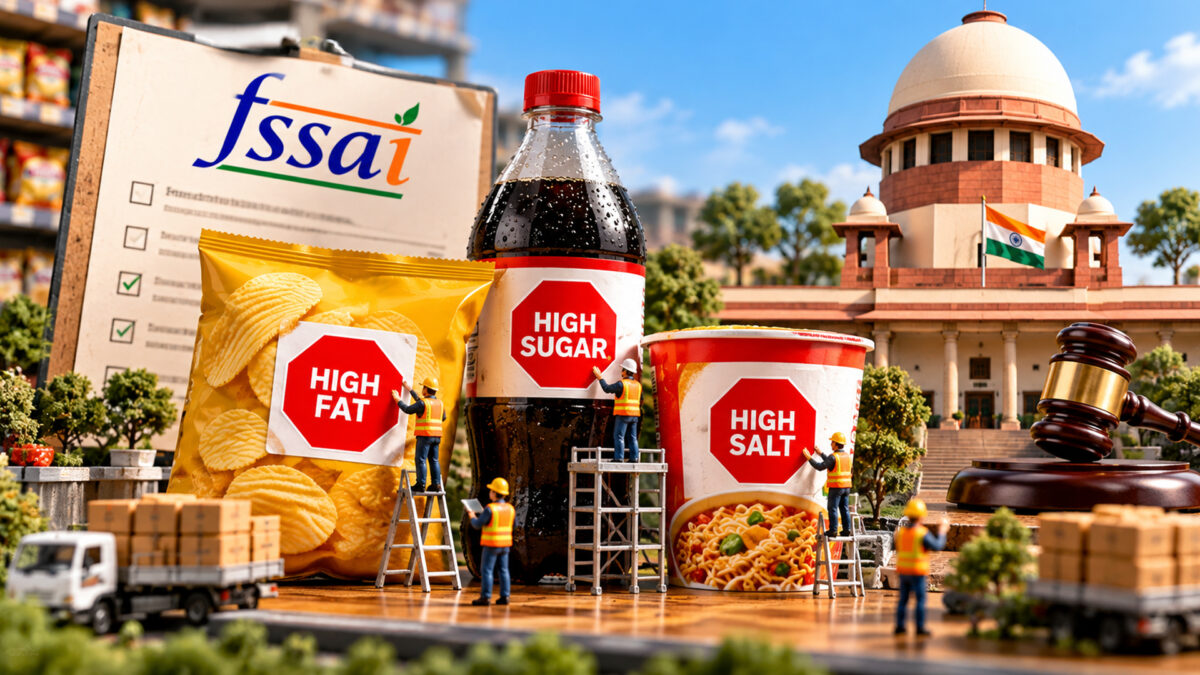
The next time shoppers pick up a packet of biscuits, breakfast cereal, snacks or a ready-to-eat food, a red warning on the front could make an important part of the choice much easier.
The Food Safety and Standards Authority of India (FSSAI) has proposed a single-phase rollout of Front-of-Pack Nutrition Labelling (FoPNL) for packaged foods that exceed prescribed limits for nutrients such as added sugar, added fat and salt. The proposal was placed before the Supreme Court as the regulator responded to questions raised by the court over its earlier two-phase plan.
Under the revised proposal, a packaged food product could carry a warning even if it is high in just one nutrient of concern. This marks a change from FSSAI’s earlier approach, under which the first phase would have covered products high in two or more specified nutrients, followed by a second phase for products exceeding the limit for any one nutrient.
The proposed warning will appear as a red hexagon on a white square background on the front of the package. It would identify the nutrient that crosses the prescribed limit, with possible declarations such as “HIGH FAT”, “HIGH SUGAR” and “HIGH SALT”. Specified sweetened beverages could also carry a warning.
The thresholds are proposed to be based on the Dietary Guidelines for Indians, 2024, issued by the Indian Council of Medical Research-National Institute of Nutrition (ICMR-NIN). FSSAI has proposed distinguishing between added sugar and total sugar, as well as added fat and other forms of fat, while deciding the applicable limits.
The label is intended to be prominent enough to catch a consumer’s attention before the product reaches the checkout counter. FSSAI has proposed that the warning text be displayed in a font size at least one point larger than the font used in the nutrition information table on the back of the pack.
The proposal comes amid a Supreme Court case concerning mandatory front-of-pack nutrition labelling. In its September 10 order, the court sought greater clarity from FSSAI on several aspects of the proposed system, including nutrient thresholds, the design and size of warnings, pictorial representations, sweetened beverages, additives and nutritional awareness among children.
The court had also questioned the logic of initially warning only products that crossed the limit for two or more nutrients. That prompted FSSAI to reconsider the rollout and propose a single-phase system covering products high in even one nutrient of concern.
Nutrition labelling has become a growing part of the public health debate as consumers increasingly look for clearer information about the contents of packaged food. Front-of-pack labelling is designed to make such information easier to understand without requiring shoppers to study the detailed nutrition table on the reverse side.
The Supreme Court has also raised questions about children’s nutritional literacy, including how schools could help young people understand nutrition information and make sense of food labels.
The proposed rules will not come into force immediately. FSSAI has said it would need around four months to prepare and finalise the draft regulations. The draft would then go through a mandatory 60-day consultation process, including stakeholder and World Trade Organization consultations, before the regulations are finalised and notified.
Once the final rules are notified, food businesses would get 365 days to comply with the new front-of-pack labelling requirements.
FSSAI said the transition period is intended to prevent commercial difficulties for food businesses that already have large quantities of pre-printed packaging. The regulator has also indicated that the timeline takes into account the need to avoid unnecessary disruption to trade and manufacturing.
The questions system could therefore bring a visible change to supermarket shelves, but the exact rules are still being worked out.
Several remain, including the final nutrient thresholds, the precise design and size of the warning, treatment of saturated and trans fats, the classification of sweetened beverages and how ultra-processed foods should be handled. The Supreme Court has also sought clarity on whether reformulation to reduce sugar, salt or fat could lead manufacturers to increase other ingredients or additives.
If finalised, the new front-of-pack warning labels would give consumers a quicker way to identify packaged foods high in key nutrients of concern. For food companies, meanwhile, the proposed system could mean changes to recipes, packaging designs and product communication as India moves towards a more prominent nutrition labelling framework.