Categories
Corporate

Sensex crashes over 1,600 points, Nifty falls below 23,300

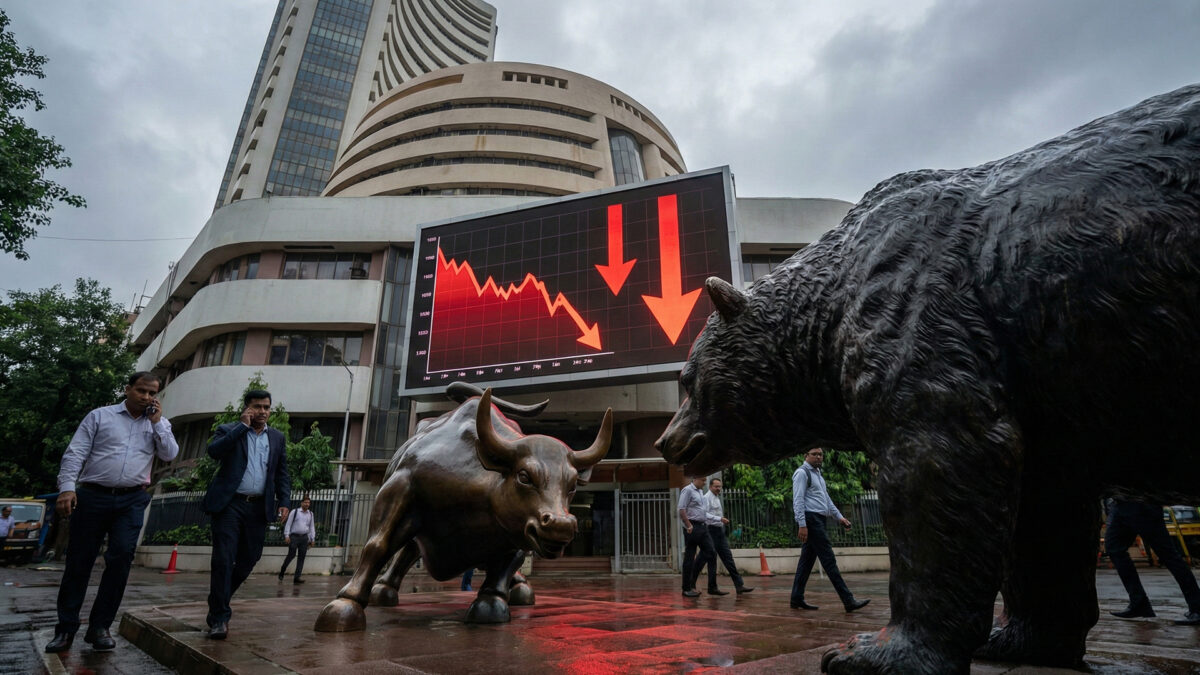
The markets suffered a sharp reversal on Thursday, with the BSE Sensex tumbling over 1,600 points to an intraday low of 74,685 and the Nifty 50 falling below 23,300, touching 23,180. The decline ended a three-day rally as investors reacted to surging crude oil prices and cautious global cues.

Markets opened sharply lower after Brent crude crossed $110 per barrel, stoking concerns over higher import bills and inflationary pressures. Weak global cues, including a hawkish signal from the U.S. Federal Reserve, added to the risk-off sentiment.

Banking and financial stocks bore the brunt, with heavyweights such as HDFC Bank, ICICI Bank, Axis Bank, and L&T registering steep losses. Defensive and commodity-linked stocks saw limited buying, with ONGC and Coal India emerging as the few gainers amid rising energy prices.

Market volatility spiked, reflected in a jump in the India VIX, as traders reassessed near-term risks. Other sectors, including auto, metals, and IT, also declined, while healthcare and FMCG stocks posted comparatively smaller losses.

Analysts attributed the sell-off to profit-booking after recent gains, foreign institutional investor outflows, and heightened sensitivity to global crude prices.


Also Read: Jio may file draft IPO papers by end of March

Categories
Corporate

Sensex jumps to 76,300, Nifty rises above 23,700

The markets found fresh momentum on Wednesday, with investors embracing a broad-based rally that pushed both the BSE Sensex and Nifty 50 higher. The Sensex surged by around 550 points to 76,300, while the Nifty climbed past 23,700, extending gains for the third consecutive session.

The upbeat mood on Dalal Street was fueled by falling global crude oil prices and stability in international markets, which eased cost concerns and inflation worries. Analysts said this encouraged domestic investors to step back in after a period of cautious trading.

Among sectors, technology, banking, and automobiles led the gains. TCS, Infosys, Wipro, HCL Tech, and Tech Mahindra posted strong rises, with some IT stocks gaining as much as 4%. In banking, ICICI Bank and other private lenders supported the upward momentum, while Maruti Suzuki led auto shares higher with nearly 2% gains.

On the other hand, metals stocks underperformed despite some individual gains, with Tata Steel performing better than most peers. Analysts noted that stocks without fresh triggers lagged behind the broader rally.

Market breadth was positive, with more advancing stocks than declining ones, indicating that the buying interest was widespread across sectors, not just limited to large-cap stocks. Mid-cap and small-cap shares also participated in the rally, reflecting renewed investor confidence.

The rupee remained stable against the US dollar, and bond yields eased slightly, mirroring the risk-on sentiment across equity markets.

While the current rally is encouraging, analysts cautioned that geopolitical tensions and global economic developments could influence markets in the coming sessions. For now, the rebound shows that investors are increasingly willing to buy on dips, particularly in fundamentally strong sectors.

Also Read: Coal India’s CMPDI launches Rs 1,842 cr IPO, March 20

Categories
Corporate

Sensex rises 300+ points, Nifty nears 23,500

The markets rebounded on Tuesday, with key indices climbing after recent declines, driven by bargain buying and easing risk concerns. The BSE Sensex jumped over 300 points, while the Nifty50 approached the 23,500 mark, signaling renewed optimism among investors.

Investors were encouraged by hopes of the Strait of Hormuz reopening, a major oil shipping route whose closure had previously pushed crude prices higher and raised global risk concerns. With crude hovering around $103 a barrel, energy-linked stocks remained under pressure, but broader market sentiment improved as traders trimmed short positions and picked up beaten-down stocks.

Sector-wise, auto, metal, and midcap stocks led the gains, reflecting selective buying across these segments. In contrast, IT, PSU banks, and FMCG stocks lagged, keeping the overall rise in check. Analysts noted that while domestic sentiment improved, global uncertainties and elevated oil prices continue to weigh on market confidence.

Some individual stocks saw notable moves. Tata Motors and other commercial vehicle companies advanced after announcing price adjustments to offset rising costs. Meanwhile, companies with exposure to Middle East markets experienced volatility amid ongoing geopolitical tensions.

Market analysts highlighted that foreign portfolio investors remain cautious, contributing to uneven participation. Technical indicators suggest that both the Sensex and Nifty are still navigating key moving averages, making the market sensitive to further global or domestic triggers.

Despite the rebound, investors remain watchful of upcoming crude price trends, corporate earnings, and geopolitical developments. These factors are expected to influence market momentum in the near term, with cautious optimism prevailing among traders.

Also Read: Exicom opens ₹216 cr EV charger plant in Hyderabad

Categories
Corporate

Sensex falls over 300 points, Nifty slips below 23,300

Indian benchmark indices fell in early trade on Monday, with the BSE Sensex dropping more than 300 points and the NSE Nifty 50 slipping below the 23,300 mark, as rising crude oil prices and global uncertainties weighed on investor sentiment.

The Sensex declined around 300 points during morning trade, while the Nifty hovered near the 23,250–23,300 range. The cautious start came despite earlier indications of a positive opening from GIFT Nifty, which had signalled gains ahead of the session.

Investor sentiment remained fragile amid escalating geopolitical tensions in the Middle East and a sharp surge in global crude oil prices. Oil prices climbed above the $100-per-barrel level, raising concerns about inflation and India’s import bill, as the country imports a large share of its crude oil requirements.

Asian markets also traded lower during the session, reflecting a broader risk-off mood among investors. The cautious trend followed losses on Wall Street in the previous session, which added to volatility across global equity markets.

Heavy selling in banking, financial and metal stocks dragged the indices lower in early trade. Shares of Hindalco Industries were among the notable losers, reflecting weakness in the metal segment and cautious investor sentiment.

Foreign institutional investors (FIIs) also continued to offload Indian equities, putting additional pressure on domestic markets. Persistent outflows from overseas investors have remained a key factor affecting the momentum of Indian stocks in recent weeks.

However, some stocks managed to buck the broader market trend. Shares of Tata Motors and Adani Total Gas saw buying interest, helping limit deeper losses in the benchmark indices. Company-specific developments also kept stocks such as Waaree Energies and IDBI Bank in focus during the session.

Market analysts expect volatility to remain high in the coming days as investors closely track geopolitical developments, movements in global crude prices and trends in foreign investor flows.

Experts noted that a sustained rise in crude oil prices could increase inflationary pressures and affect India’s fiscal balance, prompting investors to remain cautious in the near term.

Also Read: Rising tensions in Middle East surges freight costs

Categories
Corporate

Sensex dives 900 points, Nifty near 23,330

The markets opened sharply lower on Friday, with benchmark indices extending a week-long slide amid global uncertainties. The BSE Sensex fell about 900 points to roughly 75,120, while the Nifty50 dropped to around 23,331, reflecting broad-based selling across most sectors.

Investors were shaken by rising geopolitical tensions involving Iran, Israel and the US, which fueled concerns over oil supply disruptions. Brent crude prices remained above $100 per barrel, pushing fears of higher input costs and inflation for Indian companies.

Foreign institutional investors (FIIs) continued their net selling streak, amplifying downward pressure on stocks. The Indian rupee also weakened, hitting new lows against the US dollar, adding to investor caution.

Among sector leaders, Larsen & Toubro and HDFC Bank were significant drags, while Mahindra & Mahindra and ICICI Bank also faced steep losses. Conversely, Reliance Industries, Tech Mahindra, and NTPC were among the few stocks showing gains, as investors favored defensive names amid market turbulence.

The sell-off was widespread, with metals, realty, consumer durables, and PSU banking stocks posting notable declines. Defensive consumer sector stocks, by contrast, showed relative stability.

Also Read: Adani Total Gas rises 33% on gas supply push

Categories
Corporate

Sensex falls 975 points, Nifty drops to 23,500

Indian equity benchmarks declined sharply on Thursday, the BSE Sensex dropped nesarly 975 points to 75,890.72, while the Nifty50 fell 299.45 points to 23,567.15 in early trade, reflecting broad-based selling across sectors.

Among the top gainers on the Nifty were HCLTech, Infosys, and Tata Consultancy Services, as IT stocks showed resilience amid the broader market sell-off.

On the other hand, top losers included InterGlobe Aviation, Tata Motors, Larsen & Toubro, and Adani Enterprises, which came under selling pressure during the session.

Sector-wise, auto, capital goods and consumer stocks led the decline, while IT shares limited the fall in the benchmarks.

The market downturn was largely driven by a surge in global oil prices, with Brent crude oil rising to around $101 per barrel amid geopolitical tensions in the Middle East. Higher crude prices raised concerns over inflation and increased costs for businesses.

The spike in oil prices, along with cautious global sentiment, prompted investors to reduce exposure to equities, leading to losses across most sectors in the domestic market.

Also Read: Elon Musk tops Forbes Billionaires list

Categories
Corporate

Sensex falls 500 points, Nifty dips below 24,000

On Wednesday, the equity markets closed lower, reversing early gains as investors reacted cautiously to global developments. The BSE Sensex fell about 550 points, closing near 64,830, while the Nifty 50 slipped below 24,100. Early optimism, driven by hopes of easing geopolitical tensions, faded amid persistent selling and risk‑off sentiment.

Markets were influenced by ongoing geopolitical concerns, particularly the US-Iran conflict, which has created volatility in crude oil prices. Rising crude prices can impact inflation and economic growth, leading investors to adopt a cautious stance. Mixed global market cues and uncertainty over international economic indicators further weighed on sentiment.

Market weakness was broad-based. Banking, auto, FMCG, and IT sectors underperformed, pulling major indices lower. Mid-cap and small-cap stocks saw selective buying, while defensive and commodity-linked sectors, including metals, media, and infrastructure, showed some resilience.

Some stocks managed to hold ground or rise despite the overall market weakness. Adani Ports attracted buying interest amid positive sentiment in infrastructure and commodity-linked stocks. InterGlobe Aviation (IndiGo) saw gains on the back of strong travel demand. Wipro recovered some ground as investors rotated into tech stocks, while NTPC and Hindalco also recorded modest gains due to selective sectoral buying.

On the other hand, several key stocks fell sharply. Tata Consumer declined with the broader FMCG sector under pressure. Max Healthcare and JSW Steel lost value as defensive and cyclical sectors faced selling. SBI Life Insurance and Axis Bank were among the financial sector stocks that weakened, reflecting cautious investor sentiment amid global uncertainty and crude oil price volatility.

The foreign selling continued to weigh on the market, while global factors such as geopolitical tensions and rising energy prices kept investors cautious.

Also Read: Indonesia signs BrahMos deal with India

Categories
Corporate

Sensex surges 800 points, Nifty reclaims 24,200

Indian benchmark indices rebounded sharply on Tuesday, with the BSE Sensex jumping nearly 800 points and the NSE Nifty climbing above the 24,200 level as improved global cues and easing geopolitical tensions boosted investor confidence.

The rally followed a period of volatility in global markets triggered by rising tensions in the Middle East. Sentiment improved after remarks from former US President Donald Trump, who suggested that the conflict involving Iran could end soon. The comments raised hopes of a possible de-escalation in the region, easing fears of prolonged disruptions to global energy supplies.

Falling crude oil prices also supported the market rally. Brent crude slipped below the $90 per barrel mark after surging in recent sessions due to geopolitical concerns. As India imports a large share of its crude oil needs, lower oil prices are seen as positive for the domestic economy since they help reduce inflationary pressure and lower import costs.

Sector-wise, buying interest was visible across several segments including financials, consumption, pharmaceuticals and mid-cap stocks. The broader market also saw strong participation as investors returned to equities amid improving risk appetite.

Among individual stocks, aviation major InterGlobe Aviation, which operates the airline brand IndiGo, emerged as one of the top gainers. Airline stocks benefited from the decline in crude prices, as aviation turbine fuel accounts for a major portion of operating costs. Other major gainers included Asian Paints, Larsen & Toubro, UltraTech Cement and Tata Steel, which advanced during the session.

On the losing side, Reliance Industries was among the biggest laggards on the Sensex, slipping amid profit booking. A few other stocks such as Bharti Airtel and Axis Bank also witnessed mild declines despite the overall positive trend in the market.

Meanwhile, the Indian rupee strengthened slightly against the US dollar, further supporting market sentiment. Global cues also remained favourable, with several Asian markets trading higher as investors reacted positively to falling oil prices and the easing geopolitical outlook.

Also Read: Rajputana Stainless IPO opens at ₹10 cr anchor funding

Categories
Corporate

Sensex tanks over 2,400 points, Nifty slips below 24,000

Indian stock markets tumbled sharply on Monday as rising global crude oil prices and geopolitical tensions triggered heavy selling across sectors. Benchmark indices — the BSE Sensex and NSE Nifty 50 — opened with steep losses, reflecting investor concerns about inflation and economic uncertainty.

The Sensex plunged more than 2,400 points to around 76,500, while the Nifty 50 dropped over 700 points to fall below the 24,000 level in early trade. The sharp decline came after global crude oil prices surged past $105 per barrel, raising fears of higher fuel costs and pressure on India’s economy.

India, which imports a large share of its crude oil requirements, is particularly vulnerable to spikes in global oil prices. Analysts say higher oil prices increase import bills, widen the current account deficit and add to inflationary pressure, all of which can negatively affect investor sentiment.

Despite the overall market weakness, a few stocks managed to register gains. Shares of metal and pharmaceutical companies showed relative strength, with Tata Steel, Sun Pharma and Hindalco trading higher during early market hours. Investors moved towards these sectors as defensive and commodity-linked stocks often perform better during periods of global uncertainty.

However, most sectors witnessed significant declines. Banking and financial stocks were among the biggest losers, dragging the indices lower. Shares of HDFC Bank, ICICI Bank and Kotak Mahindra Bank fell sharply as investors trimmed exposure to financial stocks amid the broader market sell-off.

Aviation and oil-sensitive companies also faced heavy pressure due to rising fuel costs. Stocks such as IndiGo’s parent InterGlobe Aviation declined as higher crude prices directly impact airline operating expenses.

Market volatility also increased as foreign investors remained cautious amid global uncertainty. The surge in oil prices was linked to escalating geopolitical tensions in the Middle East, which raised concerns about possible supply disruptions.

The Indian rupee also weakened against the US dollar during the session, adding to market worries. A weaker currency can further increase the cost of crude imports and fuel inflation.

Analysts say investors will closely track crude price movements and geopolitical developments in the coming days. Until oil prices stabilise, market sentiment is expected to remain cautious, with global cues likely to continue driving market direction.

Also Read: US loses 92,000 jobs in February 2026

Categories
Corporate

Sensex drops over 450 points, Nifty slips below 24,650

Stock markets opened sharply lower on Friday, mirroring a heavy sell-off in global markets and growing concerns over geopolitical tensions in West Asia. The BSE Sensex dropped over 450 points, while the Nifty50 fell below 24,650 in early trade, reflecting widespread risk-off sentiment among investors.

Banking and engineering stocks were among the hardest hit. ICICI Bank fell from ₹970 to ₹945, Larsen & Toubro (L&T) dropped from ₹3,520 to ₹3,450, and IndiGo declined from ₹2,320 to ₹2,260. In contrast, IT and defensive stocks managed modest gains, providing some support to the broader market.

Global cues were negative, with the Dow Jones Industrial Average witnessing a steep fall overnight. Analysts said that escalating tensions in West Asia, combined with rising crude prices. Brent crude crossed $85 per barrel, added to market nervousness. Precious metals, including gold, strengthened as investors sought safe-haven assets, while the rupee weakened slightly against the US dollar.

Sector-wise, energy and financials were major draggers, whereas select IT and FMCG stocks helped cushion losses. Experts noted that the market’s short-term trajectory will remain sensitive to oil price movements, developments in West Asia, and global equity trends.

Despite the sharp decline, analysts suggested that investors monitor intraday swings closely, as bargain hunting in fundamentally strong stocks could provide opportunities.