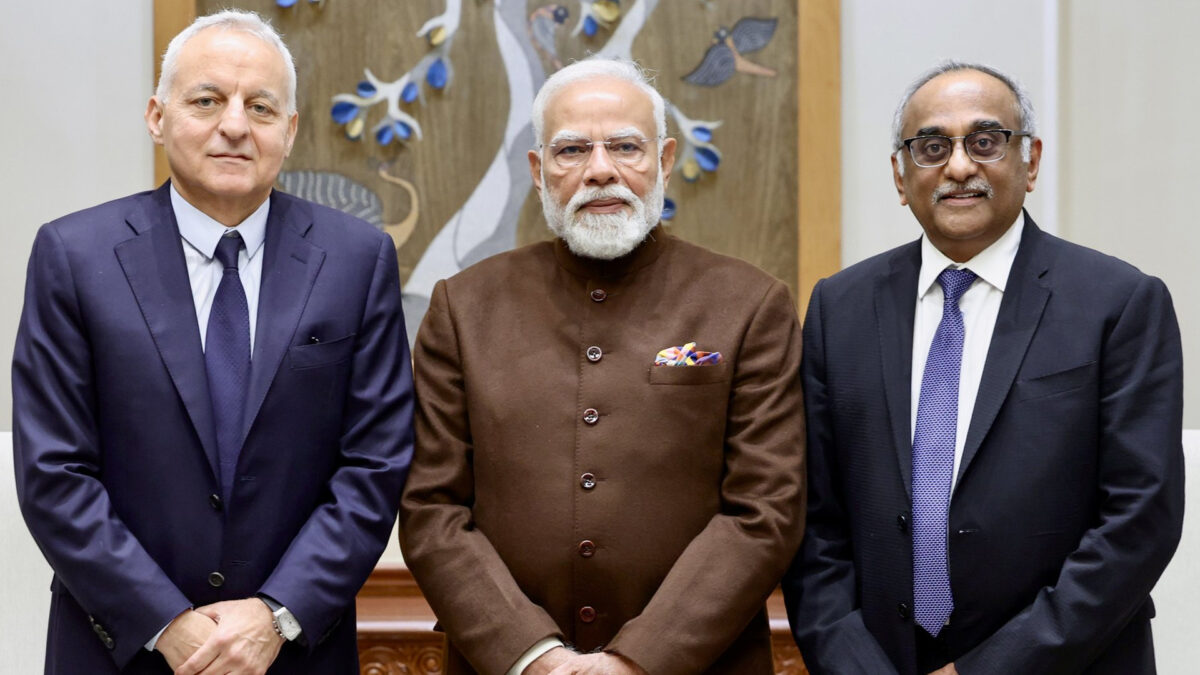
Reliance Industries and British aerospace major Rolls-Royce have announced a strategic partnership to jointly develop and manufacture a combat aircraft engine for India’s Advanced Medium Combat Aircraft (AMCA) programme, potentially giving a major boost to the country’s efforts to build critical defence technology at home.
The proposed collaboration will combine Rolls-Royce’s expertise in aircraft propulsion with Reliance’s manufacturing capabilities. The companies also plan to explore setting up an Aerospace Gas Turbine Complex in India, which could create an industrial base for developing and manufacturing advanced aero engines.
The announcement comes as India accelerates its flagship fifth-generation fighter aircraft programme. The AMCA is being developed by the Aeronautical Development Agency (ADA) under the Defence Research and Development Organisation (DRDO), with the Indian Air Force expected to be its primary user.
India’s Fighter Engine Challenge
For India, the engine remains one of the most difficult parts of the AMCA programme.
The country has developed sophisticated fighter airframes, missiles, radars and avionics, but has remained dependent on foreign suppliers for high-performance military engines. The proposed Reliance-Rolls-Royce partnership therefore focuses on one of the biggest gaps in India’s defence self-reliance strategy.
The companies intend to work towards designing, developing, manufacturing and delivering a combat engine in India. However, they have not disclosed the proposed investment, precise engine specifications or a detailed development schedule.
The partnership also does not automatically amount to a government contract for the AMCA engine. The Indian government will ultimately decide which engine proposal best fits the aircraft programme.
Rolls-Royce already has a long association with India’s defence sector. Its engines have powered several Indian military aircraft, while the company has also supported licensed engine manufacturing in the country. The new proposal aims to take that relationship further towards co-development and deeper domestic manufacturing.
Why AMCA’s Engine Matters
The AMCA is designed to become India’s first indigenous fifth-generation fighter jet, featuring stealth characteristics, internal weapons bays, advanced sensors and network-centric capabilities.
The programme is moving into a crucial development phase, with India seeking greater participation from private industry alongside its traditional defence companies. The first prototype is targeted for around 2028, while serial production is expected in the 2030s.
That makes the choice and development of the aircraft’s engine one of the most important decisions facing the programme.
India’s previous experience shows why the challenge is significant. The DRDO’s Kaveri engine programme was originally intended to power the Light Combat Aircraft but struggled to meet the required thrust and performance parameters.
As a result, Indian fighter aircraft have continued to rely heavily on imported engines. The Tejas, for instance, uses engines supplied by GE Aerospace. Delays in imported engine supplies have also affected aircraft production.
The AMCA is intended to break that cycle by developing a more secure and technologically advanced domestic propulsion capability.
Competition And A Bigger Industrial Push
The Reliance-Rolls-Royce proposal is likely to intensify competition among international engine manufacturers seeking a role in India’s next-generation fighter programme.
Safran of France has separately been discussing cooperation with India on a high-thrust fighter engine, while GE Aerospace already has a significant role in India’s military aviation ecosystem.
The objective is ultimately bigger than selecting an engine supplier. India wants to develop the ability to design, manufacture, maintain and eventually export advanced aircraft engines.
The partnership also underlines the growing role of India’s private sector in defence manufacturing. Reliance has a major presence across energy, telecommunications and retail, while its expanding defence interests are taking it into increasingly sophisticated areas of aerospace and military production.
Reliance’s growing presence across sectors is part of a wider trend of major Indian companies expanding into new businesses and strategic partnerships. More such corporate developments are covered in our Corporate News section.
An aero-engine project would require investment in precision manufacturing, specialised materials, testing infrastructure, engineering talent and a domestic supplier network. The proposed Aerospace Gas Turbine Complex could become an important part of that ecosystem if the project moves forward.
The proposed collaboration does not immediately solve India’s fighter-engine problem. Developing, testing and certifying a modern combat engine can take years and involves substantial technical and financial risks.
But it represents an important shift in India’s approach to defence manufacturing and aerospace self-reliance. For decades, the country has built fighter aircraft around imported propulsion systems. The AMCA offers an opportunity to change that model.
If the Reliance-Rolls-Royce effort succeeds, its impact could extend well beyond one aircraft. It could help India build the engineering, manufacturing and technology ecosystem needed for future combat aircraft.
For the AMCA, an advanced stealth airframe is only as capable as the engine that powers it. Developing that capability in India could become one of the defining tests of the country’s ambition to emerge as a major aerospace power.