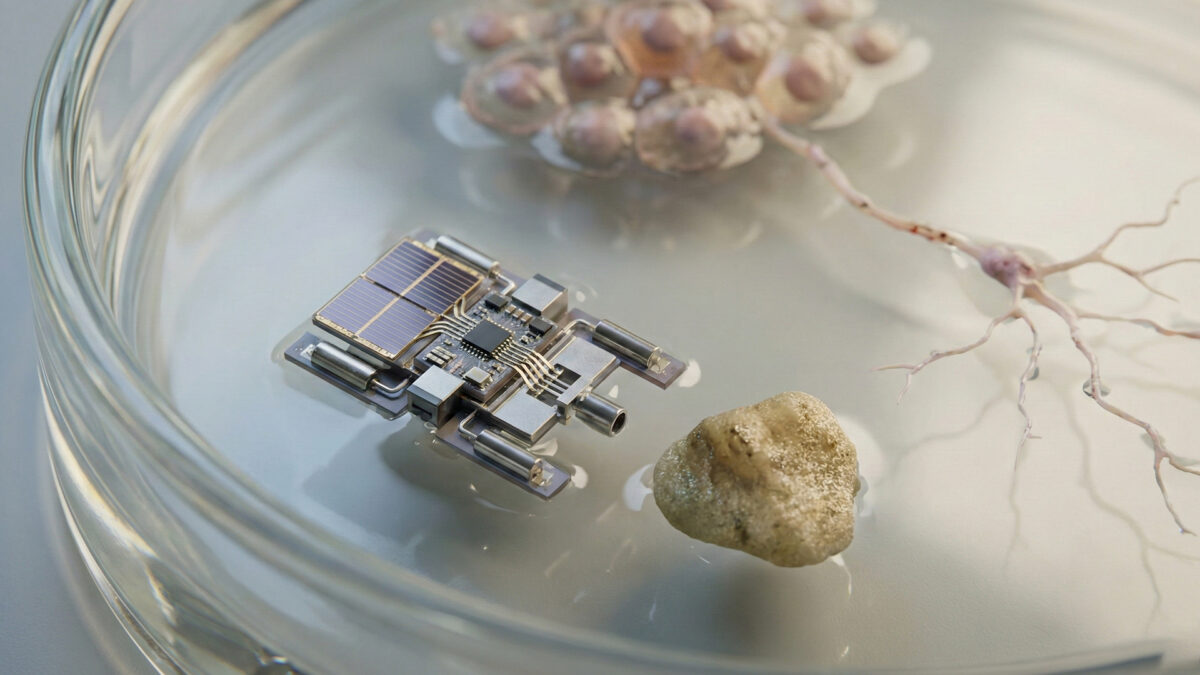
Scientists in the United States have unveiled what could be called the world’s tiniest autonomous robots, machines so small that they are invisible to the naked eye, yet capable of sensing, thinking, and moving on their own. Measuring just 0.2 mm by 0.3 mm by 0.05 mm, each robot is smaller than a grain of salt, but carries a remarkable set of capabilities, including a “micro-brain” computer and sensors that allow it to navigate its environment independently.
Unlike conventional robots that rely on remote controls or wires, these microscopic machines are powered by pulses of light, which not only fuel them but also allow them to process information and make decisions in real time. This means they can adjust their paths, respond to temperature changes, and even perform complex movement patterns without any human intervention.
The robots are designed to swim through liquids, operate for months at a time, and even coordinate as a group, mimicking behaviors seen in nature, like schools of fish. Despite their advanced abilities, these machines are incredibly affordable, costing only about one penny each to produce. This opens up the possibility of large-scale experiments or practical applications without prohibitive costs.
Researchers are already exploring medical applications, such as monitoring the health of individual cells or delivering precise doses of treatment at a microscopic level. Beyond healthcare, these tiny robots could play a role in manufacturing ultra-small devices, where precision and autonomy are crucial.
Experts say this breakthrough solves one of the biggest challenges in robotics: creating machines that are both extremely small and fully autonomous. By integrating sensing, processing, and movement into a microscopic package, scientists have opened the door to a new era of microscale, programmable robots.
With their ability to think, move, heal, and even coordinate with one another, these tiny robots could redefine fields ranging from medicine and research to industrial manufacturing, proving that even the smallest machines can have a huge impact on the world.
Also Read: Apple explores chip assembly in India