
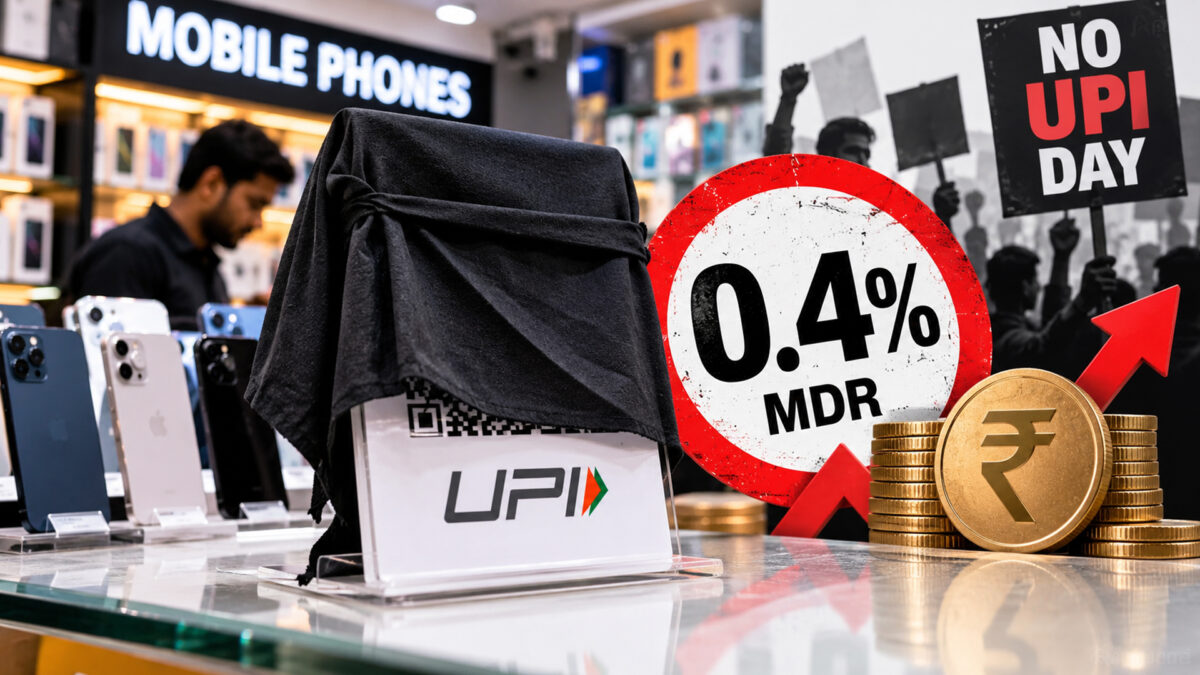
Mobile phone retailers across India will observe October 2 as “No UPI Day”, protesting the proposed Merchant Discount Rate (MDR) on certain UPI transactions. The move has been called by the All India Mobile Retailers Association (AIMRA), which wants merchant payments through UPI to continue under a zero-MDR system.
The protest will take place on Gandhi Jayanti, with participating retailers planning to cover their UPI QR codes with black cloth and stop accepting UPI payments for the day. Retailers have clarified that their protest is against the proposed charge and not against UPI or digital payments themselves.
At the centre of the dispute is a proposed 0.4% MDR on eligible UPI merchant transactions above ₹2,000, scheduled to come into effect from October 15. Person-to-person transactions and certain small-value payments will remain outside the proposed charge. The MDR is also capped at ₹300 for applicable transactions.
Retailers flag impact on margins
AIMRA has raised concerns about the effect of the proposed UPI charges on small mobile retailers, many of whom operate on narrow margins.
According to the association, a retailer processing between ₹5 lakh and ₹30 lakh through UPI every month could face an estimated additional monthly burden of ₹2,000 to ₹12,000. AIMRA has estimated that the proposed MDR could create a financial burden of around ₹40 crore a month, or nearly ₹500 crore a year, for small mobile retailers across the country.
The association has said the additional cost could reduce retailers’ earnings and make digital payments more expensive for businesses that have increasingly shifted away from cash.
AIMRA Vice President and Delhi-NCR President Tarvinder Singh said the October 2 action is intended to draw attention to the concerns of merchants. The association has called for UPI merchant payments to remain free of MDR.
How the protest will work
Participating mobile shops are expected to temporarily stop accepting UPI payments on October 2. Retailers will also cover QR codes and other UPI-related payment devices with black cloth as a symbolic protest.
The move could mean that customers visiting participating mobile stores may need to use cash or another payment method that day.
The protest, however, is not a shutdown of mobile retail businesses. Shops can continue operating, but participating retailers will not accept UPI payments during the protest.
The wider retail sector has also raised concerns over the proposed MDR. Several trader and business associations have announced plans to participate in the October 2 protest, making it broader than the mobile retail industry alone.
Debate grows over UPI charges
UPI has become a major part of India’s retail payment ecosystem, with millions of transactions taking place every day. Retailers argue that the system has reduced cash handling and made payments faster and easier to track.
Business groups now want the government and payment authorities to reconsider the proposed MDR, particularly for small retailers.
The issue has also moved into the legal arena. The Supreme Court has issued notice to the Centre, RBI and NPCI on a petition challenging the introduction of charges on certain high-value UPI merchant transactions. The proposed charges are scheduled to take effect from October 15.
The government has maintained that the new framework will not apply to all UPI transactions. The proposed structure distinguishes between different types of payments and merchant categories.
UPI payments will continue as usual in most sectors. The immediate disruption on October 2 is expected to be limited to participating mobile retailers and other businesses taking part in the protest.
The “No UPI Day” will therefore serve as a one-day show of opposition from retailers, while the larger debate over the future cost of merchant UPI payments continues ahead of the proposed October 15 implementation.