
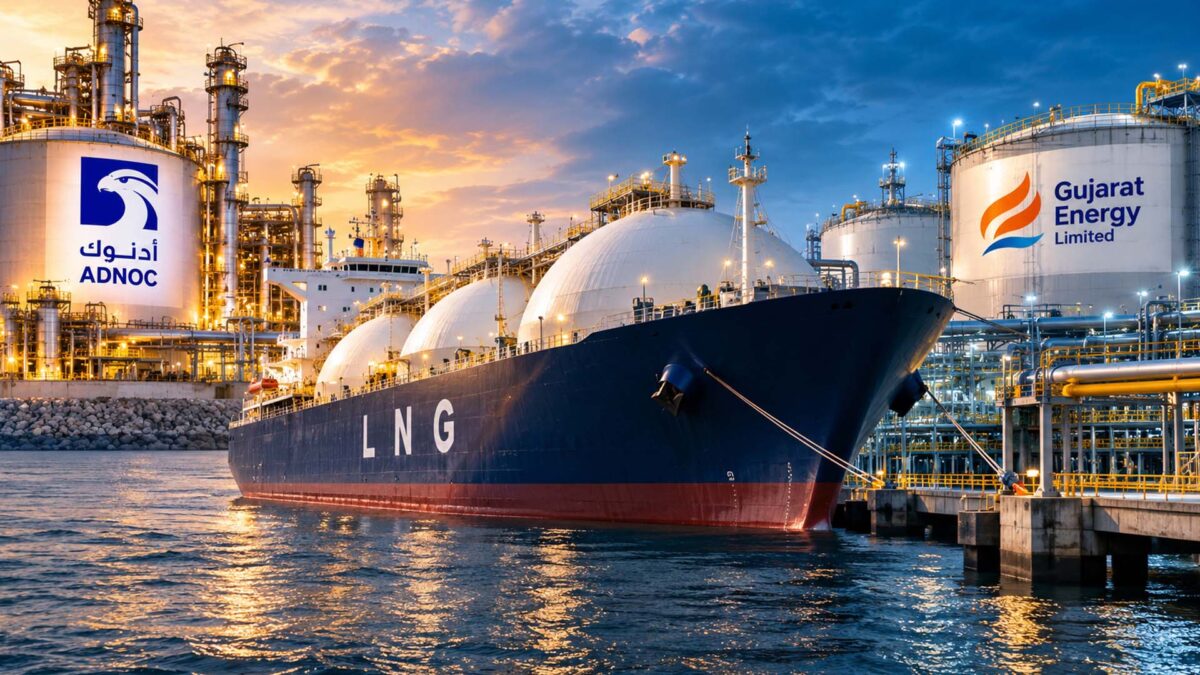
Abu Dhabi National Oil Company (ADNOC) has signed a 10-year agreement with India’s Gujarat Energy Limited to supply up to four million tonnes of liquefied natural gas (LNG), strengthening energy ties between India and the United Arab Emirates (UAE). Deliveries under the agreement are scheduled to begin in 2028.
Announced on November 6, the long-term sales and purchase agreement (SPA) marks ADNOC’s fifth LNG supply arrangement with India. It also represents the first sale of gas from the international portfolio of XRG, ADNOC’s international investment company.
The agreement is significant for India’s efforts to secure reliable natural gas supplies as the country looks to diversify its energy sources and meet growing demand from industries, households and the transportation sector.
Under the contract, Gujarat Energy will receive up to four million tonnes of LNG over a decade. The figure represents the maximum volume covered by the agreement and should not be interpreted as a guaranteed annual supply of four million tonnes. The arrangement will connect gas supplies from ADNOC’s international portfolio with India’s expanding natural gas market.
The deal also highlights ADNOC’s growing ambitions in the global LNG business, particularly across major Asian markets.
One of the most important aspects of the agreement is the source of the LNG. Unlike some of ADNOC’s earlier supply arrangements, the Gujarat Energy contract will be fulfilled using gas from XRG’s international portfolio rather than relying solely on production from the UAE.
XRG is ADNOC’s international investment arm, which is developing its presence across global energy markets. The latest agreement marks the first commercial sale of LNG from this portfolio, representing an important milestone in its expansion as an integrated natural gas and LNG business.
The arrangement will allow ADNOC to connect gas supplies produced outside the Gulf with customers in high-demand markets such as India. It also reflects the company’s strategy of building a broader international supply network instead of depending on a single production region.
For India, sourcing LNG through an international portfolio could provide another avenue for diversifying its natural gas procurement. Long-term supply agreements are particularly important for energy-importing countries because they help establish greater visibility over future supplies.
The Gujarat Energy agreement also supports ADNOC’s broader international growth strategy. In July 2026, the company launched an integrated global LNG marketing and trading platform at Abu Dhabi Global Market.
The platform brings together LNG marketing operations from ADNOC Gas and XRG, alongside the trading capabilities of ADNOC Trading. Its objective is to strengthen the company’s ability to market and supply LNG to customers across different regions.
ADNOC is targeting 47 million tonnes per annum (mtpa) of marketable LNG beyond 2030 through the platform. This ambition would place the company among the leading suppliers in the global LNG market.
The agreement with Gujarat Energy follows other supply arrangements secured by ADNOC across Asia. These include a deal with Japan’s INPEX and another with Thailand’s Gulf Group.
The company signed a 15-year agreement with INPEX in July to supply one million tonnes of LNG annually from its Ruwais LNG development. It also entered into an agreement with Thailand’s Gulf Group in October covering approximately two million tonnes of LNG over a multi-year period, with supplies expected to begin in 2027.
The latest Indian agreement further strengthens ADNOC’s presence in Asia, where demand for natural gas remains an important part of energy planning.
Formerly known as Gujarat Gas Limited, the company adopted the name Gujarat Energy Limited following a restructuring in May 2026 that brought together the businesses of Gujarat State Petroleum Corporation, Gujarat State Petronet and GSPC Energy.
The company has interests in city gas distribution, gas trading and other energy-related activities. Its infrastructure includes a city gas distribution network operating across 44 districts in six states, along with regasification capabilities and a growing trading business.
Its network supplies compressed natural gas (CNG), widely used in transportation, and piped natural gas (PNG), which serves households and commercial establishments.
Gujarat Energy Managing Director Avantika Singh Aulakh said natural gas would remain an important component of India’s transition towards cleaner energy. She highlighted its role in improving industrial efficiency, providing households with a safer cooking fuel and supporting environmentally friendly transportation.
The company believes its infrastructure and expanding market presence will help it make better use of long-term LNG supply arrangements.
|
India is among the world’s major LNG importers and relies on overseas suppliers to meet a substantial portion of its natural gas requirements. The fuel is used across industries, power generation, fertiliser production, city gas distribution and transportation.
Securing long-term LNG contracts is therefore an important part of India’s energy security strategy. Such agreements can help buyers diversify their supplier base and improve supply planning, although actual benefits depend on pricing, delivery schedules and market conditions.
The new ADNOC agreement comes against the backdrop of continuing uncertainty in international energy markets. Geopolitical tensions, shipping disruptions and fluctuations in global gas prices have highlighted the importance of maintaining diverse supply arrangements.
India’s energy relationship with the UAE has also expanded beyond conventional oil trade, with natural gas becoming an increasingly important area of cooperation.
ADNOC’s latest agreement with Gujarat Energy adds another layer to this relationship. While financial details and the pricing formula of the contract have not been publicly disclosed, the 10-year arrangement establishes a long-term supply framework beginning in 2028.