Categories
Leaders

Elon Musk becomes first person worth $600 billion

Elon Musk has become the first person in history to reach a net worth of $600 billion, according to Forbes. The sharp rise in his wealth is mainly due to growing expectations that SpaceX, his private space company, is preparing for an initial public offering (IPO) in the coming years.

SpaceX’s valuation has surged sharply as investor interest in the space industry grows. Reports suggest the company could be valued at around $800 billion when it goes public, possibly by 2026. Musk owns about 42 percent of SpaceX, making it the single largest contributor to his personal wealth. If the IPO goes ahead at the expected valuation, his net worth could rise even further.

Apart from SpaceX, Musk’s fortune is also supported by his stake in Tesla, the electric vehicle maker. He owns roughly 12 percent of Tesla, whose shares have performed strongly in recent months. Tesla remains one of the most valuable carmakers in the world and continues to play a key role in Musk’s financial standing.

Musk’s other ventures also add to his growing wealth. These include his artificial intelligence company xAI and his social media platform X. While these businesses are still evolving, investors see long-term value in Musk’s technology-driven approach and ambitious projects.

Earlier this year, Musk had already crossed the $500 billion mark, another first for any individual. The latest milestone places him far ahead of other global billionaires and sets a new benchmark for personal wealth. Market watchers say no individual in modern history has accumulated wealth at this scale.

Experts note that Musk’s fortune is closely tied to market valuations rather than cash holdings. Most of his wealth is invested in company shares, which can rise or fall with market conditions. Still, with SpaceX’s IPO on the horizon and strong investor interest in his companies, Musk’s financial influence continues to grow.

While Musk has not officially commented on the Forbes estimates or IPO plans, the numbers highlight the massive global impact of his businesses.

Also Read: SEBI starts ₹18 cr recovery against finfluencer ‘Baap of Charts’

Categories
Corporate

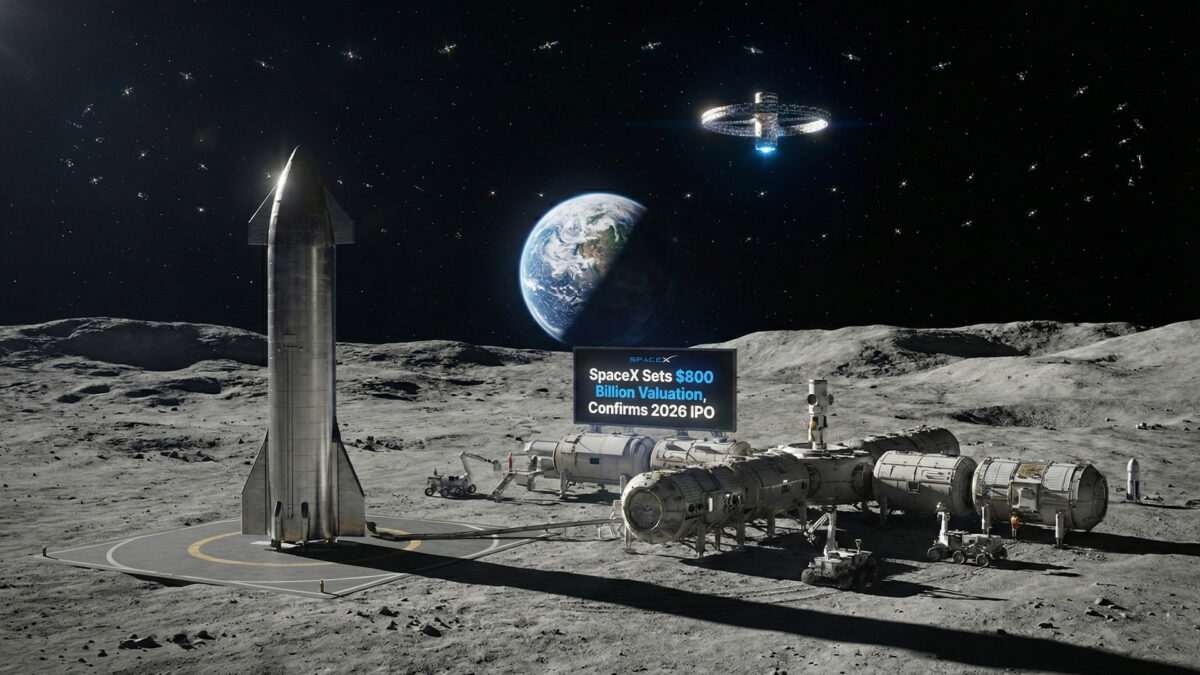
SpaceX hits $800 billion valuation ahead of 2026 IPO

SpaceX, the private aerospace company founded and led by Elon Musk, has taken a significant step toward becoming a publicly traded company. A recent insider share sale has valued SpaceX at around $800 billion, highlighting strong investor confidence as the company prepares for an initial public offering (IPO) expected in 2026.

The share sale allows existing and new investors to purchase SpaceX stock at $421 per share, a price that reflects the company’s rapid growth and ambitious plans. Analysts suggest that the IPO could raise more than $25 billion, potentially pushing SpaceX’s valuation even higher, depending on market conditions. If the company executes its plans successfully, it could become one of the largest IPOs in history.

SpaceX’s soaring valuation is largely supported by its Starlink satellite internet business, which has been expanding quickly. Starlink currently provides internet services in multiple countries and is now planning direct-to-mobile connectivity, which could open a major new revenue stream. In addition, the company continues to make progress on its Starship rocket program, designed for ambitious missions to the moon, Mars, and potentially beyond. These innovations are key drivers behind the company’s strong market interest.

Despite the excitement, SpaceX executives have emphasized that the timing and final valuation of the IPO remain uncertain. Factors such as global market conditions, regulatory approvals, and the company’s operational milestones could influence the final launch. The insider sale, however, demonstrates a clear commitment to preparing the company for public investment.

Elon Musk’s leadership and vision have been central to SpaceX’s growth, from reusable rockets to global satellite internet. Going public would not only provide a new capital influx but also mark a historic moment in financial markets. For investors, the IPO represents a rare chance to participate in a company that is shaping the future of space travel and connectivity.

With its record valuation, technological innovations, and ambitious expansion plans, SpaceX is positioning itself to become a dominant force in both aerospace and the broader tech sector, attracting attention from investors and industry watchers worldwide.

Also Read: Elon Musk confirms SpaceX IPO in 2026

Categories
Technology

Elon Musk confirms SpaceX IPO in 2026

Elon Musk has confirmed that reports about SpaceX planning an initial public offering (IPO) in 2026 are accurate, signaling a major step for one of the world’s most valuable private companies. The billionaire entrepreneur’s statement has intensified investor interest, as SpaceX could become one of the largest IPOs in history.

Media reports suggest that SpaceX could be valued at $1 trillion or more, reflecting the rapid growth of its commercial and space ventures. The IPO is expected to raise tens of billions of dollars, which would provide capital for ambitious projects, including SpaceX’s ongoing Mars exploration plans and expansion of its Starlink satellite broadband network.

SpaceX has been at the forefront of commercial spaceflight for years, launching satellites, servicing the International Space Station, and pioneering reusable rockets. Its Starship program, designed for deep space missions, including potential trips to Mars, represents both an opportunity and a financial risk. Analysts note that while the company has strong revenue streams from satellite services and government contracts, space exploration remains a high-cost venture, and investors will need to weigh these risks before the IPO.

Industry experts say that a public listing could provide SpaceX with more financial flexibility to scale its operations while also offering early investors and employees a way to realize gains from their equity. However, some caution that the IPO could be affected by market conditions, government regulations, and the inherent uncertainties of large-scale space missions.

Musk’s confirmation has fueled speculation about the timing and structure of the IPO, with some reports suggesting that shares could be offered in phases, starting with SpaceX’s Starlink division, followed by the broader company. If successful, the IPO would not only be historic in size but also highlight the growing commercialization of space and investor appetite for high-growth technology ventures.

For now, the market is closely watching, as SpaceX prepares to take its next major step from a private aerospace pioneer to a publicly listed company with global attention.

Also Read: boAt financial gaps raise concerns before IPO

Categories
Technology

Starlink India pricing leak sparks debate

SpaceX-owned Starlink has briefly displayed pricing details for its residential satellite internet service in India, giving users their first official-looking glimpse of what the service could cost once launched. The prices appeared on Starlink’s website before being taken down, with the company later clarifying that these were not final and were shown due to a technical configuration issue.

According to the website listing, the residential plan was shown at a monthly subscription fee of around ₹8,600, along with a one-time hardware cost of about ₹34,000 for the Starlink kit, which includes the satellite dish, router and mounting equipment. The plan was shown as offering unlimited data and high-speed internet access, targeted especially at remote and rural areas where traditional broadband infrastructure is weak or unavailable .

The service promises low-latency, high-speed internet delivered via a network of low-earth orbit satellites, which can provide connectivity in difficult terrains such as hills, forests and isolated villages. The setup process is designed to be simple, with a “plug-and-play” installation that allows users to go online quickly after setting up the device at home.

However, Starlink clarified that the pricing shown on the website was not an official announcement. The company said the numbers appeared due to a configuration glitch and that the service is yet to receive full regulatory approvals in India. This means customers in India cannot yet place orders or subscribe to the service, and the final pricing could change when the commercial launch actually takes place .

Industry experts say that if these prices are close to the final rates, Starlink may primarily attract users in remote and underserved regions, government projects, emergency connectivity services, and businesses operating in difficult-to-reach locations. For urban users, the service may remain a premium alternative to fibre broadband and 5G.

For now, the pricing leak has sparked wide interest and debate about the future of satellite broadband in India, but customers will have to wait for official government clearances and a formal launch announcement before the service becomes available.

Also Read: IndiGo shares fall 7%, government reallocates slots

Categories
Leaders

Elon Musk fights EU over X platform fine

Elon Musk’s social media platform X (formerly Twitter) has been fined €120 million ($140 million) by the European Union, the first major penalty under the EU’s Digital Services Act (DSA). Regulators said X violated rules by allowing users to buy “blue checkmarks,” lacking transparency in advertising, and restricting researcher access to public data.

The “blue checkmark,” previously reserved for verified public figures, can now be purchased by anyone, which the EU says misleads users about authenticity. The EU also flagged X’s advertising practices for not being transparent, with unclear information about ad buyers and targeting. Researchers were reportedly blocked from accessing public data, limiting scrutiny of content and potential misuse.

Musk reacted strongly, calling the EU a “bureaucratic monster” and saying it “should be abolished.” His response reflects his frustration with regulatory oversight and his willingness to challenge global institutions.

Since acquiring Twitter, Musk has reshaped the platform, introducing paid verification, subscription services, and new content policies. These moves, while controversial, show his focus on rapid innovation and monetization. The EU fine challenges this approach but also highlights Musk’s risk-taking leadership style.

Experts say the fine is a warning to global tech companies that EU regulations will be strictly enforced. It also underscores the tension between international regulation and the fast-moving world of digital platforms. Musk’s defiance positions him as a leader ready to confront regulatory challenges while pursuing his vision for X.

This clash marks a defining moment for Musk and the platform, showing how global tech leadership now involves navigating legal, regulatory, and political pressures. As digital rules tighten worldwide, Musk’s bold approach to innovation and governance is likely to face more scrutiny, making him a central figure in shaping the future of social media and tech regulation.

Also Read: Chinese phone makers lure iPhone users with AI

Categories
Leaders

Elon Musk imagines a future where work is a choice

Elon Musk has once again pushed the conversation on the future of work into bold new territory. Speaking openly on Nikhil Kamath’s podcast, the Tesla and SpaceX chief painted a picture of a world where people wake up each day and choose to work, not because they must, but because they want to.

Musk believes rapid advances in artificial intelligence and robotics will soon be powerful enough to take over most routine and even skilled tasks. His timeline is striking: within just 10 to 20 years, he expects machines to generate the goods and services people need, making full-time jobs optional for many.

In Musk’s view, this shift could also transform the idea of money itself. If AI systems can produce almost everything at near-zero cost, traditional economic rules may no longer apply. “Work may become more like a hobby,” he suggested, something people would pursue for meaning, passion, or creativity instead of financial survival.

While his prediction sounds liberating, Musk acknowledged the transformations won’t be simple. Societies will need to rethink purpose, income models and the role of human contribution. But he remained optimistic that freeing people from compulsory labour could unlock a more creative, fulfilled world.

Also Read: Godrej Properties wins Hyderabad land for ₹4,150 cr project

Categories
Technology

Musk Plans Tesla ‘Terafab’ Chip Plant

Tesla CEO Elon Musk has announced plans to build a massive factory to produce the company’s own artificial intelligence (AI) chips, as demand for computing power in self-driving cars and robotics continues to surge.

Speaking at Tesla’s annual shareholder meeting, Musk said the company may not be able to meet future chip requirements through its current suppliers, including Taiwan Semiconductor Manufacturing Company (TSMC) and Samsung. To fix that, Tesla is considering building what he called a “terafab”, a chip plant far larger than any existing “gigafactory.”

Musk said the proposed facility could handle at least 100,000 wafer starts per month, making it one of the world’s biggest semiconductor fabs. He added that Tesla is open to partnering with Intel for the project, saying it’s “worth having discussions” with the American chipmaker. No agreement has been finalised yet.

The move comes as Tesla develops its next-generation AI chip, known as “AI5,” expected to enter small-scale production in 2026 and mass production in 2027. A more advanced version, “AI6,” could follow in 2028 with double the performance. Musk claimed the new Tesla chip would consume one-third the power of NVIDIA’s flagship Blackwell chip and cost only 10% as much to make.

Industry experts have described Musk’s plan as bold but challenging, since building and running an advanced chip fab requires huge investment and expertise. Still, the idea has excited markets—Intel’s shares rose after Musk mentioned the potential tie-up.

At the same meeting, Tesla shareholders also approved Musk’s 10-year compensation plan, worth nearly $1 trillion, signalling continued investor confidence in the company’s long-term AI and robotics ambitions.

Also Read: India’s Top Philanthropists Give ₹10,380 Cr

Categories
Corporate

Tesla Shareholders Approve $1Trillion Musk Pay Package

Tesla CEO Elon Musk is set to become the world’s first trillionaire after more than 75% of the company’s shareholders approved as much as $1 trillion in stock over the next decade.

Shareholders voted in favor of the proposal at Tesla, based in Austin, reaffirming their faith in Musk’s leadership and vision to transform the electric vehicle pioneer into a technology powerhouse focused on AI, robotics, and autonomous systems.

Under the approved plan, Musk will receive stock awards only if Tesla achieves a series of ambitious performance and market milestones over the next decade.

These include delivering 20 million electric vehicles, deploying 1 million self-driving robotaxis, selling 1 million humanoid robots, and generating $400 billion in core profit.

If all targets are achieved, Musk would gain roughly 12% of Tesla’s shares, worth about $878 billion after adjustments.

Shares of Tesla rose more than 3 percent in after-hours trading after the shareholder voted on Thursday.

Shareholders also backed Tesla’s potential investment in Musk’s AI startup, xAI, despite concerns over conflicts of interest. The partnership could enhance Tesla’s self-driving technology while providing xAI with a major commercial client.