
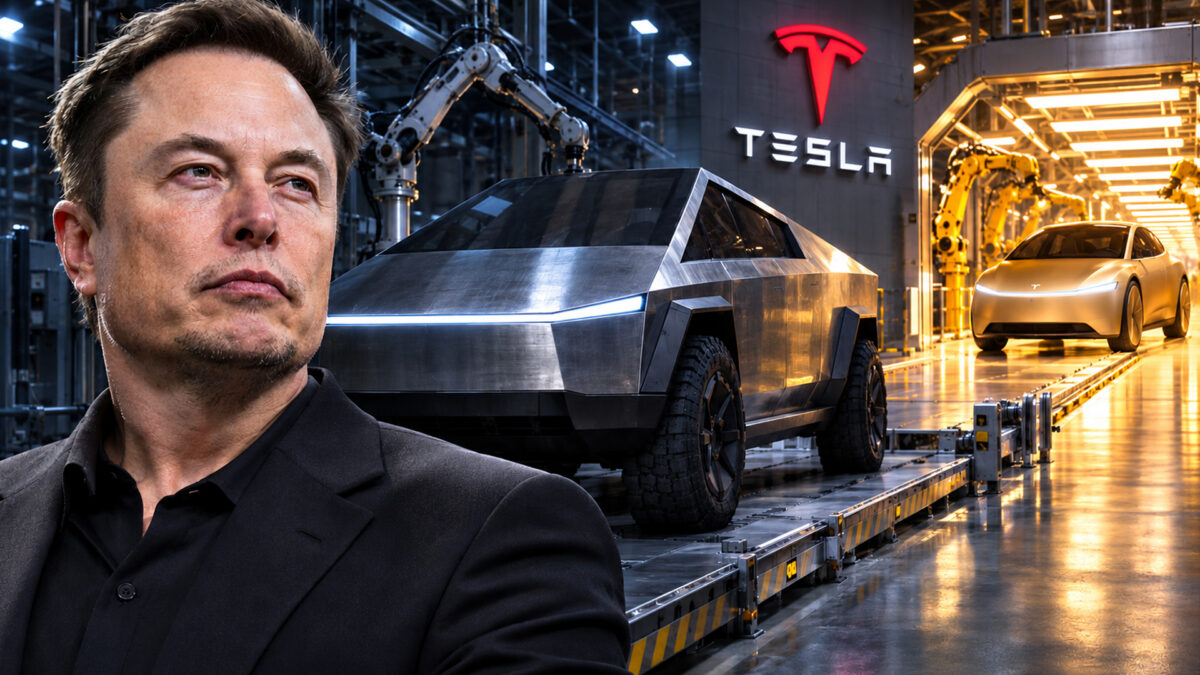
Tesla is preparing to wind down production of its much-publicised Cybertruck around the middle of 2027, marking a major setback for one of Elon Musk’s most ambitious electric vehicle projects. The decision comes after the futuristic electric pickup struggled to attract buyers in the numbers originally expected, despite generating enormous attention when it was unveiled in 2019.
Tesla CEO Elon Musk announced the development on November 6 through a post on social media platform X. He said the company would gradually wind down Cybertruck production at its Gigafactory Texas facility to make room for increased manufacturing of the Cybercab, Tesla’s autonomous two-seater robotaxi.
“Tesla will be winding down production of the Cybertruck at Gigafactory Texas around the middle of next year to make room for increased Cybercab production,” Musk said.
The announcement signals a significant shift in Tesla’s priorities, with the company increasingly directing its resources towards artificial intelligence (AI), autonomous driving technology and robotics rather than expanding its conventional electric vehicle lineup.
However, Musk has not clarified whether Cybertruck production will end permanently or whether the company plans to move manufacturing to another facility. The Texas factory remains the only known production location for the vehicle, which requires specialised equipment and manufacturing processes.
The Cybertruck was unveiled on November 21, 2019, with Tesla positioning it as a vehicle that would challenge traditional pickup trucks from established automakers such as Ford and General Motors. Its angular exterior, stainless-steel body and futuristic appearance immediately attracted attention, although the design also divided potential buyers.
The unveiling event itself became controversial when Musk attempted to demonstrate the strength of the vehicle’s supposedly shatterproof windows. Metal balls thrown at the windows cracked two of them during the presentation, creating an embarrassing moment for the company.
Despite the initial setback, the Cybertruck generated considerable interest. Tesla reportedly received 250,000 reservations within five days of its unveiling. Musk subsequently indicated that annual sales could eventually reach 250,000 units, with even higher ambitions discussed during the development phase.
However, the initial enthusiasm did not translate into actual purchases. The reservations required refundable deposits, meaning they did not represent confirmed vehicle orders.
According to Kelley Blue Book estimates, Tesla sold 38,965 Cybertrucks in the US in 2024. Sales declined sharply to 20,237 units in 2025, marking a fall of approximately 48%. The numbers remained significantly below the company’s original expectations.
Tesla does not disclose Cybertruck sales separately in its regular delivery reports. Instead, the vehicle is included in a broader category called ‘Other Models’, alongside some of the company’s other products.
The latest delivery figures also indicate the difficulties faced by the electric pickup. Tesla delivered approximately 8,300 vehicles under the Other Models category in the third quarter of 2026. This category includes the Cybertruck, making it difficult to establish the pickup’s exact contribution.
The Cybertruck’s difficulties began well before it reached customers. Tesla initially planned to begin production in late 2021, but manufacturing challenges and supply chain disruptions repeatedly pushed back the timeline.
The first vehicle rolled off the production line at Gigafactory Texas in July 2023, while customer deliveries began on November 30, 2023.
The company also faced criticism over the vehicle’s pricing. At its 2019 unveiling, Tesla had announced starting prices of $39,900 for the single-motor version, $49,900 for the dual-motor model and $69,900 for the top-end tri-motor variant.
However, the prices increased substantially by the time the vehicle reached customers. Subsequent pricing revisions made the electric pickup considerably more expensive than originally promised.
The Cybertruck also faced repeated quality and safety-related concerns. According to information reported by Reuters, Tesla issued 11 recalls after the vehicle entered the market in late 2023. Some problems required physical repairs, while others were addressed through software updates.
Its unconventional stainless-steel exterior created another challenge. The sharp-edged design raised concerns about pedestrian safety and made it difficult for the vehicle to meet regulatory requirements in Europe. Consequently, the Cybertruck never entered the European market.
These factors restricted its potential customer base and added to the challenges of building a commercially successful electric pickup.
The decision to wind down Cybertruck production reflects Tesla’s changing business strategy. Musk has increasingly spoken about transforming the company from a conventional electric vehicle manufacturer into a business focused on autonomous transportation, artificial intelligence and robotics.
The Cybercab is central to this strategy. The two-seater autonomous vehicle has been designed without a steering wheel or pedals and is intended to operate as part of Tesla’s proposed robotaxi network.
Tesla began offering paid rides using a limited fleet of Cybercabs in Austin, Texas, in September 2026. However, the technology still faces regulatory scrutiny, with the US National Highway Traffic Safety Administration reviewing aspects of its safety certification.
The company has indicated an installed production capacity of more than 125,000 Cybercabs. However, expanding the robotaxi business will depend on regulatory approvals, manufacturing capabilities and the wider acceptance of driverless transportation.
Tesla is also investing in Optimus, its humanoid robot programme, as part of its broader artificial intelligence ambitions. The company has previously indicated that factory space currently used for certain vehicle models could be redirected towards robot manufacturing.
The Cybertruck production wind-down is therefore part of a wider restructuring of Tesla’s manufacturing priorities.