
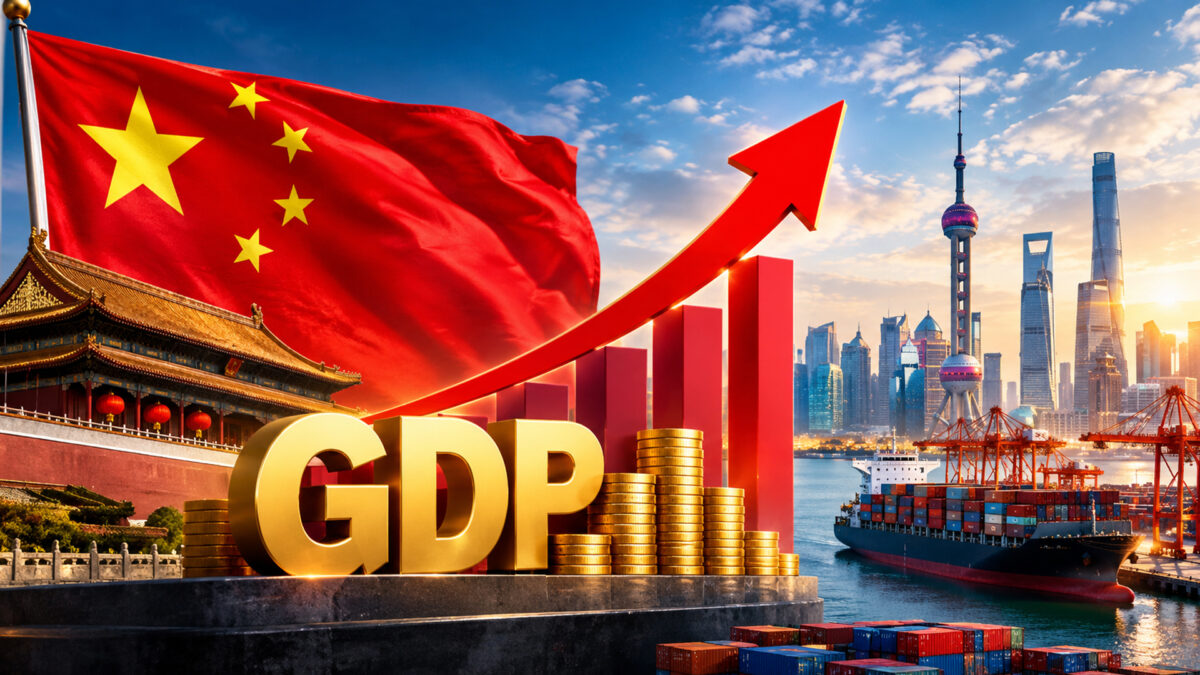
China’s economy grew faster than expected in the third quarter of 2026, supported by strong exports and improved factory activity. However, the recovery remains uneven, with cautious consumer spending and a prolonged property market downturn continuing to weigh on domestic demand.
The world’s second-largest economy expanded 4.5% year-on-year in the July-September quarter, according to data released by China’s National Bureau of Statistics on October 19.
The latest figures offer some relief to Beijing as it works towards its annual economic growth target of 4.5% to 5% for 2026. The economy grew 4.6% during the first nine months of the year, keeping it within the government’s target range.
On a quarter-on-quarter basis, China’s gross domestic product (GDP) increased 1.2% in the third quarter, accelerating from 0.9% in the previous quarter. The improvement suggests that economic activity gained some momentum towards the end of the September quarter.
Exports have become a major source of support for China’s economic growth this year. Strong international demand for technology products, semiconductors, electric vehicles and other manufactured goods has helped factories maintain production despite sluggish domestic consumption.
The global artificial intelligence (AI) boom has also supported demand for technology-related products and components. China’s expanding manufacturing capacity has enabled companies to supply overseas markets at competitive prices.
September data provided further evidence of the strength of the industrial sector. Industrial output rose 5.5% year-on-year, compared with 5.2% in August. The latest increase marked the fastest pace of growth in six months.
Chinese manufacturers have increasingly relied on overseas customers as households remain cautious about spending. The country’s competitive manufacturing sector has helped offset some of the weakness at home, although the growing dependence on exports also leaves the economy exposed to changes in global demand.
China’s export strength comes amid continuing trade tensions with major economies, including the United States and the European Union. Higher US tariffs have affected parts of bilateral trade, encouraging Chinese companies to expand their presence in other markets, including Southeast Asia, Europe and Latin America.
However, the strategy carries risks. Trade restrictions, possible new tariffs and a slowdown in global demand for AI-related products could affect China’s export performance in the coming months.
Retail sales, an important indicator of consumer spending, increased 1.1% year-on-year in September. This was an improvement from the 0.4% growth recorded in August and better than economists had expected. However, the increase remained modest compared with the expansion in industrial output.
Households have remained cautious about spending amid uncertainty over jobs, incomes and property prices. The prolonged downturn in China’s real estate sector has affected household wealth and confidence, limiting the strength of the consumer recovery.
Property investment fell 20.6% during the January-September period compared with the same period last year. Fixed-asset investment, which covers spending on infrastructure, factories, equipment and property, declined 7.2% over the same period.
The weakness in investment highlights the gap between China’s strong production capacity and the slower pace of demand at home. While factories continue to produce goods for international markets, businesses face pressure from intense competition and limited opportunities to raise prices in the domestic market.
The latest growth figures could reduce immediate pressure on Beijing to announce a large, economy-wide stimulus package. With growth at 4.5% in the third quarter, the government appears closer to meeting its annual target.
Authorities have already introduced targeted measures to support economic activity, including financing assistance for businesses and funding tools aimed at infrastructure investment. The government has also taken steps to ease borrowing costs for selected businesses and consumers.
However, the impact of these measures remains uncertain. Weak private investment, property market problems and subdued household demand continue to limit the recovery.
China’s policymakers face a difficult balance. Additional support could encourage spending and investment, but the government must also address local financial pressures and avoid relying too heavily on manufacturing and exports.
China’s third-quarter performance shows that its export and manufacturing sectors remain important engines of growth. The improvement also puts the country closer to its 2026 economic target without necessarily requiring a major new stimulus programme.
Yet stronger headline GDP growth does not mean that all parts of the economy are recovering at the same pace. Consumer demand remains subdued, property investment continues to fall and private businesses face pressure from intense competition.
The outlook will depend on whether exports can maintain their momentum and whether households regain confidence to spend more. A slowdown in global technology demand or further trade restrictions could weaken the export engine.
China has made progress towards its annual growth target, but sustaining that progress will require a more balanced recovery. Stronger domestic consumption, healthier private investment and greater stability in the property market will be essential if the economy is to depend less on overseas demand in the months ahead.