
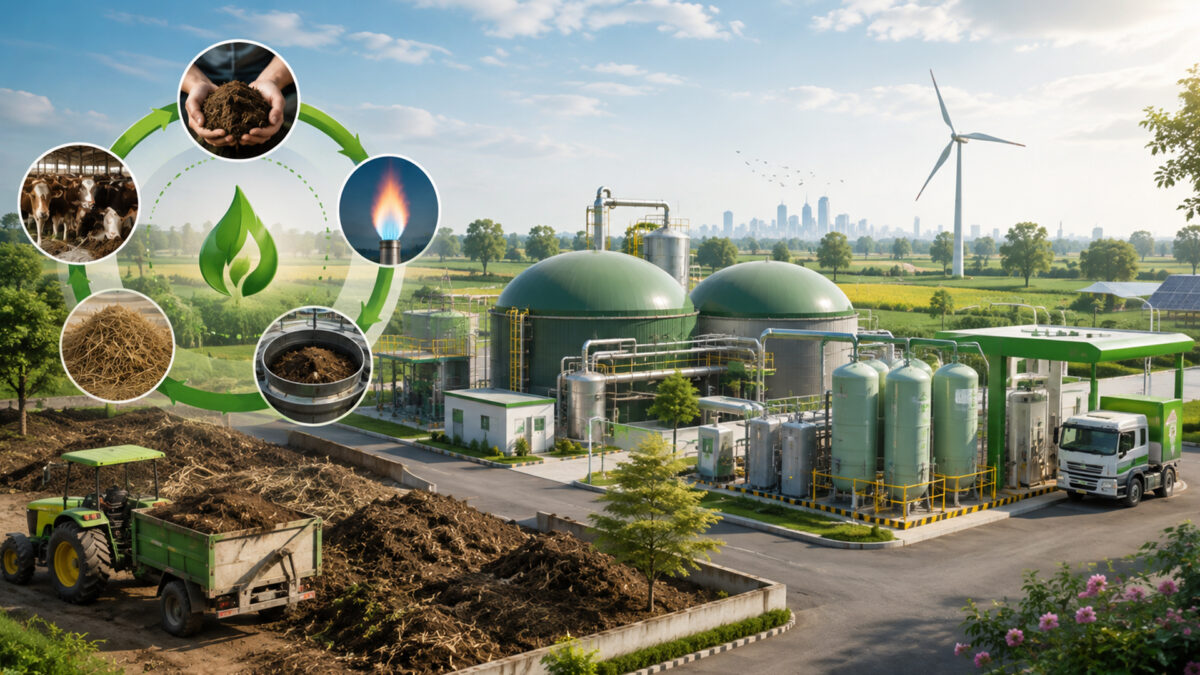
India is giving a major push to compressed biogas (CBG), with the Union Cabinet approving a ₹23,731-crore national scheme aimed at turning agricultural waste, cattle dung and other organic material into clean fuel, organic manure and a new source of rural income.
The GOBARdhan scheme, short for Galvanizing Organic Bio-Agro Resources Dhan, has been approved as India’s National Circular Bioenergy Scheme. It will be implemented from 2026-27 to 2035-36, with the government seeking to make CBG a significant part of the country’s future energy mix.
The move comes as India looks for ways to strengthen energy security and reduce its dependence on imported fossil fuels, including liquefied natural gas (LNG).
The basic idea behind the scheme is simple: waste that is often difficult to manage can be collected and processed to produce a renewable gas that can be used in the existing gas ecosystem.
The government expects the scheme to drive nearly ten-fold growth in domestic CBG production and attract large-scale private investment into the sector.
CBG is chemically equivalent to natural gas and can be used across transport, households, industry and commercial applications. This gives the fuel an advantage because it can potentially work with India’s existing gas infrastructure rather than requiring an entirely separate energy network.
The scheme brings several existing government initiatives for the biogas sector under one national framework. These include programmes supporting CBG plants, biomass aggregation, organic manure and pipeline infrastructure.
More than 200 CBG plants have already been commissioned under earlier initiatives, providing the foundation for the next phase of expansion.
Under GOBARdhan, the government has identified six major areas of support.
The first is assured CBG offtake. City Gas Distribution companies will provide a more predictable market for producers, with the notified CBG obligation set at 3% in 2026-27, 4% in 2027-28 and 5% from 2028-29 onwards for the CNG transport and PNG domestic segments.
This is important for investors because CBG plants require substantial upfront investment. A reliable market can make it easier for developers to secure financing and plan production over the long term.
The second component is a stable CBG pricing framework. The scheme provides for an administered price of ₹2,110 per Metric Million British Thermal Unit (MMBTU), with a minimum 10-year horizon. The objective is to give producers greater revenue visibility while keeping the fuel affordable.
The third is capital assistance. Eligible new CBG projects can receive support of up to ₹2 crore per tonne per day of installed capacity. Existing plants expanding their capacity can also qualify for assistance.
The support will cover not only plant equipment but also important parts of the value chain, including feedstock aggregation and organic manure processing.
The government is also planning to expand pipeline connectivity between CBG plants, trunk pipelines and City Gas Distribution networks. Better connectivity could reduce transportation and evacuation costs and allow producers to reach larger markets.
A dedicated credit guarantee mechanism is another key part of the scheme. It is expected to make institutional finance more accessible, particularly for MSME-based CBG projects. Lower lending risks could encourage participation by rural entrepreneurs, cooperatives and first-time developers.
The sixth component is a CBG Ecosystem Challenge Fund, which will support district-level planning, feedstock mapping, technology adoption, capacity building and development of local supply chains.
For farmers, the scheme could create a new income stream from materials that often have little commercial value.
Agricultural residue, cattle dung, press mud from sugar mills and municipal organic waste can become valuable feedstock for CBG plants. This could create economic opportunities not just for farmers, but also for people involved in collection, transportation, processing and plant operations.
The process also produces organic manure, creating another potential revenue stream while encouraging more scientific waste management.
The government expects this waste-to-wealth model to support a wider rural economy. Instead of treating agricultural and organic waste purely as a disposal problem, the scheme seeks to turn it into an economic resource.
There is also an environmental angle. Greater use of CBG could reduce the burning or dumping of organic waste and help lower greenhouse gas emissions by replacing some fossil fuel use.
For India, the larger objective is energy diversification.
Natural gas demand is growing across transportation, homes, industries and commercial establishments. Increasing domestic production of renewable gas could help meet part of that demand while reducing exposure to international fossil-fuel prices and import dependence.
The scheme also opens the door for greater private sector investment in India’s clean energy sector. Stable pricing, assured demand, capital assistance and easier access to credit are intended to make CBG projects more commercially viable.
However, the success of the programme will ultimately depend on how effectively feedstock is collected and transported, how quickly infrastructure is built and whether CBG plants can operate consistently at scale.