
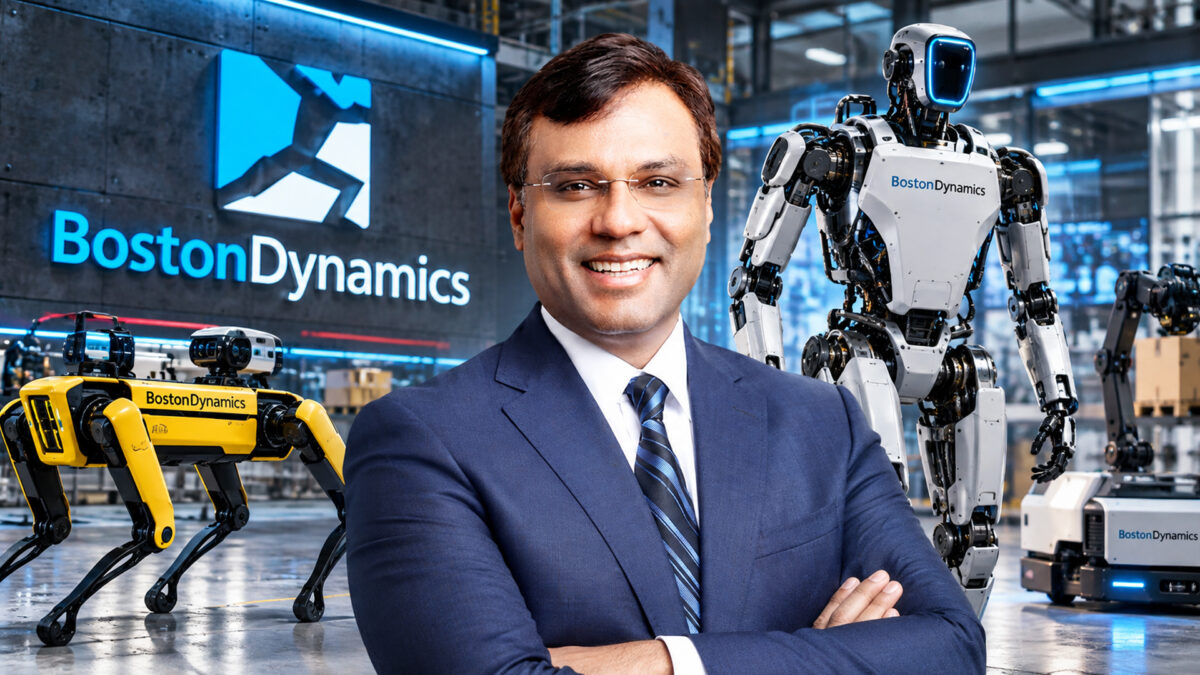
Boston Dynamics has appointed former Amazon executive Rohit Prasad as its chief executive officer, bringing an experienced artificial intelligence leader to the top of the robotics company at a time when the industry is moving rapidly towards machines that can understand and operate in the physical world.
Prasad took charge on October 7, replacing Robert Playter, who stepped down as CEO in February. The appointment comes as Boston Dynamics looks to combine its long-standing expertise in advanced robotics with increasingly powerful AI systems and turn its machines into commercially viable products at scale.
The company is owned by Hyundai Motor Group, which has been investing heavily in robotics as part of its wider strategy covering mobility, manufacturing and automation. Prasad’s arrival is expected to strengthen the company’s focus on what it calls “Physical AI” — the integration of artificial intelligence with robots that can perceive their surroundings, make decisions and perform tasks in real-world environments.
Prasad brings more than a decade of experience at Amazon, where he worked on some of the company’s most significant AI initiatives. He served as senior vice-president and head scientist for Alexa and Artificial General Intelligence, helping develop Alexa from its early stages into a large-scale consumer AI service used in hundreds of millions of households.
His more recent work at Amazon involved leading the development of the Amazon Nova family of foundation models, which are designed for enterprise applications. That combination of consumer AI, large-scale machine learning and commercial product development is expected to be particularly relevant to Boston Dynamics as it seeks to move robotics beyond research demonstrations and into wider industrial use.
Before joining Amazon, Prasad spent nearly 14 years at Raytheon BBN Technologies, where he worked on machine-learning research and its applications for government and commercial customers. He has also spent more than 25 years in the Boston area, giving him long-standing connections with the region’s technology and robotics ecosystem.
Boston Dynamics said Prasad’s experience in turning advanced AI research into products will help the company accelerate the development and commercialisation of intelligent robotic systems. The goal is to build machines capable of improving workplace safety, productivity and operational efficiency across industries.
The company currently has three major robots in its portfolio. Spot, its four-legged robot, is designed for industrial inspections and other tasks in environments that may be difficult or dangerous for people. Stretch is focused on logistics and warehouse operations, particularly the movement of boxes. Atlas, its electric humanoid robot, remains under development and represents the company’s most ambitious effort to create a machine capable of handling a broader range of physical tasks.
The appointment also fits into Hyundai Motor Group’s larger ambitions for robotics. The automaker said earlier this year that it aims to build a factory capable of producing 30,000 robots annually by 2028. Hyundai plans to deploy robots across its manufacturing facilities, highlighting how the group sees robotics not only as a technology business but also as a core part of its future industrial operations.
That strategy could give Boston Dynamics an advantage that goes beyond software and robotics research. Hyundai brings manufacturing, logistics and mobility capabilities that could help the company scale its machines in ways that technology-focused robotics firms may find harder to achieve.
Prasad’s appointment therefore comes at an important moment for the robotics industry. Artificial intelligence has advanced rapidly in areas such as language, vision and reasoning, but getting those capabilities to work reliably inside physical machines remains a major challenge.
A robot operating in a factory or warehouse must understand its surroundings, respond to unexpected situations and safely interact with people and objects. It also needs to perform those tasks repeatedly and efficiently, rather than simply demonstrating them in controlled environments.
Boston Dynamics has spent years building robots known for their balance, mobility and ability to navigate difficult environments. The company’s next challenge is to give those machines greater intelligence and make them useful at commercial scale.
Prasad is expected to lead that transition by bringing together AI models, robotics and real-world applications. Subject to the relevant approval process, he is also expected to join Boston Dynamics’ board.
His appointment signals a clear shift in emphasis for the company: the next phase of robotics will not be defined only by how a machine moves, but by how intelligently it can understand its environment and act within it.
With Prasad at the helm, Boston Dynamics is betting that the combination of advanced AI and sophisticated robotics can turn that vision into a practical business — and accelerate the arrival of Physical AI in factories, warehouses and other workplaces.