
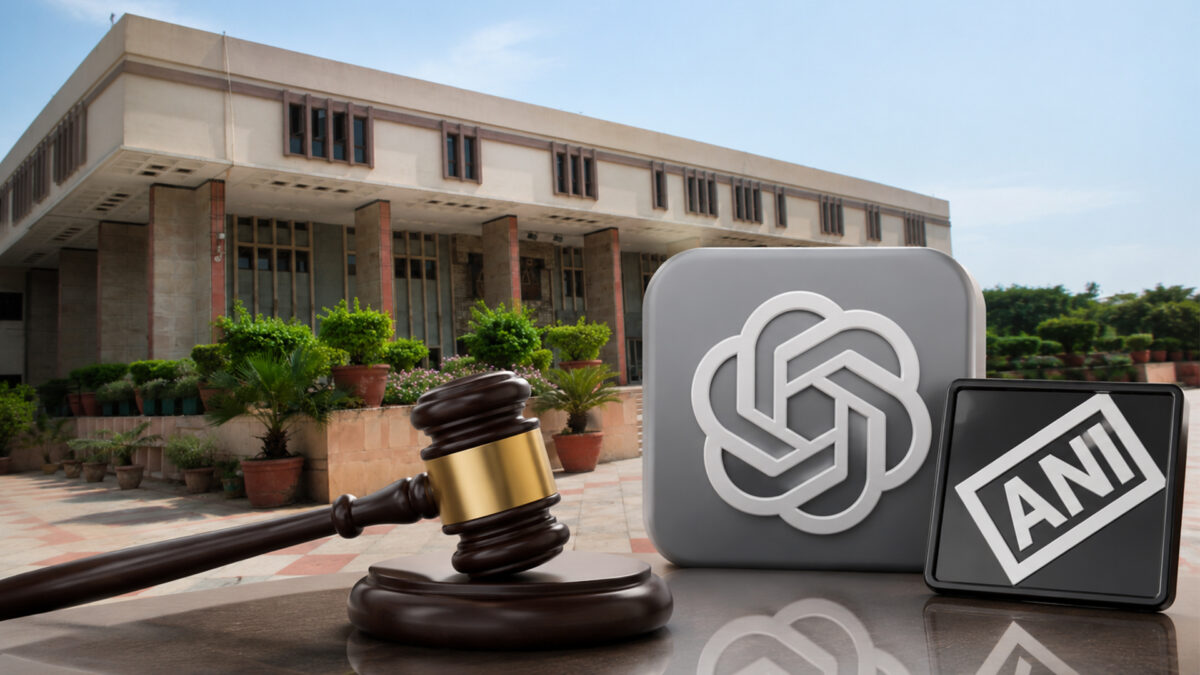
In a significant ruling that could shape the future of artificial intelligence in India, the Delhi High Court has dismissed a copyright infringement suit filed by news agency Asian News International (ANI) against OpenAI, the company behind ChatGPT. The judgment is being seen as a landmark decision that clarifies how India’s copyright law applies to AI training and could influence similar legal disputes in the years ahead.
The case centred on whether OpenAI had illegally used ANI’s news reports to train its artificial intelligence models without permission. ANI argued that the company had copied its copyrighted content for commercial purposes and sought legal protection against what it described as unauthorised use of its journalism.
However, the High Court ruled that OpenAI’s use of publicly available material to train its large language models does not amount to copyright infringement under the Indian Copyright Act. The court observed that training an AI system is fundamentally different from reproducing or republishing copyrighted work.
Justice Amit Bansal noted that AI models learn patterns, relationships and language structures from vast amounts of data rather than storing or reproducing original articles word for word. Since ANI failed to demonstrate that ChatGPT copied or reproduced substantial portions of its reports in user responses, the court found no violation of copyright.
The judgment also relied on the “fair dealing” provision under Section 52 of the Copyright Act, which allows copyrighted material to be used for research in certain circumstances. According to the court, AI model training falls within the scope of research and therefore qualifies for protection under this exception.
The lawsuit, filed in 2024, was one of India’s first major legal challenges involving generative AI and intellectual property. ANI had argued that its news reports, created through extensive journalistic effort, were valuable intellectual property that should not be used by AI developers without obtaining a licence or paying compensation.
The news agency also claimed that ChatGPT occasionally generated inaccurate information while attributing it to ANI, raising concerns about misinformation and reputational harm. While acknowledging these concerns, the court said there was no evidence that OpenAI had copied ANI’s original expression during the AI training process.
OpenAI defended its practices by explaining that ChatGPT is trained using a combination of licensed material, publicly available information and other legally accessible data. The company maintained that the system does not function as a searchable database of articles but instead learns statistical patterns that help it generate human-like responses. It also pointed out that publishers have tools available to prevent future web scraping if they do not want their content included in AI training datasets.
Legal experts believe the verdict provides much-needed clarity for India’s rapidly growing AI ecosystem. Until now, there had been uncertainty over whether developers could use publicly accessible content to train generative AI models without violating copyright law. The court’s decision suggests that using such material for AI training is legally distinct from reproducing protected content.
At the same time, the ruling does not give AI companies unrestricted freedom. The court made it clear that copyright protection still applies if an AI system reproduces substantial portions of an author’s original work or generates outputs that closely mirror copyrighted content. Each dispute, it said, would have to be assessed on its own facts.
The decision comes as courts around the world wrestle with similar questions. Several AI companies, including OpenAI, are facing lawsuits in the United States and other countries from authors, publishers and media organisations over the use of copyrighted material for AI training. As governments work to frame regulations for generative AI, the balance between encouraging innovation and protecting creators’ rights remains one of the technology sector’s biggest challenges.
For India’s technology industry, the ruling is expected to provide confidence to AI startups, researchers and developers working on next-generation language models. At the same time, it is likely to encourage publishers and content creators to explore licensing agreements and new business models as artificial intelligence becomes increasingly integrated into digital services.
The judgment is widely regarded as a milestone in India’s evolving AI policy landscape. By recognising AI training as a research activity while reinforcing that copyright protects original expression rather than ideas or language patterns, the Delhi High Court has set an important legal precedent.
As artificial intelligence continues to transform industries, from education and healthcare to media and finance, the ruling underscores the need to strike a careful balance between fostering innovation and safeguarding creative work. For now, the court’s verdict gives AI developers greater legal clarity while reminding content creators that the conversation around copyright in the age of AI is far from over.