
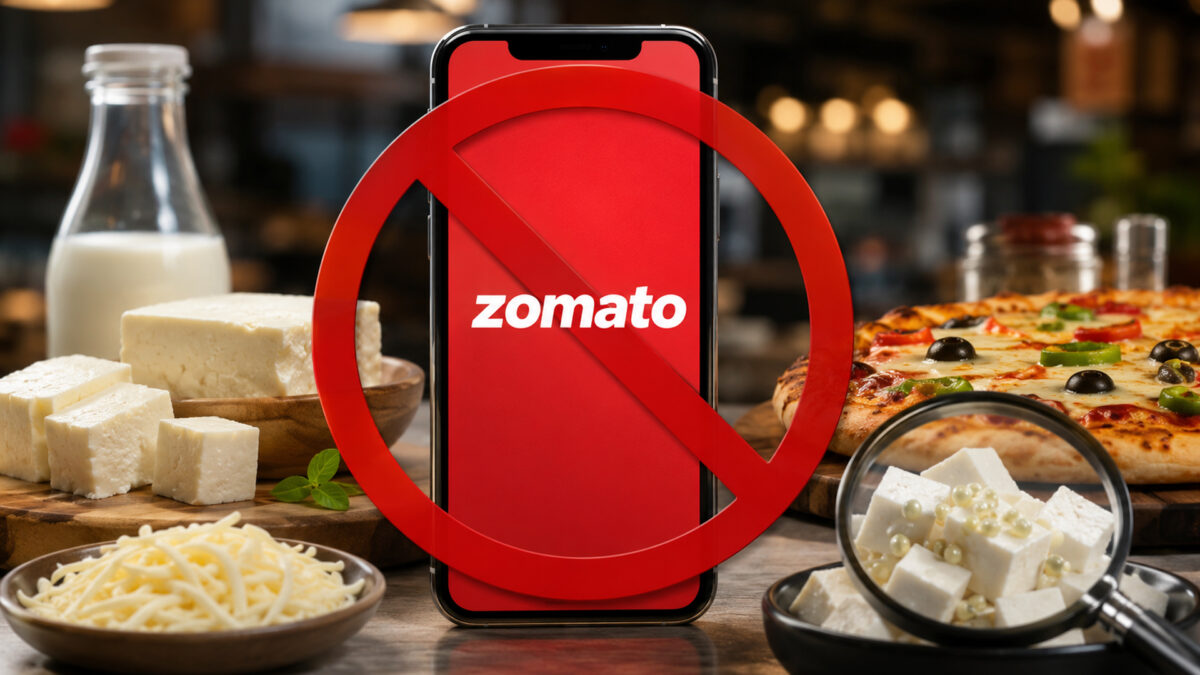
Zomato has introduced a zero-tolerance policy against dishes made with analogue dairy products, immediately removing such items from its food-delivery platform and directing restaurant partners to take corrective action.
The move covers food prepared using analogue cheese, analogue paneer and other dairy substitutes that are designed to resemble traditional dairy products. Zomato said dishes that restaurant partners have declared as containing analogue dairy have already been delisted from the platform. Restaurants have also been asked to review their menus and ingredient declarations to ensure that customers are accurately informed about what they are ordering.
Under the new policy, restaurants using analogue dairy have been asked to replace these ingredients with natural dairy products. Where an immediate switch is not possible, the affected dishes must be removed from their online menus. Zomato has warned that restaurant partners that fail to comply with the policy could be removed from the platform.
The decision comes at a time when food safety and transparency around ingredients have come under greater scrutiny across the food-service industry. Several states have recently taken action against non-dairy products being sold or described as traditional dairy items, particularly analogue paneer and similar substitutes.
Analogue dairy products are designed to replicate the taste, appearance and texture of products such as cheese or paneer but can use ingredients other than traditional milk-based dairy. Depending on the product, manufacturers may use vegetable fats, starches, proteins and other ingredients to achieve a similar texture and appearance.
Such products can offer a lower-cost alternative to conventional dairy ingredients for restaurants. But the growing concern is whether customers are clearly told when a dish contains an analogue product rather than genuine dairy.
That distinction is particularly important for dishes sold under names that consumers commonly associate with dairy ingredients. A customer ordering a paneer dish, for instance, may reasonably expect the food to contain dairy paneer unless the menu clearly states otherwise.
Zomato’s new policy puts the responsibility on restaurants to check their ingredients and ensure that menu descriptions accurately reflect what is being served. The platform has asked restaurant partners to review supplier product labels and ingredient declarations as part of the compliance process.
The company said the action is part of its broader focus on food quality, healthier choices and greater transparency for customers, while also aligning with applicable food-safety requirements. The policy is intended to strengthen consumer confidence in the information available on the platform.
The move is significant because Zomato acts as an important link between restaurants and millions of consumers. While the food delivery platform does not prepare the food itself, its menus are often the first place customers see information about a restaurant’s dishes and ingredients. Ensuring that those descriptions are accurate can therefore play an important role in consumer choice.
The policy also puts greater pressure on restaurant operators to understand exactly what goes into the products they purchase from suppliers. Restaurants may need to check invoices, packaging labels and ingredient declarations before continuing to list dishes that use cheese, paneer or other dairy-based ingredients.
The issue has gained wider attention in recent days following regulatory action by state authorities. Punjab, for example, has imposed a one-year ban on the manufacture, storage, transportation, distribution and sale of analogue or non-dairy paneer when it is sold under the name paneer. Haryana has also announced restrictions on non-dairy paneer and margarine being sold as butter.
Maharashtra has similarly stepped up scrutiny of food businesses, with action against eateries over food-safety concerns. This broader regulatory focus has increased pressure on restaurants and food businesses to ensure that ingredients are correctly labelled and represented.
Zomato’s decision could make food ordering more transparent, particularly for people who specifically want traditional dairy products. Customers may increasingly see clearer ingredient information on restaurant menus as businesses adjust to the new requirements.
However, the change could also create challenges for restaurants that have been using analogue dairy products as a cost-saving measure. Switching to natural dairy could increase ingredient costs and force restaurants to reconsider menu prices, portion sizes or margins.
The immediate impact will vary across restaurants depending on their suppliers and the extent to which analogue dairy is used in their kitchens. Some businesses may be able to switch quickly, while others could temporarily remove certain dishes until they find suitable alternatives.
Zomato’s action also signals a wider shift in the online food-delivery sector towards greater accountability for restaurant listings. As consumers increasingly rely on digital platforms to decide what and where to eat, accurate descriptions and ingredient information are becoming an important part of the customer experience.
Enforcing the policy will now be the key challenge for Zomato. The company will need to rely on information provided by restaurant partners while ensuring that businesses comply with the new rules. Restaurants that knowingly continue listing non-compliant dishes risk losing access to the platform.
The ban does not mean that all processed or alternative food products are prohibited. The central issue is the use of analogue dairy in dishes listed on Zomato and whether those ingredients are appropriately represented. Restaurants have been told to use natural dairy products or remove affected dishes where they cannot make the switch immediately.