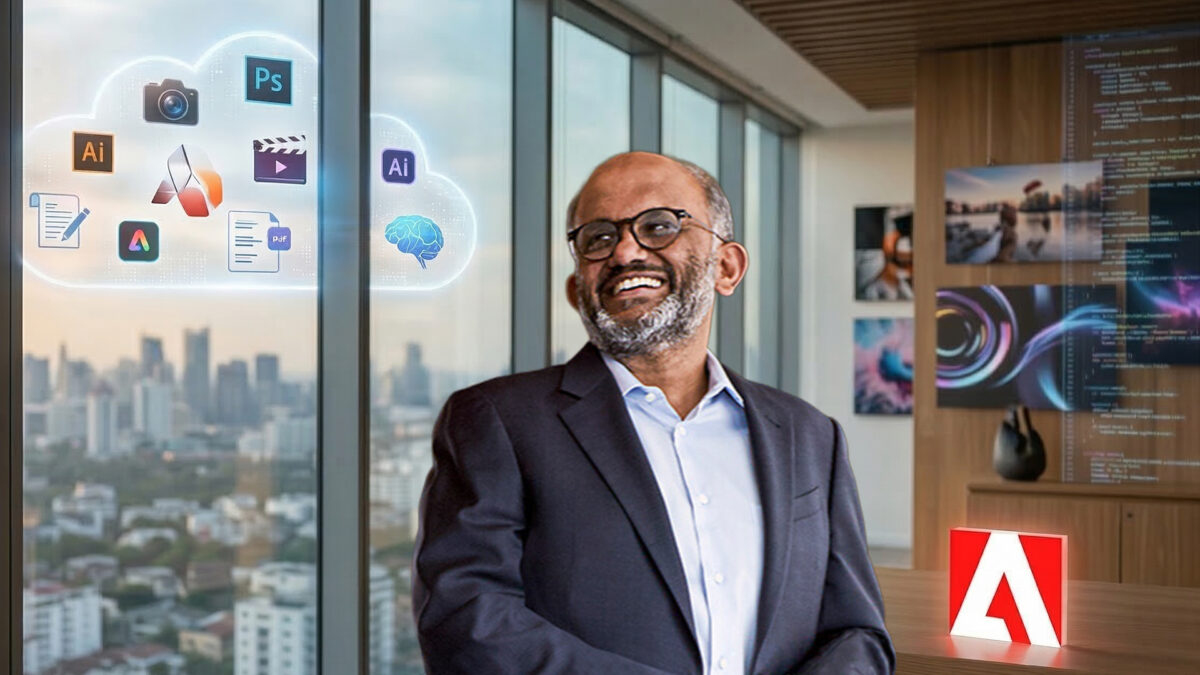
Adobe has named Indian-origin executive Anil Chakravarthy as its next president and chief executive officer, handing him the responsibility of leading the software giant through a period of rapid change driven by artificial intelligence.
Chakravarthy will take over as CEO on December 1, 2026, succeeding Shantanu Narayen, who has led Adobe for more than 18 years. Narayen will move into the role of executive chair and will continue working with the company during the leadership transition.
The appointment comes at an important moment for Adobe. The company behind widely used products such as Photoshop, Acrobat and Illustrator is facing a technology landscape that is changing quickly as generative AI becomes increasingly capable of creating and editing images, videos, documents and other digital content.
Chakravarthy, who currently serves as president of Adobe’s Customer Experience Orchestration business and oversees worldwide field operations, will also join Adobe’s board when he assumes the CEO role.
His appointment represents an internal transition for Adobe. Chakravarthy joined the company in 2020 after serving as chief executive of enterprise software company Informatica. At Adobe, he has held senior positions across its digital experience business and global operations.
His career also includes senior leadership roles at Symantec and VeriSign, along with experience at consulting firm McKinsey & Company. He holds an engineering degree from IIT-BHU, formerly known as IIT Varanasi, and later earned a PhD from the Massachusetts Institute of Technology.
That combination of technology and business experience is expected to be particularly relevant as Adobe works to adapt its products and business model to the rise of AI.
Artificial intelligence has become central to Adobe’s strategy. The company has introduced AI capabilities across its creative and digital experience products, allowing users to generate, edit and manipulate content using natural-language instructions and other AI-powered tools.
The shift has also created new competitive pressures. A growing number of startups and established technology companies are developing AI-powered creative tools that can perform tasks that once required specialised software and considerable technical skill.
Companies such as Canva and Figma have also expanded their presence in areas traditionally dominated by Adobe. Generative AI is lowering the barriers to content creation, forcing established software companies to show that their products remain valuable even as new tools become easier to use.
Adobe has been trying to respond by integrating AI directly into its existing products rather than treating the technology as a separate offering. Its Firefly family of generative AI tools has become a key part of that strategy.
His challenge will be to build on those efforts while keeping Adobe’s large base of professional and enterprise customers engaged.
The leadership change follows a period of uncertainty around Adobe’s position in the market. The company’s shares have faced pressure as investors assess the potential impact of AI on its traditional creative software business. Adobe’s stock has fallen significantly in 2026, adding to concerns about whether the company can maintain its strong position as AI-powered alternatives become more capable.
At the same time, Adobe has continued to report demand for its AI-powered products and has raised its annual profit outlook earlier this year. The company therefore enters the leadership transition with both opportunities and challenges.
Narayen’s move to executive chair means his experience will remain available to Adobe even after he leaves the CEO position. He has overseen one of the most significant transformations in the company’s history, particularly its shift from selling traditional packaged software to a subscription-based cloud model.
That transformation helped turn Adobe into a major recurring-revenue software business. Under Narayen, products such as Photoshop and Acrobat became part of the company’s broader Creative Cloud and Document Cloud ecosystems, while Adobe expanded significantly into digital marketing and customer experience services.
The next transformation is likely to be shaped by AI.
For Chakravarthy, this means balancing innovation with the needs of Adobe’s existing customers. Professional designers, photographers, marketers and businesses depend heavily on Adobe’s software, and the company will need to make AI tools useful without disrupting the workflows that have made its products industry standards.
The new CEO will also inherit a company operating in a market where the definition of creative software is changing. AI tools can now generate images, videos and designs in seconds, raising questions about how traditional creative applications will evolve.
Chakravarthy’s experience in enterprise technology and customer experience could become an important part of that transition. His current role involves helping businesses use Adobe’s technology to manage customer interactions in an increasingly AI-driven digital environment.
The CEO succession also has significance in India, where Chakravarthy’s appointment adds to the growing list of Indian-origin executives leading major global technology companies.
For Adobe, however, the immediate focus will be less on symbolism and more on execution. The company is entering a new phase in which its ability to turn artificial intelligence into sustainable growth could determine its position in the next generation of creative and enterprise software.
As Chakravarthy prepares to take charge, Narayen will remain involved from the boardroom. That gives Adobe continuity while putting a new leader at the centre of its next big challenge.
The question now is whether Chakravarthy can help Adobe make the same kind of successful transition with AI that Narayen achieved with cloud computing nearly two decades ago.