
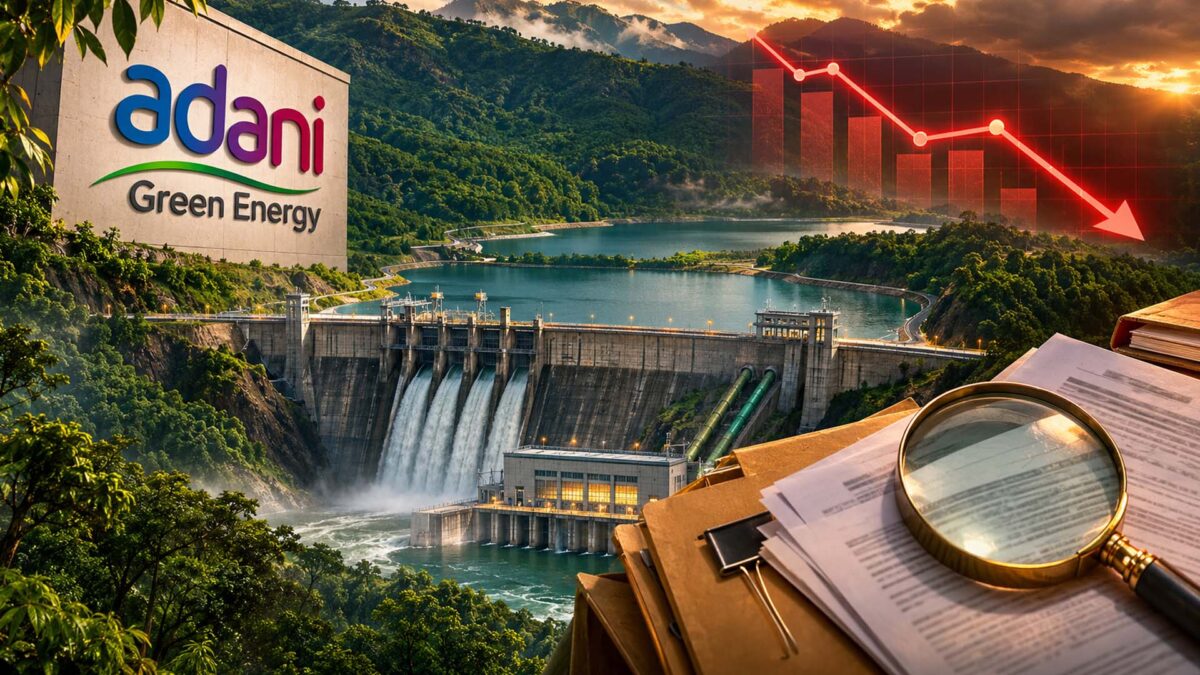
The controversy surrounding Adani Green Energy’s proposed pumped storage project in Maharashtra has intensified after the company rejected allegations that it reduced the project’s declared cost to lower its wildlife conservation obligations. The development has triggered political criticism, demands for an independent investigation and scrutiny from the Maharashtra Forest Department.
At the centre of the dispute is the 1,500-megawatt Tarali Pumped Storage Project in Patan taluka of Satara district. The controversy emerged after documents showed a sharp difference between the project’s original estimated cost of Rs 5,675 crore and a revised figure of Rs 56.75 crore submitted by Adani Green Energy to the state forest department.
The 99 per cent difference raised questions because the project’s wildlife conservation contribution was linked to its estimated cost. Under conditions imposed by the State Board for Wildlife (SBWL), the company was required to deposit 4 per cent of the project cost with the Sahyadri Tiger Reserve for wildlife conservation and protection.
Based on the original estimate of Rs 5,675 crore, the Maharashtra forest department had asked Adani Green Energy to contribute Rs 227 crore towards the conservation fund in March 2026. However, following the submission of a revised affidavit by the company, the department’s October 12 communication referred to the lower estimate of Rs 56.75 crore.
The revised calculation brought the proposed conservation contribution down to approximately Rs 2.27 crore. The company deposited Rs 56.75 lakh, representing 1 per cent of the revised figure, while the remaining amount was linked to approval from the National Board for Wildlife (NBWL).
The original project cost was recorded in a Union Environment Ministry communication dated February 11, 2025, recommending prior environmental clearance. Adani Green Energy submitted a notarised affidavit on September 8, 2026, requesting that the revised amount be considered for the proposal.
The issue gained attention after Rohan Bhate, Satara district’s Honorary Wildlife Warden, complained about the substantial reduction. On October 30, he approached the Prime Minister’s grievance redressal portal and Maharashtra Chief Minister Devendra Fadnavis through the Aaple Sarkar portal, questioning the revised valuation and its implications for wildlife conservation.
Following the complaint, the Union Ministry of Environment, Forest and Climate Change directed the Maharashtra forest department on November 6 to investigate the matter on priority. The Deputy Director of Koyna Wildlife Sanctuary had also been instructed to examine the complaint and take appropriate action.
However, the latest clarification from the state forest department has added another dimension to the controversy. Principal Chief Conservator of Forests (Wildlife) M Srinivas Reddy told the Hindustan Times that the department had not accepted the revised project estimate. It has sought an explanation and supporting documents from Adani Green Energy and is awaiting the company’s response.
The company has strongly rejected allegations that it deliberately reduced the project cost to escape statutory obligations. In a statement, Adani Green Energy said the Rs 56.75 crore figure represented only the expenditure on preliminary site investigations and surveys submitted through the online forest and wildlife clearance portal.
According to the company, the State Board for Wildlife had considered the overall project investment at Rs 5,675 crore. It explained that site investigation and survey expenses generally account for around 1 per cent of the total project cost. Therefore, the Rs 56.75 crore figure was intended to represent those preliminary expenses and not the overall investment required for the project.
Adani Green Energy also maintained that the allegations about reducing conservation-related payments were misleading. It said the Tarali pumped storage project was located entirely on privately owned, non-forest land, approximately 3.2 kilometres from the Koyna Wildlife Sanctuary.
The company further claimed that the project was outside the notified buffer zone of the Sahyadri Tiger Reserve and would not affect any tiger corridor, protected forest or notified eco-sensitive zone. It also argued that the project would not cause the diversion of protected areas or reserve forest land.
The political response has been equally strong. Congress general secretary Jairam Ramesh described the cost revision controversy as a scandal of gigantic proportions and questioned the circumstances surrounding the revised valuation. He reiterated the party’s demand for a Joint Parliamentary Committee investigation into the Adani Group.
Congress leaders have also sought an explanation from the Maharashtra government over the handling of the revised project estimate and the proposed reduction in wildlife conservation payments. Shiv Sena (UBT) leader Aditya Thackeray has separately raised concerns about the environmental implications of pumped storage projects in the Sahyadri region.
Bhate has also questioned the impartiality of an investigation conducted by the same forest department whose officials were involved in communicating the revised estimate. He has requested the Environment Ministry to appoint an independent senior authority to examine the matter.
The Tarali project involves developing a pumped storage facility using water reservoirs for electricity generation and storage. Such projects are considered important for renewable energy integration because they can store surplus electricity and supply power when demand increases.
The project is spread across 150.74 hectares in four villages in Satara district. Its proximity to the Koyna Wildlife Sanctuary and the Sahyadri Tiger Reserve has made environmental safeguards and conservation conditions central to the approval process.
With the forest department seeking further clarification from the company and the Centre having ordered an investigation, the dispute remains unresolved. The inquiry will need to establish the purpose of the revised cost declaration, the applicable conservation contribution and whether the approval process followed the prescribed rules.
The outcome could also have wider implications for environmental clearances, wildlife conservation funding and the assessment of large infrastructure projects located near ecologically sensitive areas.