
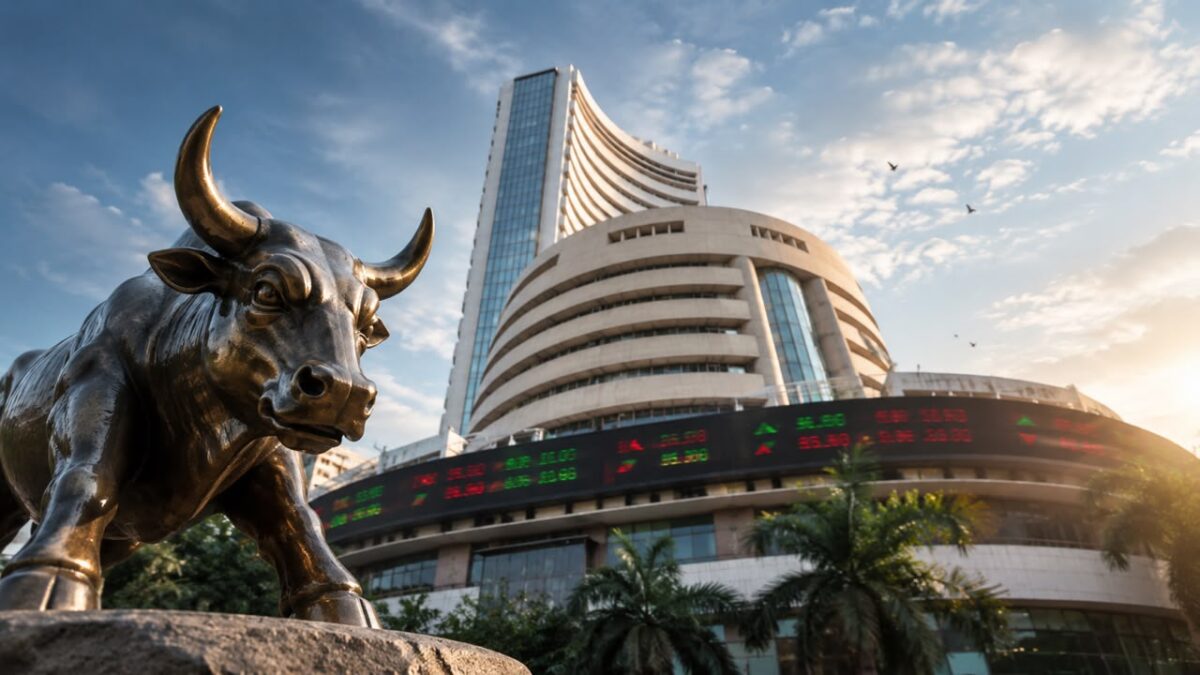
Indian stock markets remained under pressure on Thursday, with the Sensex recovering from its early lows while the Nifty 50 continued to trade below the 22,800 mark. Rising crude oil prices, weak global market cues and sustained foreign investor selling weighed on sentiment, while losses across several sectors kept investors cautious.
The BSE Sensex was down 218.41 points, or 0.30%, at 73,491.28. The NSE Nifty 50 declined 77.45 points, or 0.34%, to 22,733.90. Both benchmark indices had recovered part of their early losses, reflecting some buying interest in banking and realty shares.
The recovery, however, remained limited as selling continued in several heavyweight stocks and sectoral indices. The Nifty MidCap index fell 1.04%, while the Nifty SmallCap index lost 0.91%, indicating that the pressure extended beyond large-cap shares.
Crude oil prices, global cues weigh on sentiment
One of the biggest concerns for investors was the sharp rise in crude oil prices, which moved above $110 a barrel amid escalating hostilities in the Middle East. Higher oil prices are a concern for India because the country depends heavily on imports to meet its energy requirements.
An extended rise in crude prices could increase India’s import bill, put pressure on the rupee and complicate the inflation outlook. It could also raise input and transportation costs for companies, potentially affecting profit margins across oil-consuming industries.
Weakness in global markets added to the cautious mood. Asian equities declined during the session, with Hong Kong’s Hang Seng falling 2.9%, Japan’s Topix losing 0.8% and China’s Shanghai Composite slipping 0.9%. Futures tracking major European and US indices also pointed to a weak start.
Persistent foreign institutional investor (FII) selling remained another concern. Continued overseas outflows can weigh on domestic equities, particularly when global risk appetite deteriorates and investors move towards safer assets.
The India VIX, a measure of expected near-term market volatility, rose sharply in early trade. Business Standard reported a 6.3% increase to 16.67 around 10.30 am, signalling heightened uncertainty among market participants.
Chemical, FMCG and auto stocks under pressure
Sectoral performance remained largely negative, with chemical, automobile and metal stocks among the weaker pockets of the market. FMCG, pharmaceutical, cement, healthcare, realty and consumer durable shares also faced selling pressure.
The Nifty FMCG index was under pressure, with Nestle India, Godfrey Phillips India and Tata Consumer Products among the stocks weighing on the sector. Nestle India fell more than 2.5% in morning trade, according to The Economic Times.
Power Grid Corporation, Mahindra & Mahindra, Nestle India, Coal India and Tata Steel featured among the leading Nifty 50 laggards in Moneycontrol’s morning market updates. Power Grid fell 2.88%, Nestle India declined 2.68%, Coal India lost 2.33%, M&M dropped 2.28% and Tata Steel slipped 2.14% at the quoted prices.
The weakness in automobile and metal stocks reflected the broader risk-averse mood, while pressure on consumer-facing companies added to concerns about demand and operating costs.
Banking stocks support the recovery
Banking shares provided some support as the benchmark indices moved away from their intraday lows. Realty stocks also helped the Sensex and Nifty pare part of their initial losses.
Information technology shares showed relative resilience compared with several other sectors, although gains remained selective. Investors continued to assess individual company performance alongside broader concerns about oil prices, foreign fund flows and international markets.
Among Nifty 50 stocks, Eternal gained 1.04% and ICICI Bank edged up 0.03% in Moneycontrol’s reported snapshot, making them the index’s notable gainers. In the broader market, International Gemological Institute, Omnitech Engineering, Silky Overseas, Capillary Technologies and Namo eWaste Management were among the stocks reported as gainers by The Economic Times.
Losses were more pronounced in parts of the mid-cap segment. KEI Industries, Mahindra & Mahindra Financial Services and Swiggy featured among the notable laggards. KEI Industries fell sharply following its September-quarter results, while M&M Financial Services also came under pressure despite reporting improved quarterly earnings.
Jio Platforms IPO attracts investor interest
The Jio Platforms initial public offering (IPO) remained another key market development. By around 11.10 am, the issue had been subscribed approximately 3.48 times on its second day, according to The Economic Times.
The qualified institutional buyers’ (QIB) portion was subscribed 9.47 times, while the non-institutional investor category received bids for 2.37 times its allotted shares. The retail investor portion was subscribed 1.01 times, indicating that retail demand had reached full subscription.
The response to the IPO offered a contrasting development on a day when secondary-market sentiment remained weak. However, subscription figures alone do not indicate how listed shares will perform after the issue.
Market outlook remains cautious
Investors are likely to keep a close watch on crude oil prices, developments in the Middle East, foreign institutional investor activity and movements in global equity markets. Company earnings and management commentary will also remain important in determining stock-specific movements.
The Sensex’s recovery from its early low suggests that buying interest has emerged at lower levels, but the broader market weakness indicates that confidence remains fragile. With the Nifty still below 22,800 and volatility elevated, market direction will depend on whether buying support strengthens or renewed selling pushes benchmark indices lower.
For investors, the session underlines the importance of tracking sectoral trends and company fundamentals rather than relying solely on movements in the headline indices. Any sustained improvement in sentiment will likely require a combination of easing oil-price concerns, stronger global cues and stabilising foreign fund flows.