
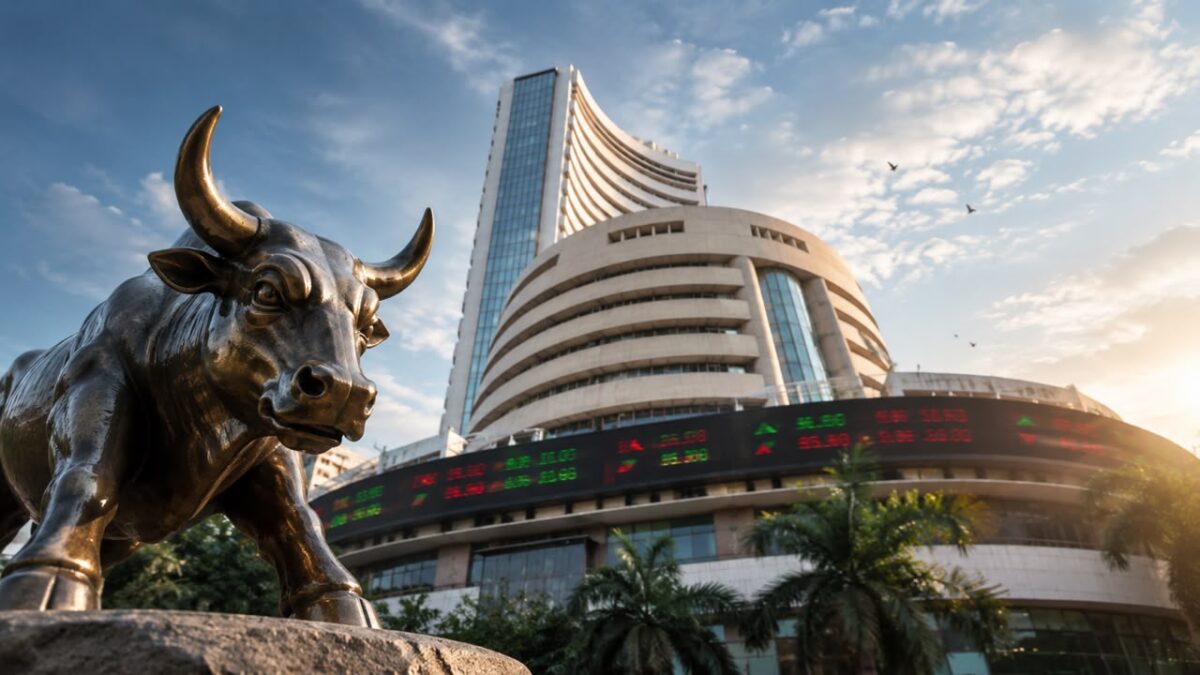
Tuesday’s strong rally failed to translate into a decisive recovery on Dalal Street on Wednesday. The Sensex rose 95 points, or 0.13%, to 73,128.50, while the Nifty 50 gained 16.10 points, or 0.07%, to 22,738.05. Both indices moved within a narrow range as investors assessed corporate earnings, global developments and the outlook for domestic equities.
The subdued performance followed Tuesday’s sharp rally, when the Sensex jumped 1,109.10 points, or 1.54%, to close at 73,033.78. The Nifty advanced 358.60 points, or 1.60%, to settle at 22,721.95, marking one of the strongest single-session performances in recent months. Rising crude oil prices, persistent foreign investor selling and weakness in heavyweight banking stocks kept the Sensex and Nifty 50 under pressure, even as IT shares continued to attract buying interest.
Wednesday’s trading highlighted the challenges facing the market. Although technology shares continued to attract buyers, weakness in banking and other heavyweight stocks prevented the recovery from spreading across sectors.
Tata Consultancy Services (TCS), Infosys, HCL Technologies and Tech Mahindra were among the IT stocks supporting the benchmark indices. The Nifty IT index gained around 1.2% in morning trade, extending its advance after rising 5.22% on Tuesday. Strong quarterly results from HCL Technologies helped revive interest in the sector, while TCS also benefited from buying following its earnings announcement.
Among individual stocks, Tata Elxsi rose 7.8% after reporting higher quarterly profit, supported by growth in its transportation and media businesses. Bharat Coking Coal gained 6.6% after increasing the basic prices of certain grades of coking coal supplied to the non-regulated sector.
On the losing side, Zydus Lifesciences declined 1.5% after a US drug regulator reported five observations following an inspection of the pharmaceutical company’s manufacturing facility in Ahmedabad. The development put the stock under pressure during an otherwise mixed session.
Banking stocks remained a key source of weakness. HDFC Bank, ICICI Bank, Larsen & Toubro, Bajaj Finance, Reliance Industries, Eternal and State Bank of India were among the major stocks weighing on the Sensex. Selling in these heavyweight shares offset support from technology companies and prevented the benchmarks from making significant gains.
The broader market also lacked a clear direction. Eight of the 16 major sectoral indices traded lower in morning trade, while mid-cap and small-cap indices remained largely unchanged. This indicated that buying interest was concentrated in selected stocks rather than spread evenly across the market.
Crude oil prices remained a major concern for investors, with prices climbing towards $107 a barrel as traders assessed supply risks linked to tensions in the Middle East. Uncertainty over potential supply disruptions and additional diesel supplies from Russia kept energy markets volatile.
Higher crude oil prices are particularly significant for India because the country relies heavily on imported oil to meet its energy needs. A sustained rise can increase the import bill, put pressure on the rupee and raise transportation and manufacturing costs. Businesses facing higher input expenses may struggle to protect profit margins, while consumers could eventually face higher prices.
Foreign portfolio investor (FPI) selling added to the pressure. Overseas investors remained net sellers of Indian equities for the 13th consecutive session on Tuesday, taking their year-to-date outflows to $32.52 billion. Persistent withdrawals can weaken market sentiment and make it harder for benchmark indices to sustain rallies.
Tuesday’s recovery had been supported by strong IT earnings and comments from Finance Minister Nirmala Sitharaman on the possibility of reviewing capital gains and securities transaction taxes. Her remarks raised hopes that the government would consider industry concerns over taxation and trading costs. However, no immediate tax change was announced, leaving investors awaiting further clarity.
Market participants are now watching the September-quarter earnings season, crude oil movements, foreign fund flows and developments in global markets. The Nifty’s inability to move decisively above 23,000 also remains a concern for traders assessing the strength of the recovery.
The immediate outlook for Indian equities therefore remains cautious. Strong corporate earnings could support further gains, particularly if the IT rally continues, but sustained buying across banking, financial services and other sectors will be needed for a broader recovery. Until crude oil prices ease and foreign investor selling moderates, the Sensex and Nifty are likely to remain sensitive to global developments and company-specific news.