
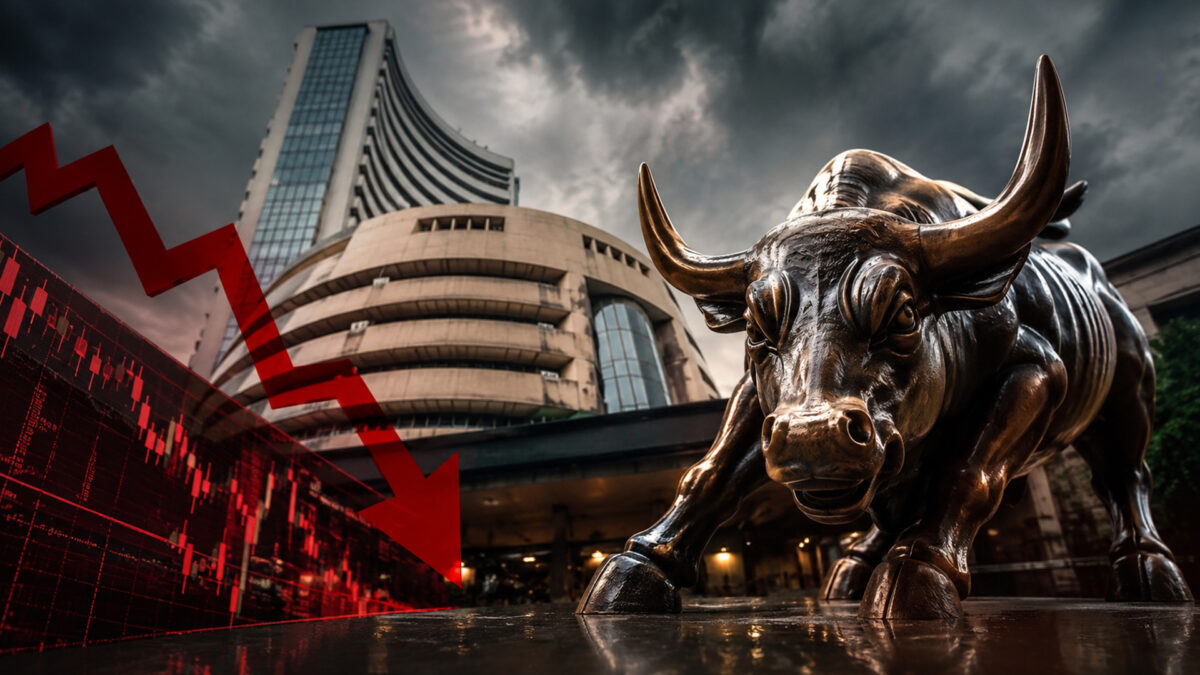
Indian stock markets traded sharply lower on Wednesday, October 28, as rising crude oil prices, heavy selling in information technology stocks and uncertainty over the US Federal Reserve’s policy decision dampened investor sentiment. The BSE Sensex fell more than 500 points, while the NSE Nifty 50 slipped below 22,650, reflecting concerns about inflation, global economic conditions and the impact of expensive energy imports on the Indian economy.
The 30-share Sensex dropped 601.14 points to 72,997.55 in early trade, while the Nifty 50 declined 146 points to 22,604.80. Selling pressure was concentrated in heavyweight technology stocks, although gains in select engineering, automobile and banking shares provided some support. Both benchmark indices had ended the previous session almost unchanged after a volatile trading day.
Among the top gainers, Larsen & Toubro (L&T) emerged as a standout performer, rising more than 4% after reporting strong September-quarter earnings. The engineering and construction major recorded a 32.5% year-on-year increase in consolidated net profit to Rs 5,202.10 crore, supported by higher revenue. Bajaj Auto also advanced around 3% following its quarterly results, while State Bank of India (SBI) and Axis Bank featured among the notable gainers in the Sensex pack.
Raymond shares climbed around 3.5% after the company reported a significant year-on-year improvement in its second-quarter profit. Automotive components manufacturer Subros also attracted buying interest after securing a contract worth Rs 1,225 crore from Maruti Suzuki. These company-specific developments helped selected stocks outperform the broader market despite the negative trend in benchmark indices.
On the losing side, information technology shares led the decline. Infosys fell around 4.4%, while Tata Consultancy Services (TCS) and HCLTech lost approximately 3% each. Tech Mahindra also traded lower, adding to the pressure on the technology sector. ITC and Asian Paints were among the other prominent Sensex laggards during early trading.
The Nifty IT index declined around 3.1%, making it one of the weakest-performing sectoral indices. Investors remained cautious about the outlook for technology companies that depend heavily on overseas markets, particularly the United States. Concerns over global client spending, business growth and valuations contributed to selling in the sector. Market participants also awaited the Federal Reserve’s policy announcement for signals on interest rates and the direction of global capital flows.
Crude oil prices added another layer of uncertainty. Brent crude rose around 1.4% to $115.40 per barrel following reports of an attack on a refinery in Saudi Arabia. The development renewed concerns about possible disruptions to global energy supplies amid continuing geopolitical tensions in the Middle East.
Higher oil prices are particularly significant for India, which relies heavily on imports to meet its energy requirements. A sustained increase in crude prices can raise the country’s import bill, put pressure on the rupee and increase costs for businesses. Airlines, transport companies and manufacturers may face higher operating expenses, while rising fuel costs could contribute to broader inflation. These concerns can also complicate the Reserve Bank of India’s efforts to maintain price stability.
Despite the weakness across several large-cap stocks, Jio Platforms attracted attention with a strong stock market debut. The shares listed at Rs 1,359 apiece, a premium of 21.36% over the initial public offering price of Rs 1,119. The listing reflected strong investor interest in the company’s business prospects and marked a significant event for India’s primary market.
However, Jio Platforms’ gains were insufficient to counter the selling pressure in heavyweight IT stocks. Investors continued to assess the company’s valuation and longer-term growth prospects while monitoring broader market conditions.
The broader market showed relative resilience during early trade. Small-cap stocks gained around 0.7%, while mid-cap shares edged up approximately 0.1%, outperforming the benchmark indices. The divergence indicated that investors were selectively buying stocks with supportive earnings or company-specific developments even as caution prevailed across the wider market.
Foreign institutional investor activity remained another factor to watch. Provisional exchange data showed that foreign investors bought Indian equities worth Rs 4,240.39 crore on Tuesday. The purchases offered some support to sentiment, although investors remained uncertain about whether the inflows would continue amid elevated oil prices and global volatility.
Market participants will closely track crude oil movements, the Federal Reserve’s policy decision and developments in the Middle East for further direction. The performance of IT stocks and the ability of the Nifty to recover the 22,650 level will also remain important indicators of near-term sentiment.
With the Sensex under pressure and oil prices elevated, volatility is likely to remain a concern for investors. While gains in L&T, Bajaj Auto and select banking shares provided pockets of strength, a sustained market recovery will depend on easing geopolitical risks, stabilising energy prices and improved confidence in the global economic outlook.