
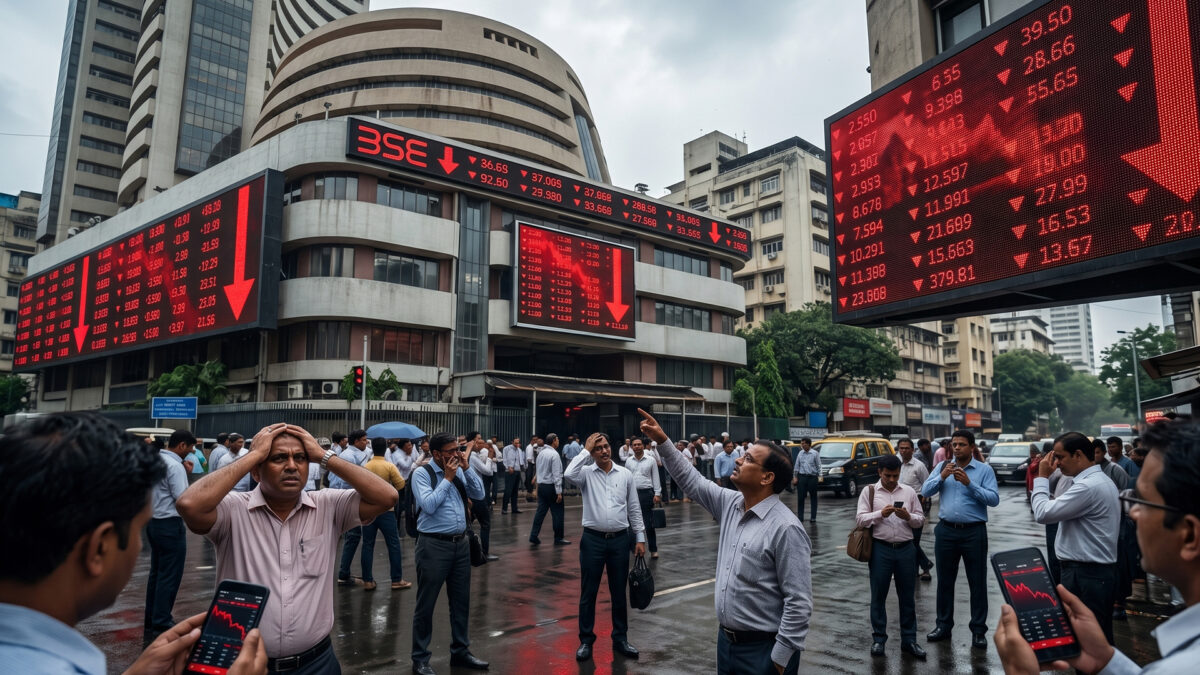
Indian equity markets came under renewed selling pressure when it opened on Wednesday, August 19, as rising crude oil prices, fresh geopolitical uncertainty and elevated global bond yields made investors more cautious. The Sensex fell more than 300 points, while the Nifty 50 slipped below the 24,100 mark as the market extended its recent losing streak.
The weakness followed another difficult session on Tuesday. The Nifty closed 132.75 points, or 0.55%, lower at 24,154.90, marking its sixth consecutive session of losses. The Sensex fell 492.70 points, or 0.63%, to end at 77,235.46. The continued decline has pushed investors to reassess near-term risks for the Indian stock market as global factors increasingly dictate trading sentiment.
The biggest concern for investors remains crude oil prices. Brent crude moved above $91 a barrel and was approaching $92, adding to worries for oil-importing economies such as India. Oil prices have risen sharply in recent weeks as uncertainty surrounding the Middle East has increased, with the US-Iran situation emerging as a major market trigger.
Concerns have also intensified around the Strait of Hormuz, one of the world’s most important energy transit routes. US President Donald Trump has denied that Washington is currently holding talks with Iran, while Tehran has made conflicting claims regarding the situation. The uncertainty has raised fears that geopolitical tensions could remain elevated and disrupt energy markets.
For India, expensive crude has wider economic implications. The country imports a significant share of its oil requirements, meaning a sustained increase in international crude prices can raise the import bill and put pressure on the rupee. Higher fuel and transportation costs can also feed into inflation and increase expenses for companies across sectors.
The impact is already visible in the currency market. The Indian rupee opened around Rs 95.71 against the US dollar, compared with Rs 95.68 in the previous session. A weaker rupee combined with higher crude prices can make India’s imports more expensive and add another challenge for policymakers and businesses.
Global bond yields are another factor weighing on equities. Long-term borrowing costs have climbed across major economies amid concerns over government debt, inflation and geopolitical risks. Higher yields can make bonds more attractive relative to emerging-market equities, potentially reducing the flow of global capital into markets such as India.
Foreign investor activity has therefore remained a key focus. Foreign investors have sold about $25 billion of Indian equities so far in 2026, according to market data cited in the latest trading setup. However, they turned buyers on Tuesday, purchasing Indian shares worth around Rs 1,651.5 crore. Domestic institutional investors provided stronger support, buying stocks worth roughly Rs 2,579.3 crore.
Despite the broader market decline, some stocks continued to attract buying interest. Prism Johnson was among the strongest gainers, climbing sharply after the company secured long-term coal supply contracts from Eastern Coalfields and South Eastern Coalfields. The development provided a stock-specific trigger at a time when the broader market remained weak.
Mahanagar Gas (MGL) and Indraprastha Gas (IGL) were also among the notable gainers. The city gas distribution companies benefited from government measures designed to encourage an increase in domestic connections for piped cooking gas.
On the other side, Tata Steel and Bajaj Finance featured among the major losers in morning trade. Weakness in financial and metal stocks added to the pressure on the benchmark indices. With financial companies accounting for a large portion of the Nifty’s weight, declines in banking and financial stocks can have a significant impact on overall index performance.
The sectoral picture was mixed. IT stocks showed some resilience after a sharp decline in the previous sessions, while auto and pharma counters also found selective buying. However, most major sectoral indices remained in negative territory.
The weakness extended to broader markets as well. The Nifty Midcap 100 and Nifty Smallcap 100 were trading lower, indicating that investor caution was not confined to large-cap stocks. The negative breadth reflected a wider risk-off mood, with traders preferring to reduce exposure rather than aggressively buy into declines.
Global markets also offered little encouragement. Asian equities opened lower on Wednesday, with South Korean markets among the hardest hit. Other major Asian markets also remained under pressure, reflecting concerns about higher oil prices, elevated borrowing costs and geopolitical risks. US equities had ended lower in the previous session, adding to the cautious tone in Indian markets.
The latest fall has also brought key Nifty technical levels into focus. The 24,000-24,100 zone is increasingly important after the index slipped below 24,100. A sustained break below nearby support could invite additional selling, while a recovery above 24,200-24,260 would be needed to improve the short-term market outlook.
Investors will now track crude oil prices, developments involving the US and Iran, movements in global bond yields and foreign institutional investor flows. The latest US Federal Reserve meeting minutes will also be watched closely for signals on the future direction of interest rates.
The immediate challenge is the combination of expensive oil and fragile global sentiment. While domestic institutional buying and selective stock-specific gains are providing some support, the Sensex and Nifty remain vulnerable as long as crude prices stay elevated and geopolitical uncertainty continues.
With the Nifty now below 24,100 and its losing streak extending into a seventh session, investors are likely to remain selective. Any easing in crude prices or improvement in global risk sentiment could provide relief, but until then, volatility is expected to remain a defining feature of trading on Dalal Street.