
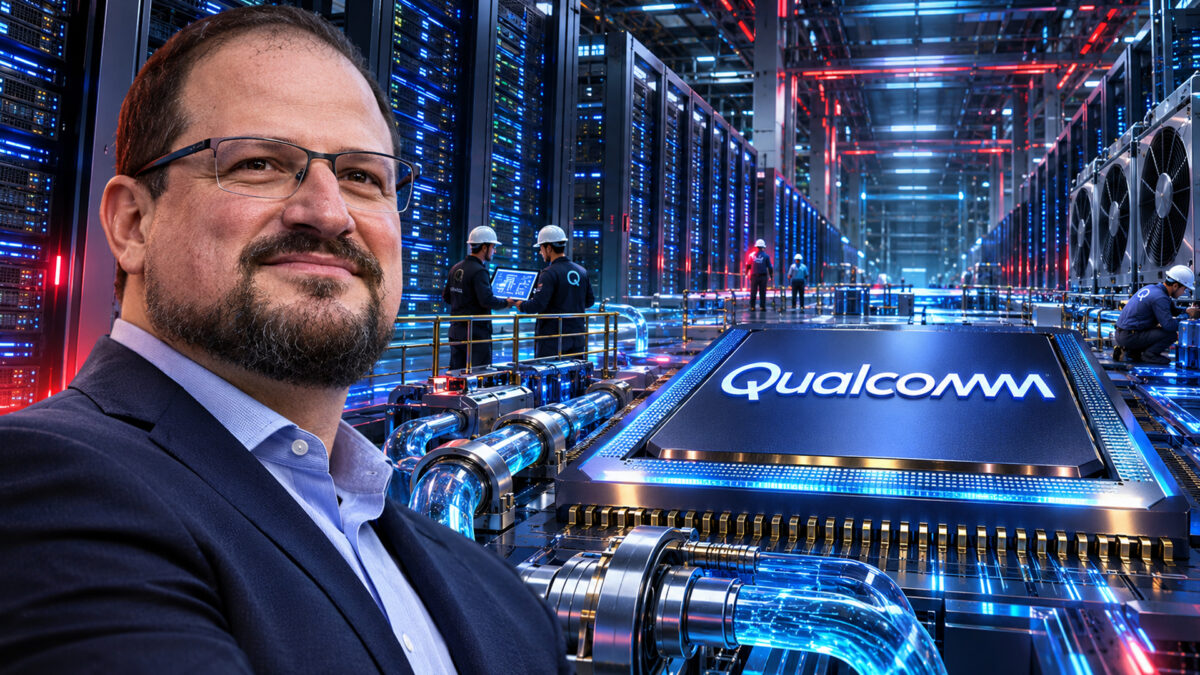
Qualcomm chief executive officer Cristiano Amon has expressed confidence in the company’s growing data centre business, saying strong demand for artificial intelligence (AI) chips could create significant growth opportunities in the coming years. The semiconductor company expects to generate $5 billion in data centre revenue in fiscal 2027, with its leadership indicating that customer demand could support even higher growth if additional supply becomes available.
In interviews with CNBC and Fox Business on November 5, Amon discussed Qualcomm’s expansion plans, the growing demand for AI computing infrastructure and the company’s strategy to diversify beyond its traditional smartphone chip business.
His comments come as global technology companies increase investments in data centres to support generative AI, cloud computing and other advanced applications. The growing use of AI tools is creating demand for specialised processors that can handle large volumes of computing tasks efficiently.
Amon said Qualcomm was seeing encouraging interest from customers as it expanded its presence in the data centre market. The company believes its expertise in designing energy-efficient processors and custom silicon could help it compete in an industry currently dominated by established semiconductor manufacturers.
The $5 billion revenue target is part of a broader strategy to make data centres an important contributor to Qualcomm’s future business.
Data centre business becomes a key growth driver
Qualcomm reiterated its target of generating $5 billion in data centre revenue in fiscal 2027, which began in September 2026. The company expects the business to expand progressively during the year and reach an annualised revenue run rate of approximately $7 billion by the end of the financial year.
According to the company’s management, the opportunity extends beyond the initial target. Qualcomm expects supply availability, rather than customer demand, to become the main limitation on additional growth beyond the $5 billion projection.
The company also has a longer-term ambition of reaching $15 billion in annual data centre revenue by fiscal 2029.
Amon’s confidence reflects the rapid expansion of AI infrastructure spending. Technology companies are investing in large computing facilities to train AI models and process the enormous number of requests generated by users and businesses.
Qualcomm is targeting a growing segment of this market by developing specialised chips for AI inference, the process through which trained AI models generate responses, analyse information and perform tasks.
As AI applications become more widely used, inference computing is expected to account for an increasingly important share of data centre workloads.
AI inference and energy efficiency offer an advantage
One of Qualcomm’s key strategies is to develop processors that deliver high computing performance without consuming excessive electricity. Power consumption has become a major concern for data centre operators as AI infrastructure expands and computing requirements increase.
Traditional data centres require substantial electricity to operate servers and cooling systems. As companies add more AI capabilities, controlling energy costs has become as important as improving processing speeds.
Qualcomm believes its experience in designing power-efficient chips for smartphones and connected devices can help it address this challenge in the data centre market.
The company is developing custom processors and connectivity solutions for large cloud computing providers. Its portfolio includes central processing units (CPUs), AI accelerators and high-speed connectivity technologies.
These products are designed to support the growing computing requirements of hyperscalers, which operate large-scale cloud and data centre networks.
Amazon partnership strengthens Qualcomm’s position
Qualcomm’s partnership with Amazon Web Services (AWS) is an important part of its expansion strategy. The two companies are working together on customised silicon and connectivity solutions for AI data centres.
The agreement represents a potential revenue opportunity of up to $60 billion over 10 years, according to Qualcomm’s disclosures.
Amazon is among the two major hyperscaler customers expected to contribute most of Qualcomm’s data centre revenue in fiscal 2027. The company has also indicated that it is working with another customer on AI accelerator products and is exploring additional custom silicon opportunities.
Qualcomm is looking to expand its customer base further, including through new opportunities involving CPUs and other data centre technologies.
The partnerships are significant because large cloud service providers increasingly prefer customised chips that can meet their specific computing requirements. Such processors can help companies improve performance, manage operating costs and reduce dependence on standardised hardware.
For Qualcomm, these relationships could provide a stronger foundation for long-term revenue growth.
Smartphone business faces challenges
While the data centre business offers fresh opportunities, Qualcomm continues to face pressure in its traditional smartphone chip division.
The company reported fourth-quarter fiscal 2026 revenue of $10.32 billion, down 8% from the corresponding period last year. Its non-GAAP revenue stood at $10.44 billion, while adjusted earnings were $2.17 per share.
Handset chip revenue declined 26% year-on-year to $5.14 billion, reflecting weakness in the smartphone market and rising memory costs.
Higher memory prices are increasing manufacturing expenses for smartphone companies and could make devices more expensive for consumers. This may affect handset demand and, consequently, orders for Qualcomm processors.
Apple’s gradual shift towards developing its own modem technology is another challenge for Qualcomm, which has historically supplied important connectivity components for the iPhone maker.
However, the company’s other businesses are showing stronger performance. Automotive revenue increased 89% year-on-year to nearly $2 billion in the September quarter, marking a record for the division. Internet of Things (IoT) revenue also increased 4% to $1.88 billion.
Qualcomm expects revenue from businesses outside smartphones to grow by more than 60% in fiscal 2027, highlighting its efforts to diversify its earnings.
Competition intensifies in the semiconductor market
Qualcomm’s data centre ambitions place it in competition with major chipmakers, including Nvidia, AMD, Intel and Broadcom.
Nvidia continues to hold a strong position in AI computing, particularly in processors used to train and operate large AI models. AMD is also expanding its AI accelerator portfolio, while other semiconductor companies are developing customised chips for major technology customers.
Qualcomm is attempting to differentiate itself through energy-efficient computing, custom silicon and AI inference solutions.
However, entering the market will require significant investment, reliable manufacturing capacity and the ability to meet the technical requirements of large cloud operators.
The company has forecast revenue of $10.4 billion to $11.2 billion for its December 2026 quarter. It expects its expanding non-handset businesses to contribute increasingly to overall performance.
What lies ahead for Qualcomm?
Qualcomm’s growing focus on AI infrastructure marks an important shift in its business strategy. The company is attempting to reduce its dependence on smartphone sales by expanding into data centres, automotive technology and connected devices.
Amon’s latest comments suggest that management sees substantial room for growth in AI computing, particularly as demand for inference and customised processors increases.
The immediate challenge will be converting customer interest into actual shipments while managing supply constraints and competition.