
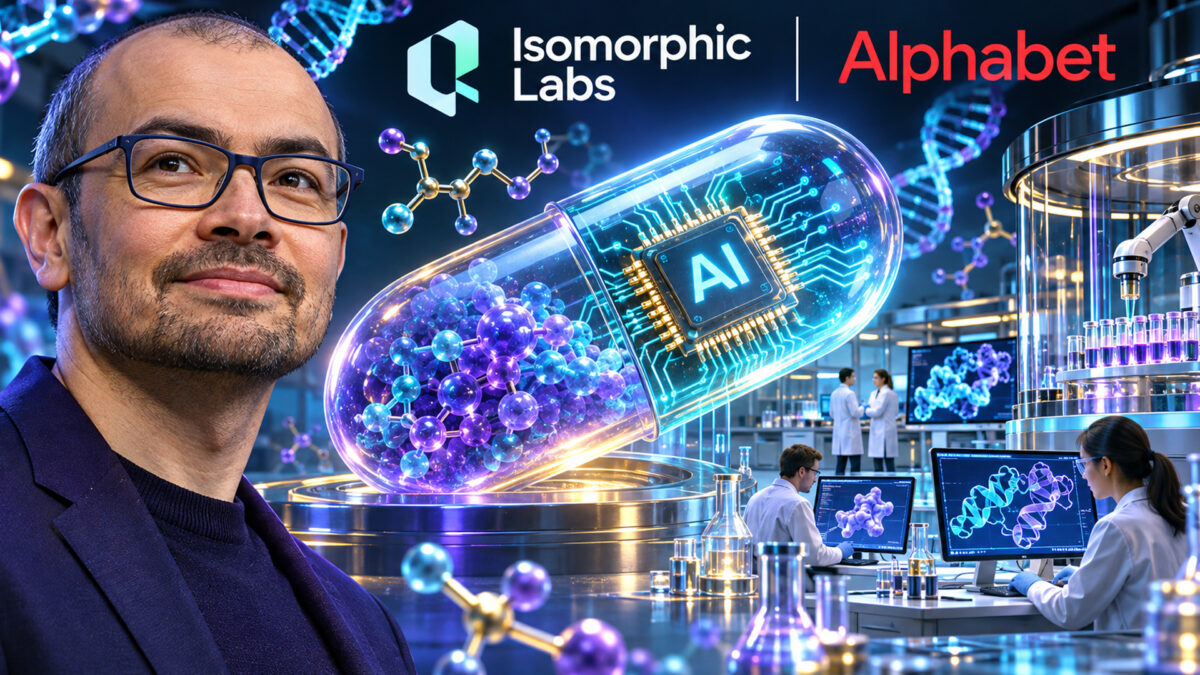
Artificial intelligence is moving beyond chatbots, automation and software development, with the pharmaceutical industry emerging as one of its most promising frontiers. In a major development for AI-powered healthcare, Isomorphic Labs, the drug-discovery company backed by Alphabet, has raised $5 billion in fresh funding as it prepares to take its AI-designed drug candidates closer to human clinical trials.
The London-based company announced on November 17 that it had secured the funding through a Series C investment round co-led by Greenoaks and Sequoia Capital. Andreessen Horowitz (a16z) and several other new investors also participated, while Alphabet and the company’s existing investors continued their financial backing.
The latest funding comes just six months after Isomorphic Labs raised $2.1 billion in a Series B round in May 2026. The successive multibillion-dollar investments underline the growing confidence among major investors in the potential of artificial intelligence to transform drug discovery and pharmaceutical research.
Isomorphic Labs plans to use the fresh capital to strengthen its proprietary AI-powered drug design technology, expand its pipeline of potential medicines and build the infrastructure required to move experimental drug candidates into clinical development.
The company’s ambitions extend beyond using AI to accelerate existing research methods. It is working towards developing a technology platform capable of designing medicines by understanding and modelling complex biological processes at the molecular level.
Founded in 2021 as a spin-off from Google’s DeepMind, Isomorphic Labs was established to apply advances in artificial intelligence to biological research and medicine development. It is led by Demis Hassabis, the co-founder of DeepMind and Nobel Prize-winning scientist whose work on AlphaFold helped transform the understanding of protein structures.
At the centre of the company’s research is its proprietary Isomorphic Drug Design Engine, known as IsoDDE. The platform combines multiple artificial intelligence and simulation models to examine complex biological systems, study molecular interactions and identify potential drug candidates.
Traditional drug discovery is a lengthy and expensive process. Researchers often spend years identifying promising molecules, testing their interactions with biological targets and refining their chemical properties before a potential treatment can enter clinical trials.
AI-powered drug discovery aims to make this process more efficient by allowing scientists to explore large chemical spaces, predict molecular behaviour and identify promising candidates through computational models. This can help researchers narrow down potential compounds before moving to laboratory experiments.
IsoDDE is designed to bring these capabilities together across different therapeutic areas and drug types. The company says its models are generating increasingly precise predictions and helping researchers develop molecules with improved drug-like properties.
The latest investment will allow Isomorphic Labs to further develop these foundational simulation models, expand into additional areas of biology and strengthen its understanding of disease mechanisms. The company also intends to establish a broader network of research partnerships and build global infrastructure for AI-led bioengineering.
An important part of the funding will go towards developing its translational research and clinical development capabilities. These will help bridge the gap between computer-designed molecules and medicines that can be tested in humans.
The company has reported positive preclinical results from its internal programmes in oncology and immunology. Its first oncology programme is approaching the preclinical study stage, while more than 20 programmes are reportedly underway across its research pipeline.
However, these developments do not mean that its AI-designed medicines are ready for patients. Preclinical research involves laboratory and other early-stage testing to assess the safety and potential effectiveness of a drug before human trials can begin. The candidates will still need to meet regulatory requirements and demonstrate their safety and efficacy through clinical testing.
Isomorphic Labs has also established partnerships with major pharmaceutical companies, including Eli Lilly, Novartis and Johnson & Johnson. These collaborations are aimed at applying its AI drug-design technology to challenging drug discovery programmes.
The company’s latest fundraising also reflects a broader shift in the pharmaceutical industry, where technology companies and traditional drugmakers are increasingly exploring artificial intelligence to improve research productivity.
Despite the enthusiasm surrounding AI-designed medicines, significant scientific and regulatory challenges remain. Predictions generated by AI models must be validated through laboratory experiments and clinical trials. A promising molecular design does not automatically translate into a safe or effective medicine.
No AI-designed drug has yet received regulatory approval, making the transition from computational research to successful human treatment a critical test for companies operating in this space.
Hassabis said the fresh investment would help accelerate the company’s efforts to build foundational biology models, deepen its understanding of diseases and move its first therapeutic programmes towards clinical trials. The broader objective is to create a platform capable of developing medicines at a much greater scale.
The company has not disclosed its valuation following the Series C funding round. Earlier reports had suggested that it was seeking a valuation of around $50 billion, but this figure has not been officially confirmed.
With $5 billion in additional capital, Isomorphic Labs is positioning itself among the most heavily funded players in AI-driven drug discovery. The coming years will be crucial in determining whether its technology can translate advances in artificial intelligence into effective medicines and make the drug development process faster, more precise and potentially more accessible.