
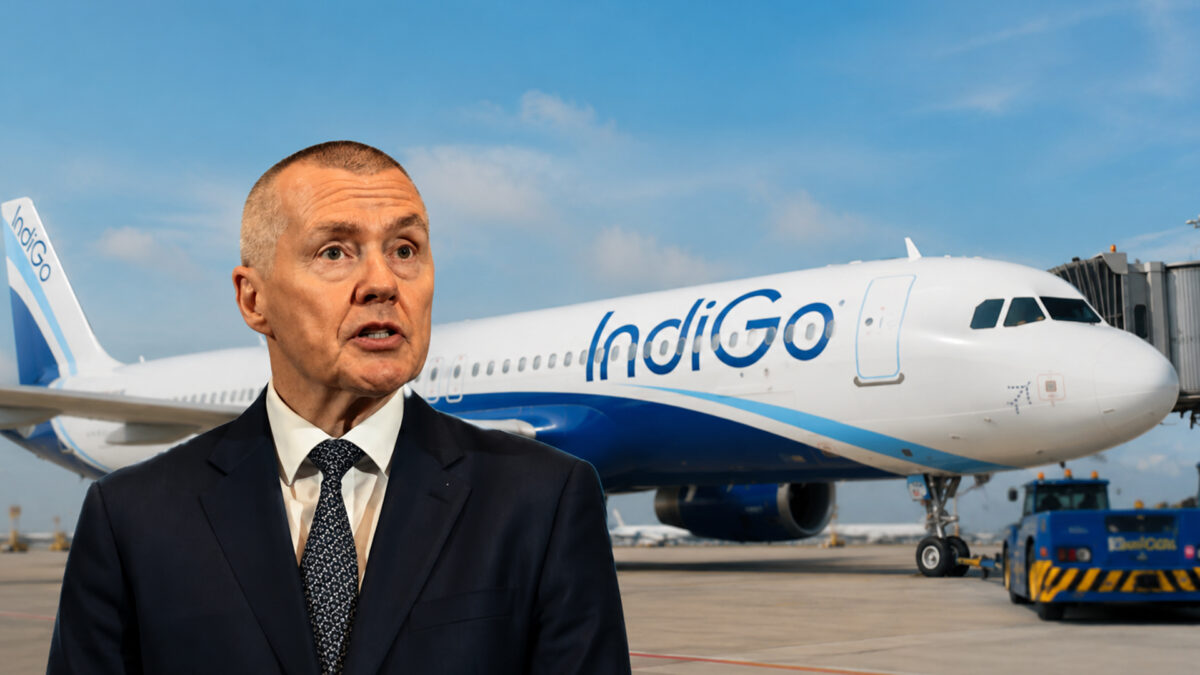
IndiGo’s new chief executive officer Willie Walsh has made it clear that the airline will not slow down its global ambitions despite the difficult environment facing the aviation industry. In his first address to employees after taking charge, Walsh said IndiGo must remain focused on international expansion while responding carefully to airspace disruptions, supply chain constraints, rising costs and changing global conditions.
Walsh took charge as IndiGo CEO on Monday, just days after completing his tenure as director general of the International Air Transport Association (IATA). His arrival comes at an important point for India’s largest airline, which is celebrating 20 years of operations while simultaneously dealing with financial pressure, international route disruptions and the need to rebuild confidence following last year’s operational crisis.
Speaking at IndiGo’s 20th anniversary town hall, Walsh struck an optimistic tone. He told employees that the airline’s biggest opportunities were still ahead and that new aircraft and an expanding international network could help connect India with more destinations around the world.
For Walsh, the opportunity is closely linked to India’s growing aviation market. He sees the country’s rising demand for air travel and its geographical position as important advantages that could help India develop into a major global aviation hub.
That ambition, however, comes with several immediate challenges.
IndiGo’s international operations have been affected by disruptions in the Middle East and Europe. Changes in airspace availability have forced airlines to alter routes and schedules, while geopolitical uncertainty has made international operations more expensive and complicated.
The airline has also decided to end its current wide-body operations from October 25, 2026, and complete its damp lease arrangement with Norse Atlantic Airways by October 31. The decisions come amid airspace restrictions, higher fuel costs and currency pressures. The move highlights the difficult balance IndiGo faces between pursuing long-haul international growth and protecting its finances in the short term.
Fuel costs are another major concern. Aviation turbine fuel, or ATF, normally represents one of the biggest expenses for an airline, accounting for roughly 35-40% of operating costs. IndiGo’s fuel bill jumped more than 84% in the first quarter of FY27, contributing to an unexpected loss.
The weaker Indian rupee has added another layer of pressure. Many airline expenses, including aircraft leases and maintenance costs, are linked to the US dollar. A weaker rupee therefore increases the cost of running the airline and can directly affect profitability.
Walsh is stepping into the role after a particularly difficult period for IndiGo. Former CEO Pieter Elbers resigned in March following the airline’s operational problems. The crisis had caused a sharp fall in IndiGo’s domestic market share, which dropped from 63.6% in November 2025 to 59.6% in December.
The airline has since recovered strongly. Its domestic market share climbed back to 66.3% in June, underlining the strength of its core business even as international operations remain more challenging.
Financially, however, the pressure remains significant. IndiGo reported a loss of ₹2,394 crore in FY26, compared with a profit in the previous financial year. The result reflects the impact of operational disruptions, higher fuel costs and other pressures affecting the airline industry.
Walsh brings extensive international aviation experience to the job. Before joining IndiGo, he served as IATA’s director general and previously led British Airways, Aer Lingus and International Airlines Group. His experience of managing large airline operations is expected to be particularly useful as IndiGo tries to strengthen its international network without compromising the efficiency that built its domestic success.
In his first message, Walsh also reminded employees that running an airline successfully is extremely difficult. He pointed out that 408 airlines had failed over the previous decade, making IndiGo’s two-decade journey particularly significant.
His message was not simply about expansion. Walsh emphasised discipline, teamwork and consistency as the foundations of a successful airline. He also said he wanted IndiGo to become the carrier of choice for travellers, building on the customer trust and operational reputation the airline has developed over the years.
That focus on the customer could prove important as competition in Indian aviation intensifies. Air India and the broader Tata group are expanding their international presence, while Indian travellers have more choices than ever before.
Walsh has also signalled that he intends to understand the airline from the ground up. He plans to visit airports, engineering facilities and offices in the coming months and meet employees across the organisation. His approach suggests that operational improvement will be as important as network expansion.
The timing is significant. IndiGo has already established itself as India’s dominant domestic airline. The next stage is more complicated: turning that domestic scale into a sustainable international presence while managing fuel prices, currency movements, aircraft availability, geopolitical risks and customer expectations.