
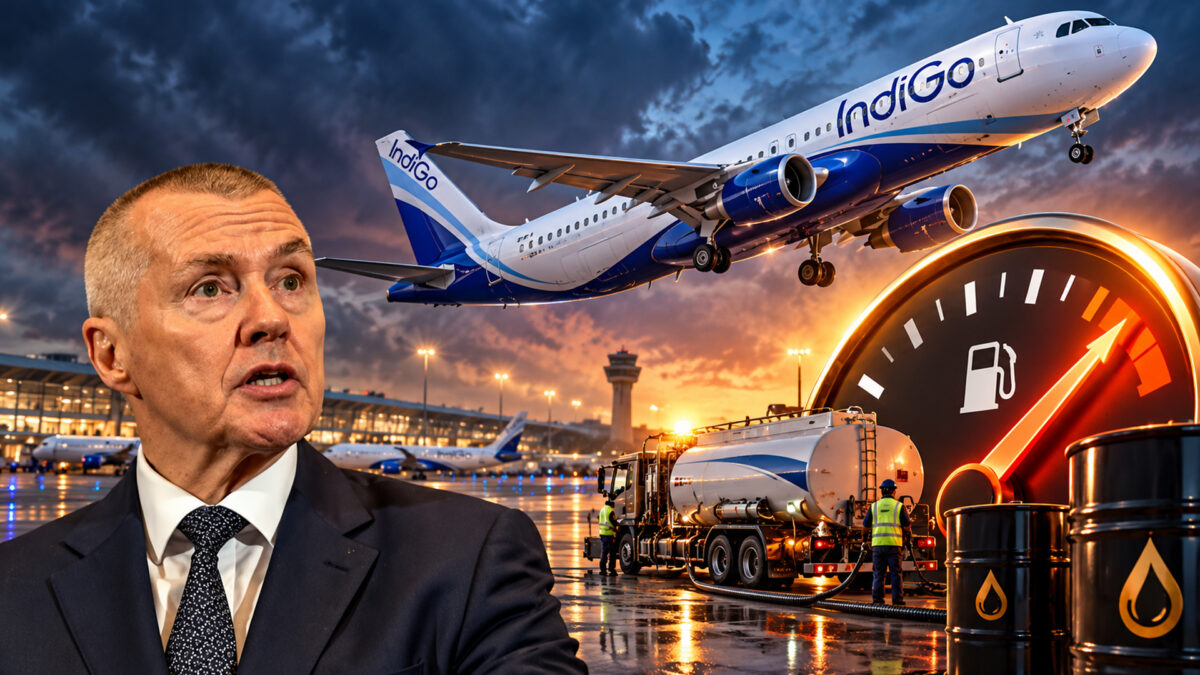
Passengers travelling with IndiGo may have to pay more for flight tickets as India’s largest airline looks to increase fares to manage a sharp rise in aviation fuel costs. Chief Executive Officer Willie Walsh has warned that the airline has little choice but to raise ticket prices, even as it tries to protect its low-cost business model and keep travel affordable.
The warning comes after IndiGo reported a consolidated net loss of ₹1,879.1 crore for the July-September quarter of the financial year 2026-27. Although the loss narrowed from ₹2,582.1 crore in the corresponding quarter last year, the airline continues to face pressure from higher fuel prices, rupee depreciation and geopolitical uncertainty.
Speaking after the announcement of the results, Walsh said the airline had experienced an exceptionally difficult quarter because of elevated fuel costs and continuing geopolitical tensions. He said IndiGo had already taken steps such as reducing capacity and improving ticket revenue, but these measures had only partly offset the increase in operating expenses.
“We have no choice but to look to increase fares in an effort to offset some of the very significant increase that we’ve seen in the fuel bill,” Walsh said. He added that the company would try to minimise the extent of the fare increases, given the importance of affordable tickets in stimulating air travel in India.
The airline’s financial results underline the challenge. IndiGo’s revenue from operations increased by around 26% year-on-year to ₹23,363.8 crore in the September quarter. Total income rose 24% to ₹24,311.9 crore. However, the growth in revenue was not enough to absorb the sharp rise in expenses.
Aircraft fuel expenses climbed 67.2% to ₹9,966.8 crore, compared with ₹5,961.8 crore in the same quarter last year. The increase was linked to higher global jet fuel prices, while the depreciation of the Indian rupee added to the burden because airlines pay for several major expenses in foreign currencies.
Fuel accounted for a significant share of IndiGo’s overall expenses during the quarter. The airline’s total expenses increased 18.6% to ₹26,188.4 crore. Its financial performance was also affected by the seasonally weaker monsoon quarter, when passenger demand generally moderates between the summer travel period and the festive season.
Walsh said IndiGo’s financial position gives it room to deal with the current challenges. He pointed to the airline’s strong liquidity and efficient cost structure, saying these provide flexibility that may not be available to all competitors.
The CEO also indicated that passengers should not expect major cost-cutting measures. IndiGo would continue looking for opportunities to trim expenses, but its existing cost base was already efficient. The airline instead plans to combine careful capacity management, better revenue generation and selective fare increases to protect its finances.
IndiGo has already adjusted its operations in response to higher costs. Its capacity, measured in available seat kilometres, declined around 1% to 40.8 billion in the September quarter. The airline carried approximately 27.5 million passengers, down 4.7% from the year-ago period.
Despite the decline in passenger numbers, ticket revenue increased 29.3% to ₹20,652.2 crore. Passenger yield, which measures the revenue earned per passenger for each kilometre flown, also improved to ₹6.30 from ₹4.69 a year earlier. However, the passenger load factor, which indicates how many available seats are occupied, fell to 80.3% from 82.5%.
These figures suggest that higher ticket realisations helped the airline generate more passenger revenue even as fewer people travelled. However, the increase was insufficient to fully compensate for the rise in fuel and other operating costs.
Looking ahead, IndiGo expects capacity growth to remain in the low single digits during the December quarter. The airline is reviewing its network and assessing flights individually, taking into account demand, fuel expenses and geopolitical developments. Capacity adjustments are expected to focus more on international routes, while domestic demand is being supported by the festive and holiday travel season.
The airline is also expecting passenger revenue per available seat kilometre to grow by more than 25% year-on-year in the December quarter, based on trends observed in October. This measure indicates how much passenger revenue an airline earns for every seat kilometre it offers.
Walsh said demand had remained reasonably strong despite higher fares. He is encouraged by the outlook for the December quarter, which generally benefits from festive travel and year-end holidays. However, the airline will have to balance the opportunity for stronger revenue with the risk that higher ticket prices could affect passenger demand.
IndiGo is also reviewing some of its international operations. The airline will end its wide-body aircraft wet-lease arrangement with Norse Atlantic from November 1. Under a wet lease, an airline rents an aircraft along with its crew and operating support. Walsh said high fuel prices and currency movements had made the arrangement less attractive, although the experience would provide useful lessons ahead of the introduction of Airbus A350 aircraft in 2028.
The airline’s long-term expansion plans remain in place despite the near-term financial pressure. IndiGo continues to focus on strengthening its domestic network while expanding international operations. Walsh has said the company intends to protect its low-cost domestic model as it prepares for long-haul services.
IndiGo’s latest results highlight the difficult balance facing airlines as fuel prices rise. Higher fares may help recover part of the additional expenditure, but the company must ensure that price increases do not weaken demand. With its strong liquidity providing some financial flexibility, the airline is preparing for a period in which cost discipline, careful route planning and ticket pricing will play a crucial role in protecting its business.