
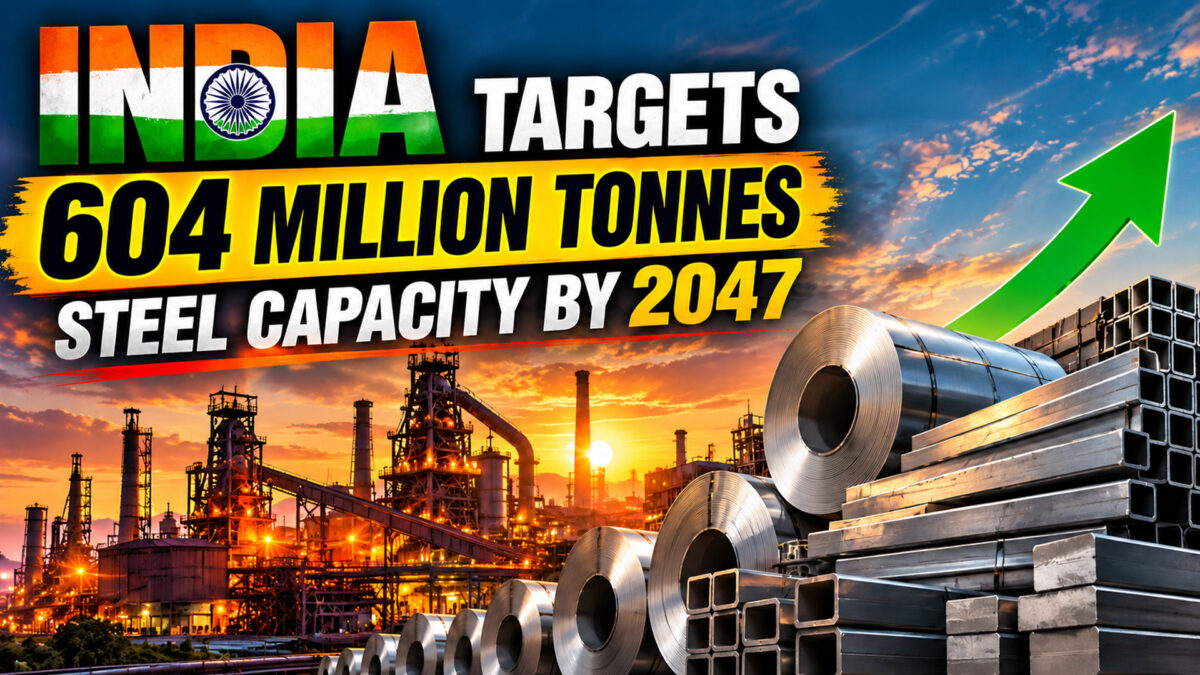
India has unveiled a draft National Steel Policy – Vision 2047 that aims to nearly triple the country’s steelmaking capacity over the next two decades, while accelerating the adoption of advanced technology and reducing carbon emissions. The proposal targets crude steel capacity of 604 million tonnes by 2047, up from the current installed capacity of around 220 million tonnes per year.
Released by the Ministry of Steel for public consultation, the draft outlines a long-term roadmap focused on artificial intelligence (AI), digitalisation, automation, cleaner production methods and improved access to raw materials. The government is seeking feedback on the proposal until October 30, 2026, before the policy is finalised.
The plan reflects the growing role of steel in India’s infrastructure development, manufacturing, transport and construction industries. It also signals a shift towards technology-led growth, with the government looking to strengthen domestic manufacturing capabilities and improve the global competitiveness of Indian steel producers.
India produced around 170 million tonnes of crude steel in 2025-26, compared with approximately 89 million tonnes in 2014-15. Finished steel consumption rose from 77 million tonnes to 164 million tonnes over the same period, according to the draft policy. Installed capacity has reached about 220 million tonnes annually, making India the world’s second-largest crude steel producer.
The proposed roadmap projects crude steel production of 531 million tonnes by 2047 and finished steel consumption of 505 million tonnes. Per capita finished steel consumption is expected to increase from the current 116 kg to 302 kg, driven by urbanisation, housing, infrastructure projects and industrial expansion.
Technology is expected to play a central role in managing this growth. The draft proposes establishing a Steel Digital Centre of Innovation under the Steel Research and Technology Mission of India. The centre would support research, technology development and the adoption of digital solutions across steelmaking operations.
The government also plans to develop a national steel data platform covering production, product quality, energy consumption, carbon emissions, logistics and raw-material availability. Better access to reliable industry data could help manufacturers identify inefficiencies, improve resource planning and make more informed investment decisions.
Artificial intelligence is another priority. The draft proposes using AI-based systems to monitor substandard steel imports, helping authorities identify products that fail to meet prescribed quality standards. Wider adoption of automation and digital technologies could also improve manufacturing efficiency, product consistency and industrial safety.
The policy places particular emphasis on developing domestic capabilities in advanced steelmaking technology and capital equipment. Increasing the production of high-value and specialty steel is another objective, as these materials are important for sectors such as automobiles, engineering, energy and advanced manufacturing.
Reducing the steel industry’s environmental footprint remains a major challenge. Steelmaking is energy-intensive and relies heavily on coal, making decarbonisation difficult even as production expands.
The draft targets a reduction in average carbon emission intensity from 2.54 tonnes of carbon dioxide per tonne of crude steel to around 1.54 tonnes by 2047, a decline of approximately 39%. The proposed approach includes energy-efficiency improvements, greater use of renewable energy, increased scrap utilisation, hydrogen-based direct reduced iron production and potential carbon capture technologies.
The transition is expected to take place in stages, reflecting differences in technology readiness, costs and infrastructure requirements. However, the draft’s intensity target does not mean total emissions will necessarily decline, as overall steel production is also projected to rise substantially.
Securing raw materials will be equally important. The government expects iron ore demand to reach 772 million tonnes annually by 2047, while coking coal requirements could rise to 236 million tonnes. The policy proposes strengthening domestic mining, pursuing overseas mineral assets and joint ventures, and diversifying international sourcing to reduce supply risks.
The draft also proposes expanding iron ore slurry pipelines, which transport finely ground ore mixed with water. These pipelines could provide an alternative to conventional freight movement, improving logistics efficiency and reducing pressure on rail and road networks. Viability gap funding is proposed to support pipeline development where projects face financial constraints.
Industrial safety is another focus area. The policy proposes a Steel Industry Safety Council and a dedicated Steel Industry Safety Directorate to promote common safety standards, occupational health, disaster management and improved enforcement across the sector.
The roadmap also seeks to modernise smaller and secondary steel producers, which account for a substantial share of India’s steelmaking capacity. Access to technology, raw materials, skills and efficient production systems will be important to ensure that smaller manufacturers can participate in the industry’s transition.
The consultation process will allow industry stakeholders to respond before the government finalises the framework. Its eventual impact will depend on investment, technology adoption and the ability to deliver the proposed changes across India’s diverse steel industry.