
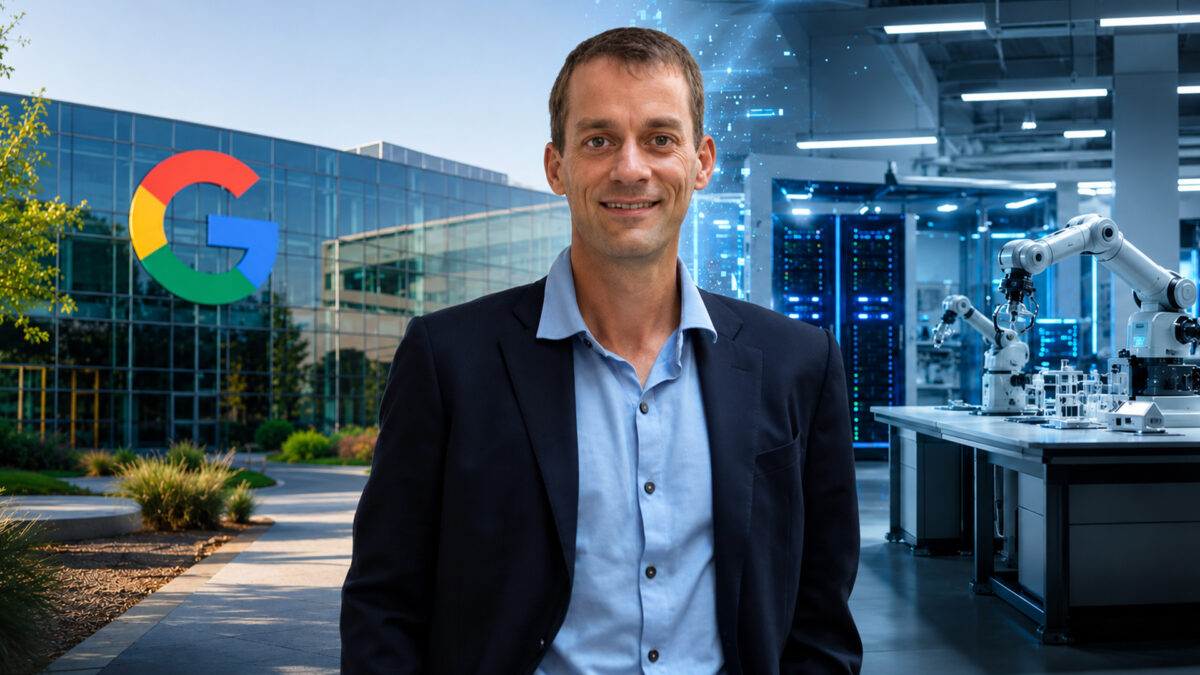
Jeff Dean, Google’s longtime chief scientist and a key architect of its artificial intelligence efforts, has left the company to co-found Discovery Loop, a new AI startup focused on using artificial intelligence to accelerate scientific and engineering breakthroughs.
Dean is not leaving alone. He is joining forces with three other prominent Google AI researchers, Sanjay Ghemawat, Oriol Vinyals and Quoc Le, in a move that brings together some of the industry’s most experienced researchers outside Google’s corporate structure.
Discovery Loop is being established as a public-benefit corporation, with a mission that goes beyond building another consumer AI chatbot. The company wants to use AI to automate parts of the scientific method — allowing systems to generate ideas, design experiments, analyse results and repeatedly test new possibilities.
The ambition is to make scientific discovery faster and more scalable.
Dean’s departure is particularly significant because of his extraordinary influence on Google’s technical foundation. He joined the company in 1999, when Google was still a relatively small organisation, and went on to become one of its most respected engineers and researchers.
Over nearly three decades, he worked on systems that helped Google handle enormous amounts of information and built technologies that became important to the company’s search, computing and AI infrastructure.
He also played a major role in Google’s development of specialised hardware for machine learning, including the Tensor Processing Unit (TPU) programme. TPUs later became a crucial part of Google’s strategy for training and running large AI models.
Dean eventually became Google’s chief scientist, putting him at the centre of the company’s long-term technology strategy.
His move comes at a particularly important moment for Google.
The company is reorganising its AI leadership as competition intensifies across the industry. Google is facing pressure from OpenAI, Anthropic and other AI companies to move quickly in areas ranging from frontier AI models and AI agents to scientific research and coding.
Google DeepMind is also undergoing a leadership reshuffle. Demis Hassabis, who has led DeepMind, is moving away from day-to-day executive responsibilities to focus more heavily on long-term research and become chairman and chief scientist. Koray Kavukcuoglu is taking greater responsibility for AI model development.
Dean’s departure is therefore part of a broader period of change inside Google’s AI organisation.
Yet the creation of Discovery Loop also highlights how the next phase of artificial intelligence may extend beyond the race to build increasingly capable general-purpose models.
The startup wants to focus on what could be called AI for discovery, systems capable of working through complex scientific problems by repeatedly proposing, testing and refining ideas.
The potential applications are wide. The company is expected to explore areas such as drug discovery, hardware design, engineering and other scientific challenges where progress often depends on running large numbers of experiments.
Traditionally, scientific research can be slow because experiments require time, specialised equipment and human researchers. AI could potentially shorten that cycle by helping researchers identify promising ideas, automate parts of experimental work and analyse huge amounts of data.
Discovery Loop’s founders believe this could create a new model for scientific research, where AI systems operate alongside scientists and engineers rather than simply serving as productivity tools.
The company has also attracted significant backing. Its investors include prominent venture capital firms such as Radical Ventures, Khosla Ventures, Lightspeed, Kleiner Perkins and Doerr Capital. Alphabet, Google’s parent company, is also participating as an investor and cloud partner.
That relationship makes Dean’s exit unusual. While Google is losing a senior AI figure, the company is also backing the new venture and providing cloud infrastructure.
The move reflects the changing relationship between large technology companies and AI startups. Major researchers can now leave established companies with deep technical experience, access to capital and ambitious ideas — while their former employers may still have reasons to support their work.
For Dean personally, the move marks a dramatic change after 27 years at one of the world’s most influential technology companies.
He joined Google during its early growth and remained there through the transformation of search, cloud computing, smartphones, machine learning and generative AI.
Now, instead of helping shape the future from inside Google, he is attempting to build a new organisation around one central question: Can AI dramatically speed up the way humans discover new things?
That question could become increasingly important as artificial intelligence moves from generating content to performing increasingly complex tasks.
Discovery Loop’s success will depend on whether its systems can produce reliable, measurable breakthroughs rather than simply promising faster research.
But with four highly experienced AI researchers at the helm and backing from major technology and venture investors, the startup is already attracting attention.