
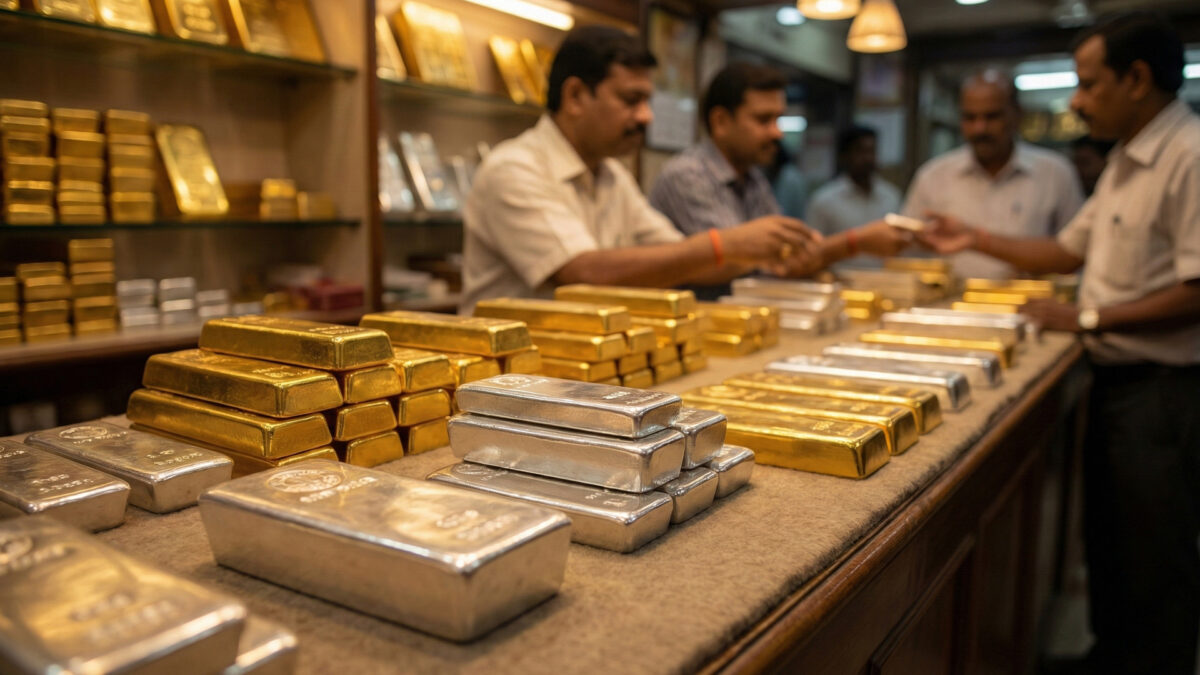
Gold and silver prices witnessed another steep decline on Friday, November 20, as selling pressure intensified across domestic and international markets. The 22-carat gold rate stood at Rs 1,15,250 per 10 grams, while silver was quoted at Rs 1,75,000 per kg. The sharp correction also dragged gold and silver exchange-traded funds (ETFs) lower, with several schemes touching their 52-week lows.
The sell-off in precious metals gathered momentum amid growing expectations of another interest rate hike by the US Federal Reserve in December. A stronger US dollar, rising bond yields and persistent inflation concerns have further weakened investor appetite for bullion, which is traditionally considered a safe-haven investment.
According to market data, gold and silver ETFs declined sharply in Friday’s trading session on the National Stock Exchange (NSE). Silver ETFs witnessed heavier selling, falling more than 6%, while gold ETFs shed around 5%.
Nippon India Silver ETF (SILVERBEES) plunged 6.4% to Rs 142.97, touching a 52-week low, with nearly 29 million shares changing hands by 9.30 am. Nippon India Gold ETF (GOLDBEES) declined 4.8% to Rs 101.21, trading close to its 52-week low of Rs 100.61.
Other gold-linked funds also faced considerable pressure. ICICI Prudential Gold ETF, 360 One Gold ETF and Axis Gold ETF fell around 5% to Rs 104.77, Rs 120.25 and Rs 102.05, respectively. Silver-linked schemes, including ICICI Prudential Silver ETF, HDFC Silver ETF, SBI Silver ETF and Zerodha Silver ETF, declined more than 6%.
The weakness in exchange-traded funds reflects the broader correction in international bullion markets. On the COMEX, gold futures fell as much as 4% to around $3,530 an ounce, while silver futures declined nearly 6% to approximately $41.60 an ounce during the trading session.
The correction has been particularly sharp over the past fortnight. International gold prices have declined 25.3% over the last two weeks, while silver has lost 20.4%, according to market data cited by Business Standard. Silver has also fallen as much as 66% from its record high of $121.785 an ounce registered in January 2026. Gold, meanwhile, is down around 37.3% from its peak.
The domestic ETF market has reflected the same trend. Gold ETFs have lost approximately 21% over the past three months and are down as much as 33% from their peaks. Silver ETFs have witnessed a steeper correction, declining around 35% over three months and falling up to 62% from their record highs.
The biggest concern for precious metal investors is the changing outlook for US monetary policy. Markets are increasingly anticipating that the Federal Reserve could raise interest rates in December as inflation remains a concern. Comments from US central bank officials have also strengthened expectations of tighter monetary policy.
Higher interest rates generally reduce the attractiveness of gold and silver because these assets do not generate interest income. When bond yields rise, investors often shift towards interest-bearing instruments, increasing the opportunity cost of holding precious metals.
The US dollar has added to the pressure. The greenback has been trading close to a 19-month high, making gold and silver, which are priced internationally in dollars, more expensive for buyers using other currencies. This can weaken demand in overseas markets and contribute to further price declines.
Market analysts have also pointed to forced liquidation across financial markets as another factor behind the sell-off. When investors face losses in other asset classes or need to meet margin requirements, they may sell profitable or liquid holdings, including gold and silver. Such selling can intensify price movements, particularly during periods of heightened volatility.
Kyle Rodda, senior financial market analyst at Capital.com, highlighted the possibility of forced liquidation across markets, alongside concerns about persistent inflation, higher yields and a stronger dollar. These factors have combined to create an unfavourable environment for bullion.
Jateen Trivedi, vice-president and research analyst for commodity and currency at LKP Securities, said the overall sentiment in precious metals remained weak, with volatility expected to stay elevated. He identified the Federal Reserve’s December policy meeting as a key trigger for the next directional move in gold and silver. Dollar movements, inflation expectations and the central bank’s policy guidance will be important factors to watch.
The weakness has extended beyond gold and silver. Platinum prices declined around 2% to $1,317 an ounce, while palladium fell 2.3% to $888.66, indicating a broader correction across the precious metals market.
With gold heading towards its steepest weekly decline in eight months, investors are closely monitoring developments in the US economy and the Federal Reserve’s next policy decision. For Indian buyers, the sharp fall has brought some relief in jewellery purchase costs, although retail rates continue to vary across cities and jewellers.
For investors, however, the steep correction in gold and silver ETFs is a reminder that precious metals are not immune to volatility. The direction of US interest rates, movements in the dollar and global investment flows are likely to determine whether bullion prices stabilise or face further selling pressure in the coming sessions.