
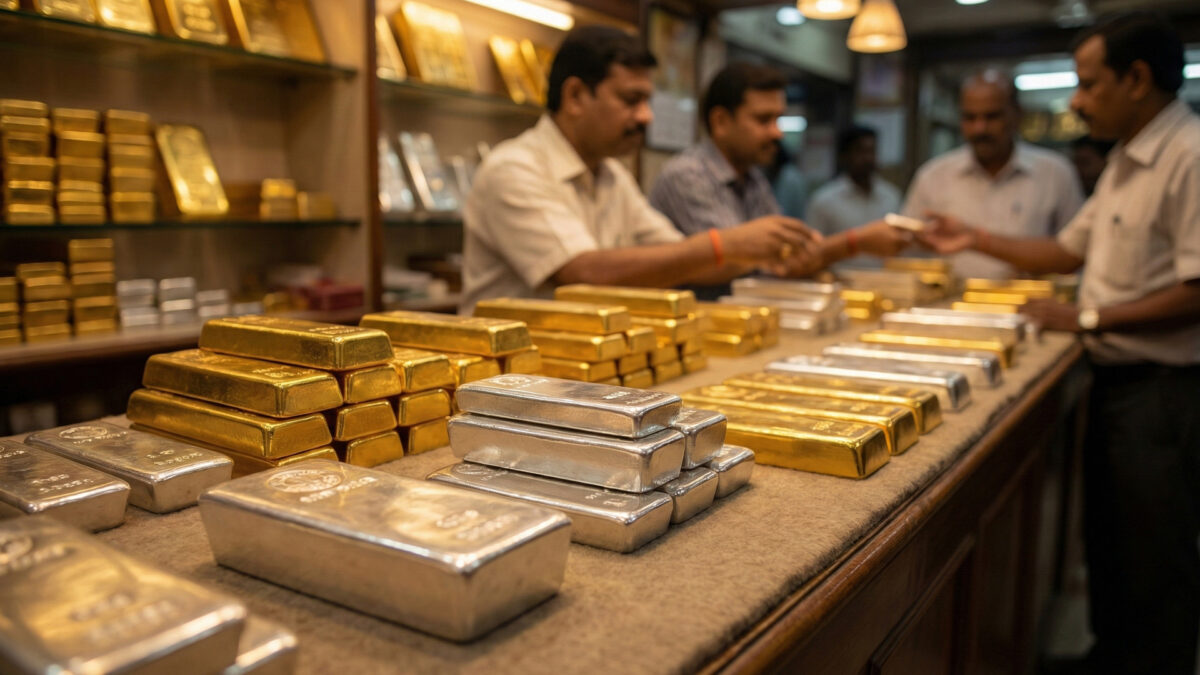
Gold and silver prices remained volatile on Tuesday, November 3, as investors assessed global economic developments, uncertainty surrounding US monetary policy and geopolitical tensions. Both precious metals have recovered some ground after recent declines, but market sentiment remains cautious amid concerns that further price fluctuations could lie ahead.
In Mumbai, 24-karat gold was priced at Rs 1,38,230 per 10 grams, while 22-karat gold stood at Rs 1,26,620 per 10 grams. Silver was quoted at Rs 1,78,389 per kilogram. These rates provide a reference for consumers and investors tracking the domestic bullion market. However, retail prices may differ across cities and jewellers.
The latest movement follows a period of considerable weakness in the precious metals market. Gold and silver had faced selling pressure in recent sessions, with both commodities touching lower levels before recovering. The improvement, however, has not yet established a clear reversal in the broader market trend.
On the Multi Commodity Exchange (MCX), gold futures for December delivery were trading at Rs 1,40,242 per 10 grams, registering a marginal gain of 0.03 per cent during the early session. Silver futures, meanwhile, declined 0.12 per cent to Rs 1,83,555 per kilogram. The previous session had ended with domestic spot gold at Rs 1,36,907 per 10 grams and silver at Rs 1,80,233 per kilogram, highlighting the continuing fluctuations in bullion prices.
International market movements, changes in crude oil prices and currency fluctuations continue to influence domestic gold and silver rates. A shift in global investor sentiment can quickly affect demand for precious metals, making short-term price movements difficult to predict.
One of the major factors shaping the current market outlook is uncertainty over the direction of US monetary policy. Investors are closely monitoring economic indicators from the United States to assess whether interest rates will remain elevated or move lower in the coming months. Federal Reserve decisions are particularly important for gold and silver because higher interest rates generally make non-interest-bearing assets less attractive compared with investments that offer returns.
Market participants are also watching employment-related data, including private-sector job figures, non-farm payrolls and unemployment numbers. These indicators could provide further clues about the strength of the US economy and influence expectations surrounding future interest-rate decisions.
Jateen Trivedi, vice-president and research analyst at LKP Securities, said gold prices could remain volatile within the Rs 1,36,500-Rs 1,41,000 range in the domestic market. He noted that investors were adopting a cautious approach while assessing the outlook for US monetary policy. Upcoming labour-market indicators are expected to provide additional clarity on the Federal Reserve’s possible policy direction and could influence bullion prices in the near term.
Developments surrounding US-Iran negotiations have also contributed to uncertainty in commodity markets. Hopes of progress in discussions have eased some concerns over regional tensions and helped bring down crude oil prices. Lower oil prices can reduce inflationary pressures, potentially influencing expectations about interest rates and demand for precious metals.
However, geopolitical developments remain an important factor for bullion investors. Gold is traditionally considered a safe-haven asset during periods of economic or political uncertainty. Any fresh escalation in international tensions could therefore trigger renewed demand. At the same time, changes in interest-rate expectations and broader financial-market sentiment could limit gains.
Silver faces additional challenges because its demand is closely linked to industrial activity. Apart from being an investment asset, the metal is widely used in electronics, solar energy and manufacturing. Expectations surrounding industrial demand, therefore, play an important role in determining its price movement.
Swapnil Aggarwal, director at VSRK Capital, expressed caution about the near-term outlook for silver. He indicated that prices could remain under pressure through the end of 2026 if US interest rates stay elevated and the Federal Reserve does not begin reducing borrowing costs. A significant recovery in silver prices may be difficult in the short term, despite the possibility of a longer-term improvement.
Aggarwal suggested that investors adopt a wait-and-watch approach rather than rush into fresh purchases at current levels. He indicated that a decline towards Rs 1,75,000 per kilogram could offer an opportunity for investors to consider adding small quantities. However, investment decisions should take into account prevailing market conditions and the interest-rate outlook.
For jewellery buyers, the latest movement in gold prices could influence purchasing decisions, particularly ahead of the upcoming wedding and festive buying periods. Consumers planning to purchase gold may benefit from comparing rates across jewellers and checking additional charges, including making charges and applicable taxes, before completing transactions.
Silver buyers and investors may also prefer to monitor the market for clearer signs of stability. With global economic indicators, geopolitical developments and central bank decisions likely to influence price movements, both metals could continue to experience fluctuations.
The immediate direction of gold and silver prices will largely depend on incoming economic data and changes in global investor sentiment. Although the recent recovery has offered some relief after the correction, analysts believe it is too early to conclude that the precious metals market has entered a sustained upward trend.