
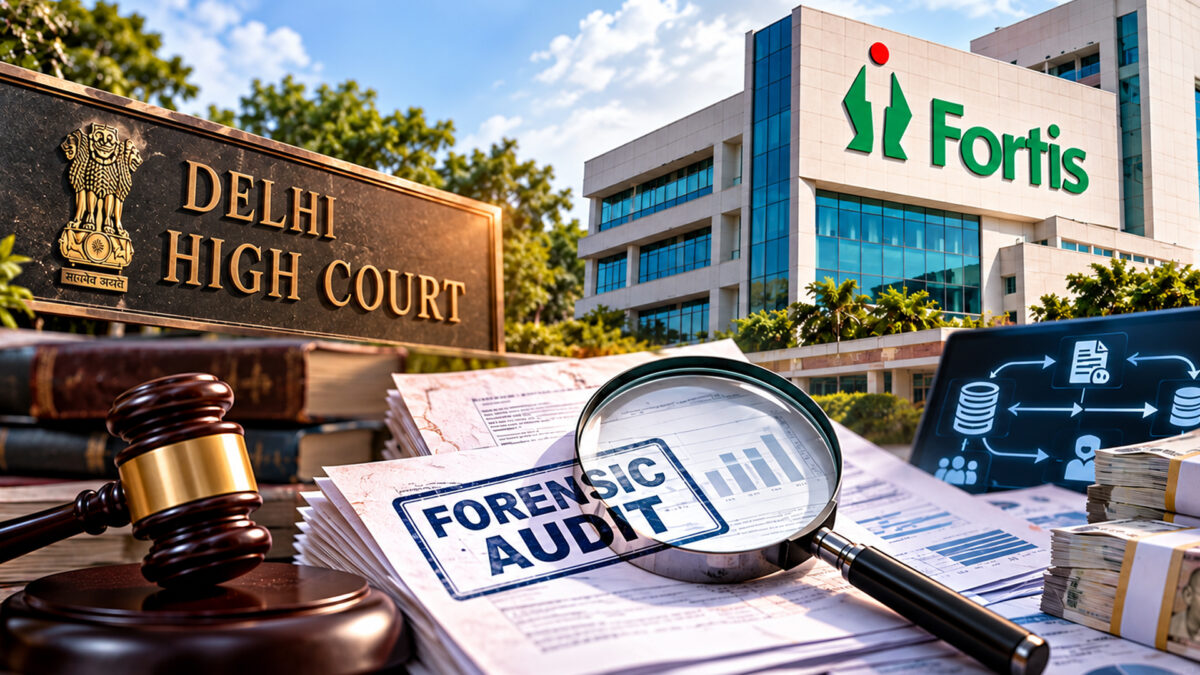
The Supreme Court has refused to interfere with a Delhi High Court order directing a forensic audit of transactions involving Fortis Healthcare and its former promoters Malvinder Mohan Singh and Shivinder Mohan Singh. The case is part of Daiichi Sankyo’s long-running efforts to enforce a ₹3,500 crore arbitral award against the Singh brothers.
A bench headed by Chief Justice Surya Kant and comprising Justices Joymalya Bagchi and V Mohana allowed the audit to continue. At the same time, the court clarified that the observations made by the Delhi High Court against Fortis were only tentative and prima facie. The findings, therefore, cannot be treated as a final determination of Fortis’ liability in the dispute.
The dispute has its roots in the 2008 sale of Ranbaxy Laboratories to Daiichi Sankyo by the Singh brothers. Daiichi later alleged that material information relating to regulatory investigations into Ranbaxy had not been disclosed during the transaction. An international arbitration process eventually resulted in a ₹3,500 crore award in favour of the Japanese pharmaceutical company in 2016.
The Singh brothers challenged the award in Indian courts, but the Delhi High Court upheld it in January 2018. The Supreme Court subsequently dismissed their challenge, leaving the award enforceable in India. Daiichi has since pursued legal proceedings to identify and trace assets that could potentially be used to satisfy the award.
Fortis became part of the enforcement proceedings because Daiichi sought examination of transactions involving the healthcare company, the Singh brothers and other entities. The Delhi High Court, in its August 31 order, directed a comprehensive forensic audit to examine the movement of Fortis shares and other assets.
The audit will look at the sequence of transactions, identify the entities and individuals involved and examine whether assets that could have been available to meet Daiichi’s award were allegedly transferred or otherwise dissipated. Chartered accountancy firm S Ramanand Aiyar & Co has been appointed as the forensic auditor and has been given six months to complete the exercise.
The transactions also involve Fortis’ ownership changes and the subsequent investment by Malaysian healthcare group IHH Healthcare. Fortis argued before the Supreme Court that the company was not a party to the original arbitration and should not be treated as a judgment debtor for the Singh brothers’ obligations.
Senior advocate Abhishek Manu Singhvi, appearing for Fortis, also pointed to the Singh brothers’ exit from the company in 2018 and IHH’s subsequent investment of about ₹4,000 crore. The company challenged the forensic audit order on the grounds that it should not be made part of proceedings concerning a liability arising from the former promoters’ separate dispute with Daiichi.
The Supreme Court, however, found no reason to interfere with the Delhi High Court’s direction. This means the forensic investigation can now move ahead and examine the transactions identified by the lower court.
The clarification on the High Court’s observations is significant for Fortis. While the Supreme Court has permitted the audit, it has not endorsed the underlying allegations as established facts. The observations that supported the audit were described as tentative and prima facie, and the forensic auditor is expected to conduct an independent examination.
The development also highlights the wider legal and corporate implications of the Daiichi-Fortis dispute. The proceedings are examining whether transactions involving a listed company and its former promoters have any connection with efforts to recover liabilities arising from the promoters’ personal legal dispute.
The forensic audit is expected to reconstruct the relevant transactions and establish the movement of shares and other assets. Its findings could provide the Delhi High Court with further material while it considers Daiichi’s efforts to enforce the arbitral award.
The Supreme Court’s order does not settle the larger dispute or establish that Fortis is responsible for the Singh brothers’ award. Instead, it clears the way for the fact-finding process ordered by the Delhi High Court.
The next stage will therefore focus on the forensic examination of the transactions. The auditor’s report and subsequent court proceedings will determine what conclusions, if any, can ultimately be drawn from the transactions involving Fortis, the former promoters and other entities.