Categories
Corporate

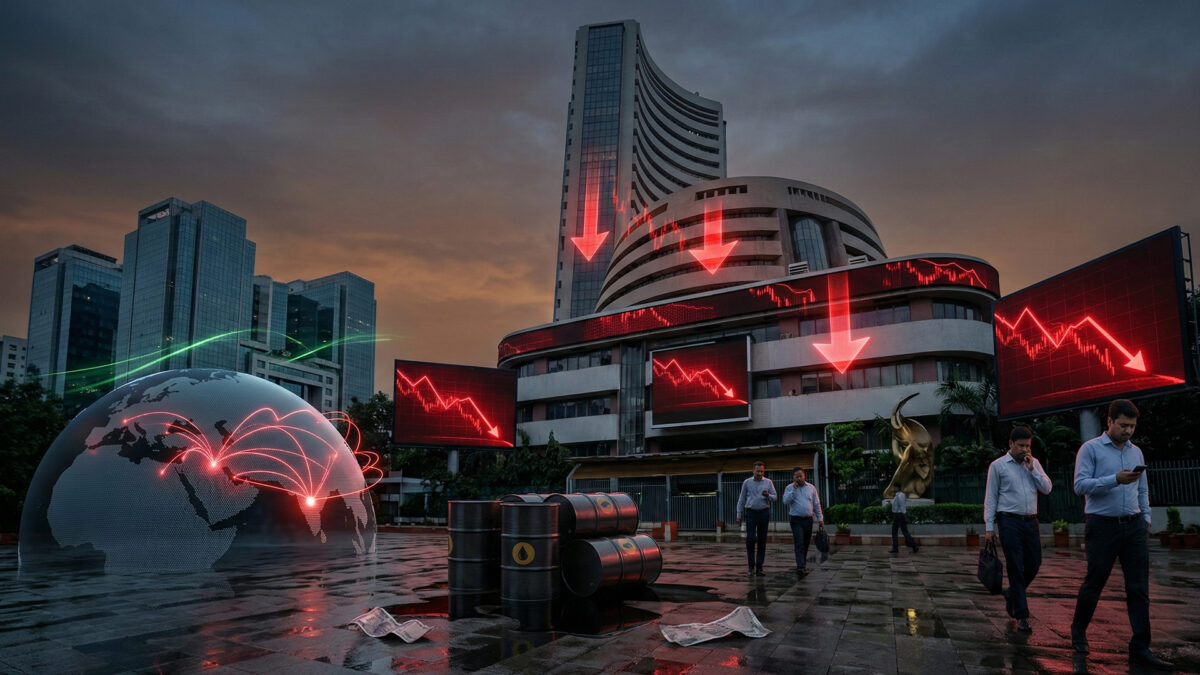
Sensex drops 750+ points, Nifty slips below 25,600

Markets opened sharply lower on Friday, February 13, 2026, with the BSE Sensex dropping over 750 points and the NSE Nifty50 slipping below 25,600. Weak global cues and a heavy sell-off in IT stocks led the steep decline, creating broad-based bearish sentiment across Dalal Street.

The IT sector bore the brunt of the selling. Large-cap technology names, including Infosys, Tata Consultancy Services, and Wipro, were among the top losers, as investors grew concerned about slowing global demand and pressure on margins. This dragged the broader market lower, with all major indices trading in the red.

In contrast, banking and financial stocks showed relative resilience. Shares of State Bank of India, HDFC Bank, and ICICI Bank gained, providing some cushion to the market. Defensive stocks in sectors such as FMCG also saw minor gains, reflecting investors’ cautious rotation into safer bets amid volatility.

Analysts attributed the fall to multiple factors. Global markets were weaker, particularly in the tech space, following disappointing U.S. data and softer cues from Asian markets. Investors also remain watchful of domestic indicators and sector-specific headwinds, including regulatory developments and corporate earnings reports.

The sharp market slide wiped out significant wealth from investor portfolios, with estimates suggesting multi-lakh-crore losses across the indices. Traders advised caution, noting that the market could remain volatile in the coming sessions as it absorbs both domestic and global developments.

Also Read: Adani Power launches unit to enter nuclear energy

Categories
Corporate

Google offers exit to staff not ready for AI shift

Google is giving some employees the option to leave the company voluntarily as it focuses more on artificial intelligence (AI). Staff who feel they cannot keep up with the company’s AI plans or are not fully committed can take severance packages to help them transition out.

The offer is mainly for employees in the Global Business Organisation (GBO), including teams in sales support, corporate development, and solutions. However, large customer-facing sales teams in the US and some frontline staff are not included, to avoid affecting clients.

Philipp Schindler, Google’s Chief Business Officer, told staff that the company started 2026 in a strong position but needs everyone to be fully engaged with AI to stay competitive. He emphasized that the technology world is changing fast, and Google wants employees who are “all in” on AI.

This is not the first time Google has done this. Over the past year, similar exit options were offered to teams in engineering, Android, Core, and YouTube as part of reorganizing around AI and productivity.

Industry experts say this is part of a broader trend in big tech. Companies like Amazon, Meta, and Microsoft are also reshaping teams and offering incentives or restructuring to focus on AI.

For employees, the program is a chance to leave voluntarily with financial support if they feel their skills or interests don’t match Google’s AI direction. For the company, it allows a smoother transition to an AI-first workforce without major layoffs.

Also Read: Zomato founder flooded with 8,000 emails

Categories
Corporate

SBI rises above TCS to claim fourth spot in India

The State Bank of India (SBI) has overtaken Tata Consultancy Services (TCS) to become the fourth-largest listed company in India. This marks a rare moment when a public sector bank has climbed ahead of a major IT firm in market value.

SBI’s leap comes on the back of a record-breaking quarterly profit of ₹21,028 crore, a rise of nearly 25% compared to the same period last year. Strong growth in loans, higher interest and fee income, and better asset quality have helped the bank shine, even as other sectors faced pressure.

Investors responded enthusiastically. SBI’s shares surged over 3% to a 52-week high, while TCS saw a modest dip amid broader IT sector weakness. The rise in SBI’s market value to around ₹10.9 lakh crore nudged TCS, at ₹10.5 lakh crore, down a notch in the rankings.

While Reliance Industries, HDFC Bank, and Bharti Airtel continue to hold the top three spots, SBI’s climb reflects renewed confidence in the banking sector, particularly in India’s public banks. Analysts say the move signals that investors are paying closer attention to domestic financial growth, even in a market often dominated by technology companies.

Also Read: Global tech leaders gather for India AI Summit

Categories
Corporate

Adani Power launches unit to enter nuclear energy

Adani Power has officially stepped into India’s nuclear energy sector with the creation of a wholly-owned subsidiary, Adani Atomic Energy Limited (AAEL). The Ahmedabad-based company announced the formation of AAEL on February 11, 2026, with an authorized capital of ₹5 lakh, divided into 50,000 equity shares, fully held by Adani Power. The new unit will focus on producing, transmitting, and distributing electricity from nuclear energy sources, marking the company’s first formal move into atomic power.

This strategic move follows the passage of the SHANTI Bill (Sustainable Harnessing and Advancement of Nuclear Energy for Transforming India), which allows private firms to participate in India’s previously state-controlled nuclear sector. Until now, the Nuclear Power Corporation of India Ltd (NPCIL) was the only operator of nuclear power plants in the country. The reforms aim to attract private investment, expand electricity generation, reduce carbon emissions, and diversify India’s energy mix.

While AAEL’s exact capacity plans, project timelines, and technology partners have not been disclosed, industry analysts say Adani Power is likely to explore partnerships with international firms to acquire nuclear technology and expertise. The company already has a strong presence in thermal and renewable energy, and this move signals a broader strategy to diversify into low-carbon, long-term energy solutions.

Financially, the market has responded positively to the news, reflecting investor confidence in the private sector’s entry into nuclear power. Government incentives, including customs duty exemptions on imported nuclear equipment and budget allocations for atomic energy, further support private participation.

Experts note that Adani Power is among the first private utilities to enter India’s nuclear sector, positioning it for potential long-term growth as the country scales up nuclear capacity.

Also Read: UBS opens Hyderabad hub, promising 3,000 jobs

Categories
Corporate

Sensex drops 559 points, Nifty slips under 25,850

On Thursday, the BSE Sensex dropped 559 points to close near 83,675, while the Nifty 50 slipped below 25,850, ending at 25,807. Investor sentiment weakened as global macro data and domestic sector pressures combined to trigger selling across most segments of the market.

Market participants reacted cautiously to stronger-than-expected US jobs data and the likelihood that the Federal Reserve may delay interest rate cuts. This prompted a risk-off mood globally, with Indian markets reflecting the cautious stance.

Technology stocks were the biggest drag on the indices. Heavyweights such as Tech Mahindra fell about 6%, while HCL Technologies declined nearly 5%. Other IT majors including TCS and Infosys also saw losses, dragging the Nifty IT index sharply lower and contributing significantly to overall market weakness.

Meanwhile, some financial and banking stocks showed resilience, with ICICI Bank, Bajaj Finance, and State Bank of India (SBI) recording modest gains. FMCG and metal stocks held steady but could not offset the broader losses across IT and other high-beta sectors.

On the corporate front, Muthoot Finance reported a near doubling of quarterly profit, offering a rare bright spot amid a generally negative market trend. Commodity markets saw slight gains in industrial metals such as copper and zinc, while the Indian rupee finished marginally stronger against the US dollar.

Also Read: Sensex falls 400+ points, Nifty below 25,850

Categories
Corporate

UBS opens Hyderabad hub, promising 3,000 jobs

Swiss banking major UBS has opened a new Global Capability Centre (GCC) in Hyderabad and plans to hire around 3,000 employees over the next two years. The decision boosts the bank’s presence in India and highlights Hyderabad’s growing role as a global business hub.

The new centre will support UBS’s global operations, especially in areas such as technology, digital services, and back-end financial operations. The company said the Hyderabad hub will play an important role in building advanced technology solutions and improving efficiency across its worldwide businesses.

Telangana IT and Industries Minister D. Sridhar Babu, who attended the inauguration, said the investment shows global companies’ trust in Hyderabad’s skilled workforce and strong infrastructure. He added that the state government continues to support international firms looking to expand in the region.

UBS officials said Hyderabad is a key location for the company’s long-term growth plans. The centre will focus on innovation, including digital platforms and advanced technologies such as artificial intelligence and data analytics. By expanding in India, UBS aims to strengthen its global delivery network and improve services for clients worldwide.

India has become a major destination for Global Capability Centres, with several multinational companies setting up large offices in cities like Hyderabad, Bengaluru, and Pune. These centres provide technology development, research, operations support, and other high-value services to global headquarters.

Industry experts say UBS’s expansion reflects the increasing importance of India in the global financial and technology ecosystem. The country’s large talent pool, competitive costs, and strong IT expertise continue to attract major global players.

With this new facility, UBS joins the growing list of international firms choosing Hyderabad as a strategic base for innovation and global operations.

Also Read: RBI targets bank mis-selling


Categories
Corporate

RBI clears 9.95% stake IDFC first, then Federal Bank

The Reserve Bank of India (RBI) has approved ICICI Prudential Asset Management Company (AMC) and ICICI Bank group entities to acquire up to 9.95% stake in IDFC First Bank and Federal Bank.

Both banks informed stock exchanges that they received the RBI’s approval on February 11, 2026. The approval allows ICICI Prudential AMC, along with related entities of the ICICI Bank group, to buy up to 9.95% of the paid-up share capital or voting rights in each bank.

The permission is subject to strict regulatory conditions. The stake purchase must comply with the Banking Regulation Act, 1949, RBI’s guidelines on shareholding in banks, SEBI regulations, and rules under the Foreign Exchange Management Act (FEMA), wherever applicable.

Importantly, the RBI has given a one-year deadline to complete the acquisition. If the stake is not acquired within this period, the approval may lapse.

A 9.95% stake is considered a significant minority holding in the banking sector. While it does not give control over the bank, it allows the investor to have meaningful financial exposure and influence as a large shareholder.

Following the announcement, market participants closely tracked the development, as institutional investments by large financial groups are often seen as a sign of confidence in a bank’s growth prospects.

Also Read: Strong Q3 drives M&M profit to ₹4,675 cr

Categories
Corporate

HUL Q3 profit jumps 136% to ₹7,075 cr

Hindustan Unilever Ltd (HUL) reported a sharp 136 percent rise in net profit for the third quarter of FY26, helped mainly by a one-time exceptional gain. The company posted a standalone net profit of ₹7,075 crore for the October–December quarter, compared to ₹3,001 crore in the same period last year.

A major part of this increase came from a one-time gain of ₹4,516 crore related to the demerger of its ice-cream business. This accounting adjustment significantly boosted the bottom line. Excluding this exceptional item, the company’s underlying profit growth was much more moderate.

Revenue from operations during the quarter rose 4 percent year-on-year to ₹15,805 crore, up from ₹15,146 crore in the corresponding quarter last year. The company’s EBITDA (earnings before interest, tax, depreciation and amortisation) increased 2 percent to ₹3,640 crore. However, EBITDA margin declined by 50 basis points to 23.3 percent, reflecting input cost pressures and competitive market conditions.

HUL said demand trends showed early signs of gradual recovery, with modest underlying volume growth during the quarter. The company continues to focus on driving growth through innovation, premiumisation, and strengthening its core brands.

On the strategic front, HUL’s board approved the acquisition of the remaining 49 percent stake in Zywie Ventures for ₹824 crore. Zywie owns the health and wellness brand OZiva. With this move, Zywie and its subsidiary will become wholly owned subsidiaries of HUL. The acquisition aligns with HUL’s strategy to expand its presence in the fast-growing health and wellbeing segment.

At the same time, the company approved the sale of its entire 19.8 percent stake in Nutritionalab Private Limited, which operates the Wellbeing Nutrition brand, as part of portfolio realignment.

Following the announcement of results, HUL shares fell around 2 percent, as investors assessed the impact of the one-time gain versus core operating performance.

Also Read: ₹2,834 cr Fractal Analytics IPO subscribed 2.66 times

Categories
Corporate

₹2,834 cr Fractal Analytics IPO subscribed 2.66 times

The ₹2,834-crore initial public offering (IPO) of Fractal Analytics closed with an overall subscription of 2.66 times on the final day of bidding, reflecting a mixed response from investors.

The IPO, priced in the band of ₹857 to ₹900 per share, saw stronger participation on the last day after a slow start. Qualified Institutional Buyers (QIBs) played a key role in lifting the issue, subscribing their portion over four times. However, retail individual investors and non-institutional investors showed relatively cautious interest, with their segments being subscribed just about one time each.

Fractal Analytics is one of India’s leading artificial intelligence (AI) and advanced analytics companies, serving global clients across industries such as healthcare, consumer goods, banking and technology. The IPO attracted attention as one of the first large pure-play AI companies from India to tap the public markets.

Despite the full subscription, market sentiment appeared guarded. The grey market premium (GMP), which indicates unofficial market expectations before listing, remained muted and even softened closer to the closing day. This suggests that investors are not expecting very strong listing gains.

The company had earlier reduced the size of its IPO compared to initial plans, possibly to improve investor appetite amid fluctuating market conditions. Analysts have pointed out that while Fractal operates in a high-growth AI segment, valuation concerns and broader market volatility may have tempered enthusiasm, especially among retail participants.

Funds raised from the IPO will be used for business expansion, investment in subsidiaries, repayment of borrowings, strengthening technology capabilities, and general corporate purposes.

Share allotment is expected to be finalised shortly, with the stock likely to list on the stock exchanges next week. Investors will closely watch the listing performance to gauge market confidence in AI-focused companies entering the public space.

Also Read: JSW Motors’ first car launch may be delayed

Categories
Corporate

JSW Motors’ first car launch may be delayed

JSW Motors has indicated that the launch of its first passenger vehicle in India could be delayed due to regulatory hurdles related to importing key components from China. The company is preparing to enter the Indian automobile market with hybrid and electric vehicles, with its first model expected in the second half of 2026. However, approvals required for certain imported parts are still pending.

The issue relates to India’s quality control regulations, introduced in recent years to ensure that imported products meet prescribed standards. Under these rules, foreign suppliers must obtain certification before their components can be shipped to India for manufacturing use. Some of JSW Motors’ selected Chinese vendors are still awaiting these clearances, creating uncertainty around supply timelines.

According to reports, the company has written to the government seeking faster processing of licences for critical components, including specialised automotive glass used in windshields and sunroofs. JSW has said that it explored domestic sourcing options but could not find suitable alternatives for certain high-specification parts. The firm is also assessing suppliers from other countries, but shifting sourcing may increase production costs.

JSW Group, led by Sajjan Jindal, has committed significant investment to build its automotive business, including setting up manufacturing operations in Maharashtra. The company aims to compete in India’s fast-growing electric and hybrid vehicle segment, where global and domestic players are expanding aggressively.

Industry observers say the delay highlights broader challenges faced by companies dependent on imported components, particularly from China. While India is encouraging local manufacturing, the supplier ecosystem for some advanced automotive parts is still developing.

If approvals are not granted in time, JSW Motors’ planned launch schedule may need to be revised. The company, however, remains committed to its long-term strategy of establishing a strong presence in India’s new-energy vehicle market.

Also Read: Sattva Group enters Mumbai with ₹11,000 cr projects