Categories
Corporate

Google Cloud Shrinks Headcount as AI Takes Center Stage

Google is making another round of job cuts, this time letting go of more than 100 employees in its Cloud division as part of an AI-focused restructuring. The layoffs have been targeted specifically for design and user experience research teams, with some U.S.-based groups viewing the headcount slashed by nearly half. Quantitative research and platform service experience units were among the hardest hit segments.

The affected staff were notified via internal emails and given until early December to find alternate roles within the company. For employees on temporary work visas, the situation is even more pressing, as they have just 60 days to secure a new job or face leaving the country.

What makes the cuts striking is that they come despite Google Cloud’s strong growth. The unit posted $13.6 billion in revenue in Q2 2025, a 32% rise year-on-year, with operating income hitting $2.8 billion. Still, Google is pressing ahead with a tighter, AI-first roadmap that includes voluntary exits, management shake-ups, and retooling workflows around machine learning tools. CEO Sundar Pichai has signaled that streamlining is key to scaling efficiently.

Earlier this year, Microsoft had trimmed 9,000 roles while Meta continues its multiyear downsizing in pockets. Across Big Tech, profitability no longer guarantees job security. This restructuring echoes a broader industry trend prevalent among renowned companies. Companies are recalibrating for what they see as the next big shift, embedding AI deeply into their businesses, even if it comes at the cost of letting go of manpower.

Also Read: Elon Musk Becomes the First Person Ever Worth $500 Billion

Categories
Corporate

Reliance Introduces Budget-Friendly Packaged Water “Campa Sure”

Reliance Consumer Products is getting ready to enter India’s bottled water market with a fresh, value-forward brand called Campa Sure. The idea is to support the local dealers. Instead of buying out bottling companies, Reliance plans to team up with regional partners to ramp up production and bring the brand closer to consumers across Northern India.

Campa Sure is just a few weeks away from the launch. It will be offered at pocket-friendly prices that make safe, clean drinking water more accessible. The company will sell 250 ml bottles at ₹5, 1-litre bottles at ₹15, and 2-litre bottles at ₹25, which is about 20 to 30% cheaper than popular brands like Bisleri and Aquafina.

This is a thoughtful strategy of Reliance’s bigger plan in order to shake up everyday consumer categories with smart partnerships and affordable products. The bottled water market in India has a huge market, valued at around ₹30,000 crore, but it’s also fragmented, with many small players serving local markets.

By working with regional bottlers rather than acquiring them, Reliance hopes to keep up quality standards and also curb the common issue of fake bottled water thriving in the market.

With Campa Sure, Reliance wants to offer consumers a trustworthy and budget-friendly option, bringing more choice and competition to a vital segment that touches millions of lives every day.

Also Read: Google’s Smart Homes Get Smarter with Gemini AI

Categories
Corporate

India Eyes $8B IPO Boom, LG Leads the Charge

India is swiftly heading for a blockbuster IPO season in late 2025, with companies expected to raise nearly $8 billion in the final quarter alone. At the forefront is LG Electronics, which has revived plans to list its Indian arm by selling a 15% stake. The offering could fetch up to ₹116 billion, which is around $1.3 billion, valuing the unit at approximately ₹774 billion, which is close to $8.7 billion.

LG’s public listing aligns with a wider strategy to cement India’s place as a global manufacturing hub. Alongside the IPO, the company is investing $600 million in a new factory at Sri City, Andhra Pradesh, its third in the country, to boost production for both local demand and exports, particularly targeting European markets.

The upcoming IPO wave extends beyond LG. Heavyweights like Tata Capital are also preparing to tap the markets, with individual issues expected to range between $600 million and $1.8 billion. Strong participation from retail and institutional investors, coupled with buoyant valuations and government-backed policies, is fueling this fundraising rush.

So far in 2025, more than 240 companies have collectively raised $10.5 billion, making India one of the top three destinations globally for IPO proceeds. With the latest surge, the country’s capital markets are reflecting firm investor confidence and a growing role in global finance and manufacturing.

Also Read: India-EFTA Trade Pact Takes Effect, Promises $100 Billion Investment

Categories
Corporate

OpenAI launches Sora app to rival TikTok, Instagram

OpenAI described Sora’s launch as a potential “ChatGPT moment for video generation.”

OpenAI has unveiled a new video app, Sora, alongside its upgraded video model, Sora 2, marking a direct push into the short-form video space dominated by TikTok and Instagram Reels.

The app is currently invite-only and available on iOS in the U.S. and Canada. It enables users to generate, share, and remix AI-driven short videos featuring themselves and others.

Sora 2 brings major improvements over the first version, including better alignment with real-world physics. OpenAI noted that earlier video models sometimes produced unrealistic results—such as a ball teleporting after a missed shot—whereas Sora 2 ensures more natural outcomes like realistic bounces.

The new model also supports synchronized audio, while the “Cameo” feature allows users to insert themselves into videos by uploading a one-time recording for identity verification.

The app is designed for AI-generated content only, with a “Remix” feature allowing users to interact with trends, adopt popular formats, and co-create content. OpenAI described Sora’s launch as a potential “ChatGPT moment for video generation.”

Copyright concerns remain central. By default, Sora may include content from copyrighted materials unless rights holders opt out, and at least one major studio, Disney, has already chosen to exclude its content. The app also prohibits generating likenesses of public figures unless they have opted in.

OpenAI has introduced safeguards to prevent misuse. Users whose likeness is used can revoke access or remove content, and the app bans the creation of explicit, violent, or extreme videos.

Industry analysts see Sora as a significant step for OpenAI into social media, aiming to transform how video content is created and shared. However, some experts caution that a surge of AI-generated content could overwhelm authentic posts and create trust issues among users.

Looking ahead, OpenAI plans to expand Sora globally and release an API to allow third-party developers to integrate Sora 2 into other video tools. An Android version is also in development.

With Sora, OpenAI aims to redefine short-form video by centering AI-generated content rather than relying solely on user recordings—a move that could reshape the digital content landscape if widely adopted.

Also Read: Apple, Google, and Meta Face Legal Challenges Over Gambling Apps

Categories
Corporate

Apple, Google, and Meta Face Legal Challenges Over Gambling Apps

The lawsuits, filed in 2021, allege that the companies facilitated access to gambling apps that were addictive and harmful to users.

Apple, Google, and Meta Platforms are facing lawsuits in the United States over their roles in hosting and promoting gambling applications on their platforms. The lawsuits allege that these tech companies have facilitated access to illegal gambling services, leading to financial harm for users.

The cases are currently under legal review, with discussions focusing on the extent of the companies’ responsibilities and potential liabilities in relation to the content available through their app stores and platforms.

A federal judge in San Jose, California, has ruled that the lawsuits against Apple, Google, and Meta can proceed. The plaintiffs claim that the companies promoted illegal gambling by hosting and accepting commissions from casino-style apps that allegedly led to user addiction. The tech giants had argued for immunity under Section 230 of the Communications Decency Act, which protects online platforms from liability over third-party content. However, the judge rejected this defense, stating that the companies’ role in processing payments and collecting commissions made them potentially liable.

The lawsuits, filed in 2021, allege that the companies facilitated access to gambling apps that were addictive and harmful to users. The plaintiffs claim that the companies participated in a racketeering scheme by brokering transactions and taking up to 30% in commissions, totaling an estimated $2 billion. While some claims were dismissed, most consumer protection claims (outside of California) were allowed to proceed. The judge permitted an immediate appeal due to the significance of the Section 230 interpretation.

The cases are being litigated in the U.S. District Court for the Northern District of California. The outcome of these lawsuits could have significant implications for the tech industry, particularly regarding the extent of platform responsibility for third-party content and activities conducted through their services.

As of now, Apple, Google, and Meta have not publicly commented on the ruling. The legal proceedings are ongoing, and further developments are anticipated as the cases progress through the courts.

Also Read: LG Electronics India to Launch ₹11,607 Crore IPO on October 7

Categories
Corporate

Tata Motors Completes Demerger, Creates Two Companies

Tata Motors officially completed its demerger on Wednesday, marking the creation of two separate publicly listed entities. The restructuring separates the company’s commercial vehicle operations from its passenger vehicle segment, which includes electric vehicles (EVs) and the Jaguar Land Rover (JLR) brand. The move is part of Tata Motors’ strategy to provide operational clarity and allow each business to focus on its core areas, while potentially unlocking shareholder value.

Corporate Structure and Shareholder Details

Under the new structure, Tata Motors Limited will continue as the passenger vehicle company, overseeing its EV initiatives and managing the JLR portfolio. The commercial vehicle operations have been shifted to a newly formed company, Tata Motors Commercial Vehicles Limited (TMLCV), which will handle trucks, buses, and other commercial transport solutions.

Shareholders of Tata Motors will receive one share of TMLCV for every share they hold in the parent company, maintaining proportional ownership in both entities. This 1:1 share swap ensures that existing investors retain an equal stake across the two companies. The demerger is effective immediately, with the record date for share allocation set later this month.

Alongside the demerger, key leadership appointments have been announced. Shailesh Chandra has been appointed Managing Director and CEO of Tata Motors Passenger Vehicles Ltd., while Girish Wagh assumes the role of Managing Director and CEO of TMLCV. Both executives are tasked with steering their respective companies through the next phase of growth, including product launches, market expansion, and operational efficiency improvements.

Market Outlook and Strategic Implications

Industry analysts note that separating the commercial and passenger vehicle businesses could enhance focus and allow more targeted growth strategies. TMLCV is expected to concentrate on strengthening its commercial vehicle portfolio, leveraging its expertise in trucks and buses to capture market share across India and other key markets. Meanwhile, the passenger vehicle company will focus on capitalizing on growing demand for EVs and premium vehicles through the JLR brand.

The JLR business, acquired by Tata Motors in 2008, has faced challenges in recent years due to global economic fluctuations and supply chain disruptions. However, Tata Motors’ EV push and ongoing investments in technology and product development are expected to strengthen the passenger vehicle entity’s prospects. The separation is also seen as a move to make the JLR brand more agile and responsive to market dynamics.

Experts suggest that the demerger could unlock shareholder value by enabling investors to evaluate each company on its standalone performance. Analysts also anticipate that the move may attract strategic investment interest, particularly in the EV segment, as the market for electric mobility continues to expand in India and globally.

The split comes at a time when Tata Motors is focusing on scaling up production of electric models domestically, while JLR continues to push luxury and hybrid vehicle offerings in international markets. By creating distinct entities, Tata Motors aims to streamline operations, improve decision-making, and position both companies for long-term growth.

The completion of the demerger is being viewed as a significant milestone in Tata Motors’ strategic evolution, marking the beginning of a new chapter for the company’s commercial and passenger vehicle businesses. Both companies are expected to pursue focused strategies that leverage their respective strengths, ensuring competitiveness and operational efficiency in their markets.

Also Read: Apple, Google, and Meta Face Legal Challenges Over Gambling Apps

Categories
Corporate

LG Electronics India to Launch ₹11,607 Crore IPO on October 7

At the upper end of the price band, the IPO values LG Electronics India at approximately ₹77,400 crore (around $8.7 billion).

LG Electronics India is set to launch its Initial Public Offering (IPO) on October 7, 2025, aiming to raise ₹11,607 crore (approximately $1.38 billion).

The IPO will close on October 9, 2025, and is expected to list on the Bombay Stock Exchange (BSE) and National Stock Exchange (NSE) on October 14, 2025.

The company has fixed the price band for the offering at ₹1,080 to ₹1,140 per equity share, each with a face value of ₹10. The issue comprises an offer for sale (OFS) of 10,18,15,859 equity shares by LG Electronics Inc., the South Korean parent company, representing a 15% stake in the Indian subsidiary.

No fresh capital will be raised by LG Electronics India through this IPO. The proceeds from the sale will go entirely to the selling shareholder, LG Electronics Inc.

At the upper end of the price band, the IPO values LG Electronics India at approximately ₹77,400 crore (around $8.7 billion).

This valuation positions the company as one of India’s leading consumer electronics firms. The IPO is expected to be among the largest in India in 2025, following Tata Capital’s ₹15,500 crore issue and HDB Financial Services’ ₹12,500 crore offering. 

The company has reported a net profit of ₹513.26 crore and a revenue of ₹6,337.36 crore for the three months ended June 30, 2025. For the fiscal year ending March 31, 2025, LG Electronics India posted a net profit of ₹2,203.25 crore and revenue of ₹24,630.63 crore.

The IPO will be managed by a consortium of book-running lead managers, including Axis Capital, Citigroup Global Markets, Morgan Stanley India, JPMorgan, and BofA Securities. The registrar for the issue is Kfin Technologies Ltd.

Investors can apply for a minimum of 13 equity shares, with subsequent bids in multiples of 13. The allocation of shares will be as follows: 50% for Qualified Institutional Buyers (QIBs), 35% for Retail Individual Investors (RIIs), and 15% for Non-Institutional Investors (NIIs).

The finalization of share allotment is expected on October 10, 2025, with refunds initiated on October 13, 2025, and shares credited to demat accounts on the same day. 

This IPO follows LG Electronics India’s announcement in May 2025 of a ₹600 million investment in a new manufacturing plant in Sri City, Andhra Pradesh. The facility, located near Chennai, is expected to create direct employment for 1,495 people and indirectly support 10,000 jobs. The plant is part of the company’s expansion plans in India as it prepares for the IPO. 

With the IPO, LG Electronics India aims to enhance its presence in the Indian market and provide investors with an opportunity to participate in the growth of one of the country’s prominent consumer electronics companies.

Also Read: Trump Grants Pfizer Three-Year Tariff Relief in Drug Pricing Deal


Categories
Corporate

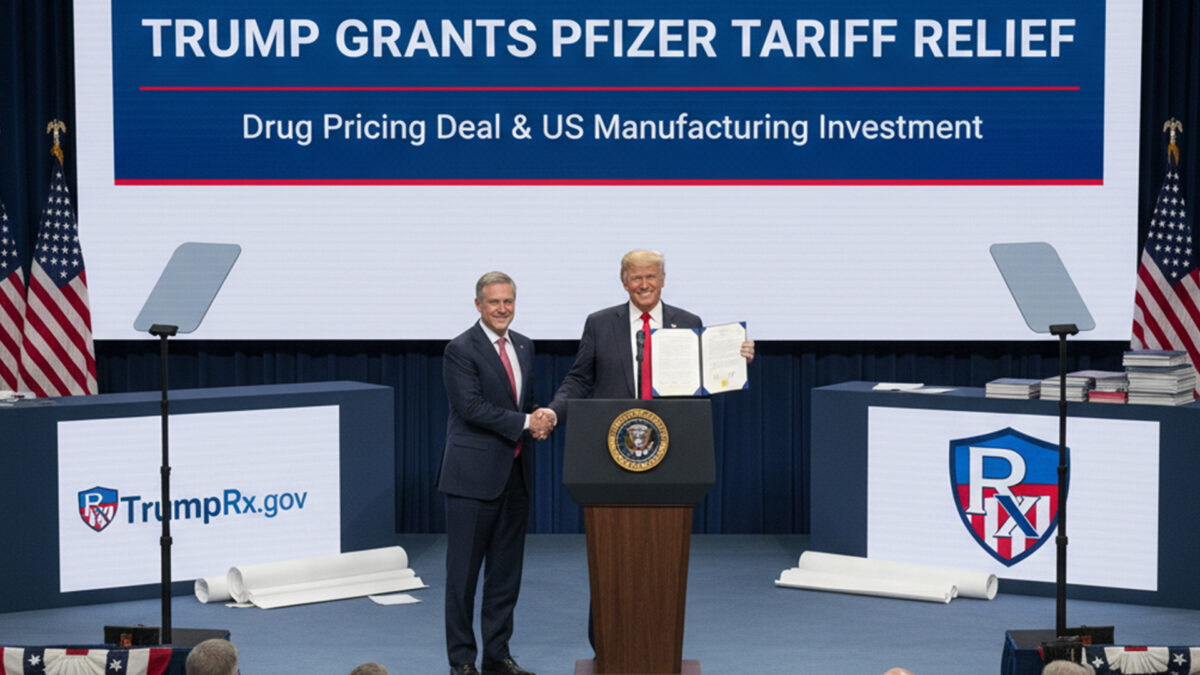
Trump Grants Pfizer Three-Year Tariff Relief in Drug Pricing Deal

U.S. President Donald Trump announced a significant agreement with Pfizer to reduce prescription drug prices for American consumers.

Under the deal, Pfizer will offer many of its primary care and specialty medications through a new government purchasing platform, TrumpRx.gov, at discounts averaging 50% and reaching up to 85%. In return, Pfizer will receive a three-year exemption from tariffs proposed under a national security investigation into pharmaceutical imports.

The agreement also includes a commitment from Pfizer to invest $70 billion in U.S. manufacturing and research and development over the next few years. Additionally, Pfizer has pledged to provide all its prescription medications to Medicaid at “most-favored nation” prices, aligning U.S. Medicaid prices with those in other developed countries.

The TrumpRx platform, set to launch in early 2026, will serve as a direct-to-consumer website allowing Americans to purchase medications at discounted rates negotiated by the government. Pfizer’s participation in this initiative is expected to lower drug costs domestically while boosting pharmaceutical revenues internationally. The agreement is part of the administration’s broader efforts to align U.S. drug prices with those in other developed nations.

This deal marks a political and policy win for President Trump, contrasting his administration’s efforts to lower drug prices with Democrats’ healthcare proposals. Other pharmaceutical companies are reportedly considering similar strategies in response to the administration’s initiatives.

Pfizer’s stock experienced a nearly 5% increase following the announcement, reflecting investor confidence in the company’s new pricing strategy and tariff relief.

The agreement is expected to begin benefiting consumers in 2026, with the potential to significantly reduce out-of-pocket costs for prescription medications. However, experts caution that the full impact remains uncertain due to limited details on pricing terms and the scope of the discount programs.

This development is part of a broader effort by the Trump administration to address rising drug prices and reduce U.S. subsidies for global healthcare costs. The administration has indicated that similar agreements with other pharmaceutical companies may be forthcoming.

Also Read: Electronic Arts Acquired in $55 Billion Buyout

Categories
Corporate

Electronic Arts Acquired in $55 Billion Buyout

Electronic Arts (EA), the renowned video game publisher behind franchises like “Madden NFL,” “Battlefield,” and “The Sims,” has agreed to be acquired in a historic $55 billion leveraged buyout. This deal, announced on September 29, 2025, is led by Saudi Arabia’s Public Investment Fund (PIF), private equity firm Silver Lake, and Affinity Partners, a firm managed by Jared Kushner.

The acquisition will be the largest private equity-funded buyout in history, surpassing the previous record held by the $32 billion TXU Energy buyout in 2007.

Under the agreement, EA shareholders will receive $210 per share in cash, representing a 25% premium over the company’s closing price on September 25, 2025.

The deal comprises about $36 billion in equity from the investors, including a rollover of PIF’s existing nearly 10% stake in EA, and $20 billion in debt financing from JPMorgan Chase, with $18 billion expected to be funded at closing. The transaction is expected to close in the first fiscal quarter of 2027, pending regulatory and shareholder approvals.

CEO Andrew Wilson will remain at the helm and EA will remain based in Redwood City, California. The move to take EA private aims to provide the company with greater flexibility to innovate and invest in long-term strategic initiatives without the pressures of public market scrutiny. This acquisition comes at a pivotal time, as EA is preparing for the launch of its highly anticipated game, “Battlefield 6,” scheduled for release in October 2025.

The buyout also marks the end of EA’s 36-year tenure as a publicly traded company.

The acquisition is expected to have significant implications for the gaming industry, potentially influencing future mergers and acquisitions and the strategic direction of major gaming franchises. PIF, already a 9.9% stakeholder in EA, is increasing its role in the gaming industry through this acquisition. Their ongoing strategy includes investments in companies like Nintendo, ESL, FACEIT, and Scopely, reinforcing efforts to expand their Savvy Gaming Group.

As the gaming industry continues to evolve, this landmark deal underscores the growing convergence of entertainment, technology, and investment, setting the stage for new developments in the gaming landscape.

Also Read: A Lotus in Steel, Glass and Technology to Bloom in October

Categories
Corporate

SEBI Bars Man Industries and Executives Over Fund Diversion

The Securities and Exchange Board of India (SEBI) has imposed a two-year ban on Man Industries (India) Ltd. and three of its senior executives—Chairman Ramesh Mansukhani, Managing Director Nikhil Mansukhani, and former Chief Financial Officer Ashok Gupta—from accessing the securities markets.

This action follows allegations of financial misconduct, including fund diversion and misrepresentation of financial statements.

SEBI’s investigation revealed that the company failed to consolidate its subsidiary, Merino Shelters Pvt. Ltd. (MSPL), into its financial statements between fiscal years 2015 and 2021.

Additionally, the company was found to have misrepresented related-party transactions and engaged in round-tripping of funds to obscure its true financial position.

A forensic audit was commissioned in November 2021 to examine the company’s financial records during this period.

In response to SEBI’s order, Man Industries stated that the penalty is minimal relative to its size and operations and will not affect day-to-day business.

The company continues to maintain a strong order book of over ₹4,700 crore and remains fully operational.

Following the regulatory action, shares of Man Industries (India) Ltd. experienced a significant decline, falling 16% to an intraday low of ₹340.90 on the Bombay Stock Exchange on September 30, 2025.

The stock pared losses to trade 14.5% lower at ₹347.3 apiece, compared to a 0.08% advance in the Nifty 50 index. This marked the fifth consecutive session of decline for the company’s stock.

SEBI’s decision underscores its commitment to maintaining transparency and accountability in India’s financial markets, sending a strong message against corporate misconduct.

Also Read: Air India Raises $215 Million for Debt Refinance