
Categories
Corporate

Nifty 50 Index Undergoes Reshuffle; IndiGo, Max Healthcare Included

The National Stock Exchange (NSE) has implemented its semi-annual rebalancing of the Nifty 50 index, effective September 30, 2025. As part of this reshuffle, InterGlobe Aviation (the parent company of IndiGo Airlines) and Max Healthcare Institute have been included in the index, replacing Hero MotoCorp and IndusInd Bank.

This change is expected to result in significant passive inflows into the newly added stocks. According to Nuvama Institutional Equities, IndiGo’s inclusion is anticipated to attract passive inflows of approximately $545 million, while Max Healthcare is projected to receive around $372 million. Conversely, Hero MotoCorp and IndusInd Bank are expected to experience outflows of $309 million and $217 million, respectively.

In addition to the constituent changes, the weightage of certain existing Nifty 50 stocks has been adjusted. Notably, State Bank of India (SBI), ITC, and Bajaj Finserv have seen increases in their index weightages, which could lead to additional inflows of $99 million, $38 million, and $19 million, respectively.

These adjustments reflect the dynamic nature of the market and aim to ensure that the Nifty 50 index accurately represents the top-performing companies listed on the NSE. The rebalancing is part of the NSE’s regular review process, which considers factors such as market capitalization and liquidity to determine index composition.

The inclusion of IndiGo and Max Healthcare in the Nifty 50 index underscores the growing prominence of the aviation and healthcare sectors in India’s economy. IndiGo, as the country’s largest airline, has seen significant growth in recent years, while Max Healthcare has expanded its presence in the healthcare industry. Their addition to the benchmark index is expected to enhance the representation of these sectors in the market.

The removal of Hero MotoCorp and IndusInd Bank from the Nifty 50 index reflects shifts in market dynamics and company performances. Hero MotoCorp, a leading two-wheeler manufacturer, has faced challenges in maintaining its market position, while IndusInd Bank has experienced issues affecting investor confidence. These changes highlight the evolving nature of the market and the importance of regular index reviews to ensure accurate representation.

Investors and market participants will closely monitor the impact of these changes on the Nifty 50 index and the broader market. The adjustments are expected to influence investment strategies and fund allocations, particularly for index-tracking funds and exchange-traded funds (ETFs) that replicate the Nifty 50 index.

Also Read: UST, Kaynes to set up ₹3,330 crore semiconductor facility in Gujarat
Categories
Corporate

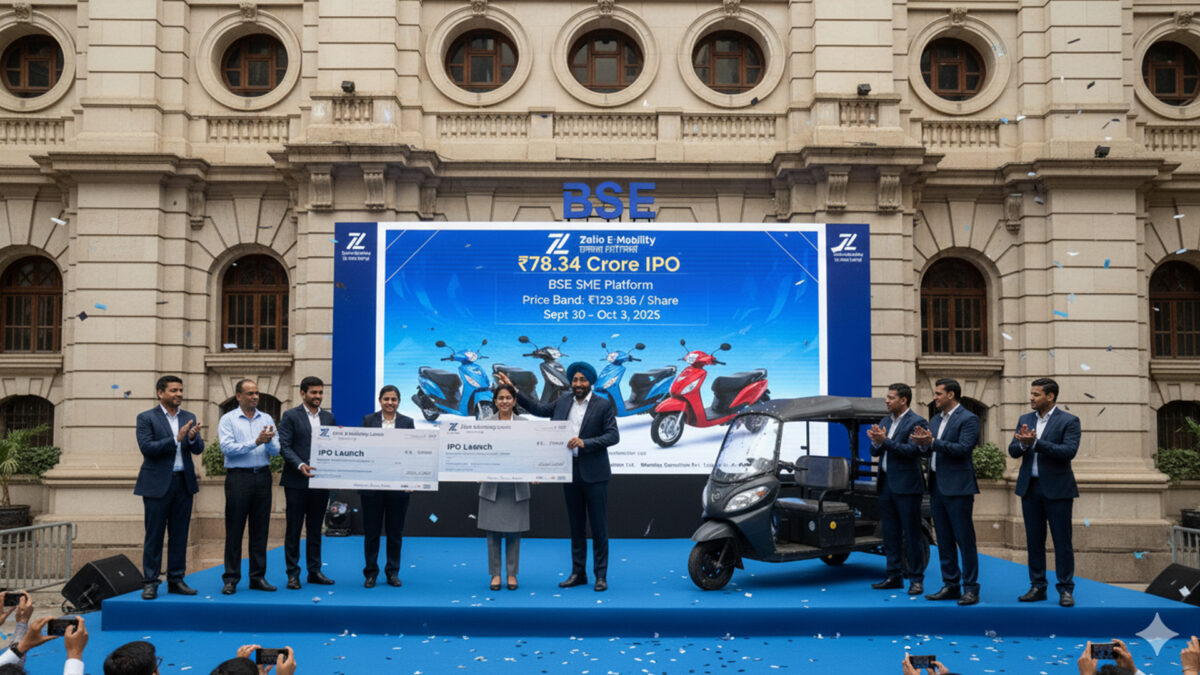
Zelio E-Mobility Launches ₹78 Crore SME IPO

Zelio E-Mobility Limited, an electric vehicle manufacturer based in Haryana, has launched its ₹78.34 crore Initial Public Offering (IPO) on the BSE SME platform.

The IPO opened for subscription on September 30, 2025, and will close on October 3, 2025. The price band for the issue has been set between ₹129 and ₹136 per share, with a lot size of 1,000 shares, requiring a minimum investment of ₹2.58 lakh at the upper price band.

The issue comprises a fresh issue of 5,760,000 equity shares, aggregating to ₹78.34 crore, with no offer for sale component. The funds raised through the IPO are intended to support the company’s expansion plans, including enhancing manufacturing capabilities and expanding its dealer network.

Zelio E-Mobility manufactures electric two-wheelers under the brand name ‘Zelio’ and electric three-wheelers under the brand ‘Tanga’.

The company operates from a 24,458 square meter facility in Ladwa, Haryana, with an annual production capacity of 72,000 units. It distributes its products through a network of over 280 dealers across more than 20 states and union territories.

The IPO’s tentative listing date on the BSE SME platform is October 8, 2025. Hem Securities Ltd. is the book running lead manager for the issue, and Maashitla Securities Pvt. Ltd. is the registrar. Hem Finlease Pvt. Ltd. serves as the market maker for the company.

Also Read: Govt Weighs Overhaul of HAL to Improve Efficiency, Expedite Defence

Categories
Corporate

TCS Leases 1.75 Million Sq Ft Office Space in Bengaluru for ₹975 Crore

Tata Consultancy Services (TCS) has entered into a significant lease agreement for 1.75 million square feet of office space at Sattva Knowledge Point in Yeshwanthpur, Bengaluru.

The lease, valued at about ₹975 crore over five years, underscores TCS’s commitment to expanding its presence in the city’s thriving IT sector.

Under the terms of the agreement, TCS will pay a monthly rent of ₹15.37 crore, translating to ₹87.73 per square foot. A security deposit of ₹25 crore has been made, and the lease includes a 14% rental escalation every three years, with an option to renew for an additional five-year term. The leased space spans across three floors in both Tower A and Tower B of the development.

This move is part of TCS’s broader strategy to strengthen its infrastructure in key technology hubs. Earlier this year, the company secured another substantial lease for 1.4 million square feet at 360 Business Park in Bengaluru’s Electronic City, valued at ₹2,130 crore over 15 years. These strategic expansions align with TCS’s long-term growth objectives and its role as a leading player in the global IT services industry.

The Sattva Knowledge Point development, owned by Darshita Southern India Happy Homes Pvt Ltd, is among Bengaluru’s premier commercial properties, offering state-of-the-art facilities to meet the evolving needs of IT companies. TCS’s latest lease agreement reflects the sustained demand for high-quality office spaces in Bengaluru, driven by the city’s status as a major IT and business hub.

Also Read: Nifty 50 Index Undergoes Reshuffle; IndiGo, Max Healthcare Included

Categories
Corporate

Air India Raises $215 Million for Debt Refinance

Air India has secured approximately $215 million from Standard Chartered and Bank of India in a six-year loan facility arranged through GIFT City (Gujarat International Finance-Tec City), according to a Bloomberg report.

The financing carries a margin of around 168 basis points over the secured overnight financing rate. The proceeds will help refinance shorter-tenure debt that the airline had taken on to acquire six Boeing 777-300ER aircraft.

This is the first time Bank of India has served as a mandated lead manager in a GIFT City loan transaction. Neither the airline nor the lenders has publicly confirmed the arrangement.

The new $215 million facility underscores the airline’s ongoing strategy to replace shorter-term, higher-cost borrowing with longer-maturity debt, strengthening its financial position as it expands its fleet and network under the Tata Group ownership.

Also Read: UST, Kaynes to set up ₹3,330 crore semiconductor facility in Gujarat

Categories
Corporate

UST, Kaynes to set up ₹3,330 crore semiconductor facility in Gujarat

UST, a global AI and technology transformation solutions company, has announced a strategic investment in Kaynes Semicon to establish a ₹3,330 crore semiconductor manufacturing facility in Sanand, Gujarat.

The new plant will focus on Outsourced Semiconductor Assembly and Test (OSAT) solutions, aiming to strengthen India’s semiconductor ecosystem and enhance its global competitiveness.

“This ambitious partnership between UST and Kaynes Semicon will help shape the future of semiconductor manufacturing in India. Together, our two great companies will harness the strengths of the Indian market and build a formidable foundation for the country to become a key player in the global semiconductor industry,” said Krishna Sudheendra, Chief Executive Officer of UST.

Raghu Panicker, Chief Executive Officer of Kaynes Semicon, highlighted the synergy between the two firms. “Our partnership with UST brings together world-class manufacturing and digital engineering expertise. This enables Kaynes Semicon to deliver advanced OSAT solutions while strengthening India’s self-reliant semiconductor ecosystem,” he said.

The collaboration aims to leverage both companies’ strengths in manufacturing and technology. UST’s global presence and established semiconductor client base are expected to open new opportunities for Kaynes Semicon, helping Indian assembly and testing services reach a wider international audience. By integrating digital engineering, AI-driven process optimization, and real-time data analysis, the partnership is designed to ensure scalability, reliability, and cost efficiency in semiconductor production.

The facility will also target key sectors such as electric vehicles, consumer electronics, and renewable energy technologies, aligning with India’s broader push for self-reliance in strategic industries. Both companies stressed that the investment represents not only a manufacturing expansion but also a platform for long-term collaboration, innovation, and industry growth.

Semiconductor manufacturing is a complex process that involves multiple stages, including wafer fabrication, photolithography, etching, doping, packaging, and rigorous testing. OSAT facilities, such as the one planned in Sanand, focus on the assembly, packaging, and testing phases, which are critical for ensuring chip reliability and performance. By localizing these processes in India, the partnership is expected to reduce dependence on imports and support domestic demand for advanced electronic components.

The investment also reflects growing interest from global technology firms in India’s semiconductor sector. With increasing demand for chips in electronics, electric vehicles, and renewable energy systems, local manufacturing and testing capabilities are becoming essential to meeting both domestic and international market requirements.

UST and Kaynes Semicon have stated that the facility will incorporate advanced digital solutions and AI-driven monitoring systems to streamline operations and maintain high-quality standards. The collaboration aims to create a resilient supply chain while supporting India’s ambitions to emerge as a global hub for semiconductor production.

The Sanand facility is expected to play a key role in shaping India’s semiconductor landscape, providing both technological expertise and manufacturing capacity that can meet the growing needs of domestic and international clients.

Also Read: Govt Weighs Overhaul of HAL to Improve Efficiency, Expedite Defence Deliveries

Categories
Corporate

Govt Weighs Overhaul of HAL to Improve Efficiency, Expedite Defence Deliveries

The Indian government is exploring a comprehensive restructuring of Hindustan Aeronautics Limited (HAL) to boost its operational efficiency and accelerate its ability to meet defence procurement timelines.

An external consulting firm has been engaged to design a strategic roadmap that could transform HAL’s current structure, the Economic Times has reported. One of the leading ideas under discussion is to split HAL into multiple independent entities, each focused on a particular domain such as fixed-wing aircraft manufacturing, helicopters, and maintenance, repair and overhaul (MRO).

The overhaul is being considered in view of HAL’s expanding order backlog and performance challenges. The defence PSU is said to be managing a record order book exceeding ₹2.7 lakh crore, covering fighter jets, helicopters, engines and other aeronautical platforms. As delays in deliveries have become a growing concern, the proposed restructuring aims to ensure that HAL can respond more nimbly to the needs of the armed forces.

According to reports, the plans are still in nascent stages and under deliberation. The roadmap may create discrete units dedicated to design, manufacturing, MRO services, and supply chain operations. Previously, similar restructuring ideas were considered but shelved when HAL’s order volumes were smaller.

The government’s interest in reforming HAL coincides with recent large defence contracts awarded to the company. In a recent procurement, the Ministry of Defence signed a deal worth over ₹62,370 crore with HAL for 97 Light Combat Aircraft (LCA) Mk-1A jets, which underscores the scale and importance of HAL’s upcoming commitments.

HAL has also begun to diversify its operations. Its Nashik MRO facility has expanded into civilian aircraft overhauls—recently servicing Airbus A320s and Embraer jets under a collaboration with Airbus. This move into civil aviation maintenance is seen as a push to leverage HAL’s technical infrastructure beyond defence production.

The restructuring, if approved, would mark a significant shift for HAL, which already holds Maharatna status, granting it enhanced financial and operational autonomy. Observers suggest that a leaner, domain-focused structure could reduce bottlenecks, improve accountability, and generate more specialization within HAL’s divisions.

However, there are challenges ahead. Deciding how to divide assets, allocate liabilities, preserve institutional knowledge, retrain employees, and manage transition costs will demand detailed planning. Moreover, the move will likely require approvals from multiple arms of government and the defence establishment.

As of now, no formal announcement has been made. The government continues to deliberate on the proposal, weighing the benefits against the complexity of reengineering a legacy defence enterprise.


Also Read: FADA President: Hatchbacks Here to Stay Despite Rising SUV Dominance

Categories
Corporate

FADA President: Hatchbacks Here to Stay Despite Rising SUV Dominance

Despite the global trend of SUVs and GST 2.0 era, hatchbacks will maintain their market relevance across the auto industry, the Federation of Automobile Dealers Associations (FADA) said.

“This ‘SUVisation’ of the industry is happening throughout the world. It is not because India has bad roads…this whole thing about SUVs is not going to go away. It is going to be there for quite some time to come,” FADA President CS Vigneshwar said.

He also added that while SUVs give a purpose of comfort, style and safety, “hatches will have their own space because some people still want the hatches”.

Vigneshwar said many car makers are still offering multiple products in small car segment which in turn keep the market alive through competition unlike in the mid-size sedan segment, which has been squeezed.

“SUVs in every category, and hatchbacks in one or two categories, you will have literally every OEM with multiple products sometimes. So, this is going to happen. Hatches will exist, and SUVs will exist,” Vigneshwar said.

India’s largest carmaker Maruti Suzuki India, which grabs a top position in the small car segment, expects about 10 per cent growth in the segment after the GST rate reduction, its rival Hyundai Motor India feels that micro SUVs like Exter and Punch will grow at the cost of hatchbacks as consumer preference has evolved.

Also Read: Consumers Can Soon Switch LPG Suppliers Like Mobile Numbers

Categories
Corporate

TKIL Industries, SoHHytec to Establish Green Hydrogen Plant in India

TKIL Industries, formerly known as Thyssenkrupp Industries India, has partnered with Swiss company SoHHytec to establish a green hydrogen production facility in India.

The plant, expected to commence operations within the next 12 months, will utilize SoHHytec’s proprietary artificial photosynthesis (photo-electrolysis) technology to produce green hydrogen from renewable energy sources such as solar and wind.

This collaboration aims to support India’s National Hydrogen Mission, which targets the production of 5 million tonnes of green hydrogen annually by 2030.

The partnership designates TKIL Industries as SoHHytec’s exclusive partner in India. TKIL will be responsible for manufacturing and supplying specific equipment and machinery, as well as installing green hydrogen projects across the country.

The green hydrogen produced is intended for use in various industrial applications, including steel manufacturing, oil refining, and chemical production.

Vivek Bhatia, Managing Director and CEO of TKIL Industries, expressed optimism about the project, stating that the company is in discussions with potential clients in sectors such as steel and oil marketing companies to set up green hydrogen plants. He emphasized that TKIL’s role as an engineering, procurement, and construction (EPC) player positions the company to build and hand over these plants to clients upon completion.

SoHHytec’s artificial photosynthesis technology is recognized for its cost efficiency in producing green hydrogen. The process involves using renewable energy to split water molecules into hydrogen and oxygen, a method that is both scalable and adaptable to various industrial needs. This technology aligns with India’s objectives to reduce dependence on fossil fuels and enhance renewable energy capacity.

The establishment of this green hydrogen plant is seen as a significant step in India’s efforts to transition towards cleaner energy sources and achieve its climate targets. The collaboration between TKIL Industries and SoHHytec underscores the growing emphasis on sustainable energy solutions and the role of international partnerships in advancing green technologies.

As the project progresses, further details regarding the location of the plant, investment figures, and specific timelines for each phase of development are expected to be announced. The success of this initiative could serve as a model for future green hydrogen projects in India and contribute to the country’s leadership in the global clean energy transition.

Categories
Corporate

HUL Warns of Flat-to-Low Sales Growth Amid GST Impact

Hindustan Unilever Ltd (HUL) has projected nearly flat to low single-digit consolidated business growth for the quarter ending September 30, 2025, attributing the subdued performance to the recent Goods and Services Tax (GST) rate revisions.

The company noted that approximately 40% of its product portfolio, including items such as toilet soap, toothpaste, shampoo, and hair oil, now benefit from a reduced GST rate of 5%, down from the previous rates of 12% or 18%.

The GST adjustments, effective from September 22, 2025, have led to temporary disruptions in the sales and distribution channels. HUL reported that distributors and retailers have delayed new orders to clear existing inventory priced under the previous tax regime, resulting in postponed consumer purchases.

This transition has caused a short-term impact on sales, with the company expecting the effects to persist into October. HUL anticipates a recovery starting in November as prices stabilize and consumer demand normalizes.

In response to the GST changes, HUL has passed on the tax benefits to consumers through competitive pricing across a wide range of products. The company remains committed to supporting the government’s efforts to stimulate consumption and expects the reforms to increase disposable income and drive long-term demand across key categories.

Despite the short-term challenges, HUL views the GST reforms as a positive step for the consumer goods sector. The company expects that the transitional impact will be temporary and anticipates a rebound in growth as the market adjusts to the new pricing structure.

Analysts have expressed cautious optimism regarding HUL’s outlook. Jefferies maintained a ‘Buy’ rating on the stock with a target price of ₹3,000, citing the long-term benefits of the GST cuts despite the short-term sales slowdown. Similarly, BofA Securities retained a ‘Neutral’ rating with an unchanged target price of ₹2,840, highlighting the temporary nature of the disruptions. However, Morgan Stanley reiterated an ‘Equal-Weight’ rating, noting that the company’s recent update fell below market expectations.

On September 29, 2025, HUL’s shares experienced a decline, falling by up to 2.5% in early trading. The stock’s performance reflects investor concerns over the immediate impact of the GST reforms on the company’s sales growth. However, the broader market sentiment remains positive, with expectations of a recovery in the coming months as the effects of the tax changes dissipate.

In conclusion, while HUL faces short-term challenges due to the GST rate adjustments, the company remains optimistic about the long-term prospects. The anticipated recovery in consumer demand, coupled with the benefits of the tax reforms, positions HUL for sustained growth in the future.

Also Read: Sensex rises 200 pts, Nifty above 24,700 after 6-day slide

Categories
Corporate

Pharma stocks rebound as tariff fears ease; Sun Pharma, Lupin, Cipla lead gains

After a sharp sell-off last week, which analysts said was sentiment-driven since US tariffs target branded and patented drugs while Indian exports are largely generic, pharma stocks recovered.

Out of the 20 index stocks, 15 advanced, led by Sun Pharma, Lupin, Cipla, Zydus Life, Biocon, Granules India, Torrent Pharma, Laurus Labs, Aurobindo Pharma, and Glenmark Pharma, which gained up to 2 percent.

The sell-off was triggered by US President Donald Trump’s announcement of 100 percent tariffs on branded and patented drugs starting October 1, part of its broader push to onshore pharma manufacturing, create jobs, and cut foreign reliance.

Also Read: Sensex rises 200 pts, Nifty above 24,700 after 6-day slide