
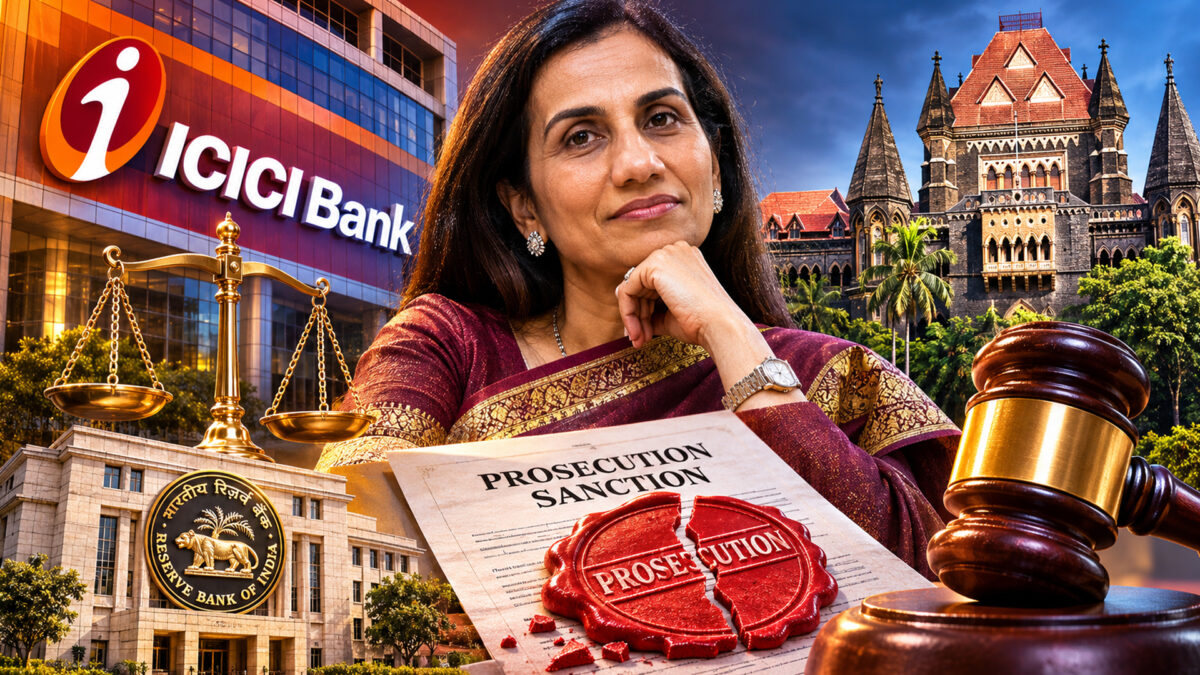
The Bombay High Court has quashed the sanction granted by ICICI Bank’s board to prosecute its former managing director and chief executive officer, Chanda Kochhar, in the alleged ICICI-Videocon loan case. The court ruled that the bank’s board was not legally authorised to grant the sanction and had also failed to independently examine the evidence collected by the Central Bureau of Investigation (CBI).
In a significant order delivered on November 18, Justice Milind N Jadhav held that the prosecution sanction issued on May 15, 2023, was legally unsustainable and amounted to a nullity. The court found that the authority to grant such sanction rested with the Reserve Bank of India (RBI), not ICICI Bank’s board of directors.
The judgment came on a petition filed by Kochhar challenging the legality of the sanction. She argued that under the Banking Regulation Act, 1949, the RBI was the authority empowered to remove her from the position of managing director and CEO and, therefore, was also the competent authority to approve her prosecution under the Prevention of Corruption Act, 1988.
The CBI had opposed her petition, maintaining that ICICI Bank’s board had the power to appoint and remove its managing director under the Companies Act, 2013, and the bank’s Articles of Association. It argued that the RBI’s regulatory powers did not take away the board’s authority.
Rejecting this argument, the High Court examined provisions of the Banking Regulation Act, particularly Sections 35-B and 36-AA. It observed that the RBI’s approval is necessary for the appointment, reappointment or termination of a managing director or CEO of a banking company.
Section 36-AA also empowers the RBI to remove a bank’s chairman, director or chief executive through a written order, after providing the concerned individual an opportunity to respond.
The court held that these statutory provisions override contrary provisions in a bank’s Articles of Association, board resolutions or other applicable laws.
“Thus the power of removal vests with RBI and RBI only,” Justice Jadhav observed.
Consequently, the court ruled that ICICI Bank’s board could not exercise a power that legally belonged to the RBI. It also said the CBI should have approached the central bank for the necessary prosecution sanction instead of seeking approval from the bank’s board.
Apart from questioning the board’s authority, the High Court identified another serious defect in the sanction process. It found that ICICI Bank’s board had failed to apply its mind independently to the material gathered during the CBI investigation before approving Kochhar’s prosecution.
The court noted that although the CBI had forwarded its request and investigation report to the bank, the underlying evidence, including witness statements, documents and other relevant material, had not been placed before the board for proper consideration.
The minutes of the board meeting and the sanction order also did not indicate any meaningful discussion or examination of the evidence against Kochhar.
The court emphasised that granting prosecution sanction is not a routine administrative exercise. The competent authority must examine the entire relevant record, including material that could potentially favour the accused, before deciding whether prosecution should be permitted.
Relying on the Supreme Court’s ruling in CBI versus Ashok Kumar Aggarwal, the High Court reiterated that the sanctioning authority must independently assess the evidence rather than simply accept the investigating agency’s allegations.
Justice Jadhav observed that there was no evidence to show that the board had examined the material collected during the investigation. The court also found no meaningful discussion of the allegations in the board meeting records.
The case relates to a loan of ₹3,250 crore sanctioned by ICICI Bank to the Videocon Group in 2012, when Kochhar was heading the private sector lender.
The CBI alleged that Kochhar had facilitated the loan despite a potential conflict of interest because her husband, Deepak Kochhar, and his business interests allegedly benefited from transactions involving the Videocon Group.
According to the investigating agency, Videocon chairman Venugopal Dhoot had invested in Nu Renewable, a company associated with Deepak Kochhar. The CBI alleged that this investment was part of a quid pro quo arrangement linked to the loan approval.
The loan subsequently turned into a non-performing asset (NPA), with the CBI alleging irregularities in its sanction and disbursement. The agency had registered a case involving allegations of cheating and corruption.
Chanda Kochhar and her husband were arrested by the CBI in December 2022. They were granted interim bail in January 2023. In June 2023, the agency informed a special court that ICICI Bank had granted the necessary sanction to prosecute Kochhar, citing the alleged exchange of favours connected with the loan.
Under Section 19 of the Prevention of Corruption Act, prior sanction from the legally competent authority is required before a court can take cognisance of certain corruption offences involving public servants. Employees of banking companies are treated as public servants for the relevant provisions of the law.
The CBI had also argued that Kochhar’s objections regarding the validity of the sanction should be examined during the trial rather than at the preliminary stage.
The High Court rejected this position, observing that the question of whether the sanction had been granted by a legally competent authority was a fundamental issue that could be decided at the outset.
It relied on Supreme Court judgments, including Nanjappa versus State of Karnataka and Abdul Wahab Ansari versus State of Bihar, to underline that a valid sanction is a necessary condition for the court to proceed with the relevant prosecution.