Categories
Counterpoint

India’s defence is strong — but not yet deep enough

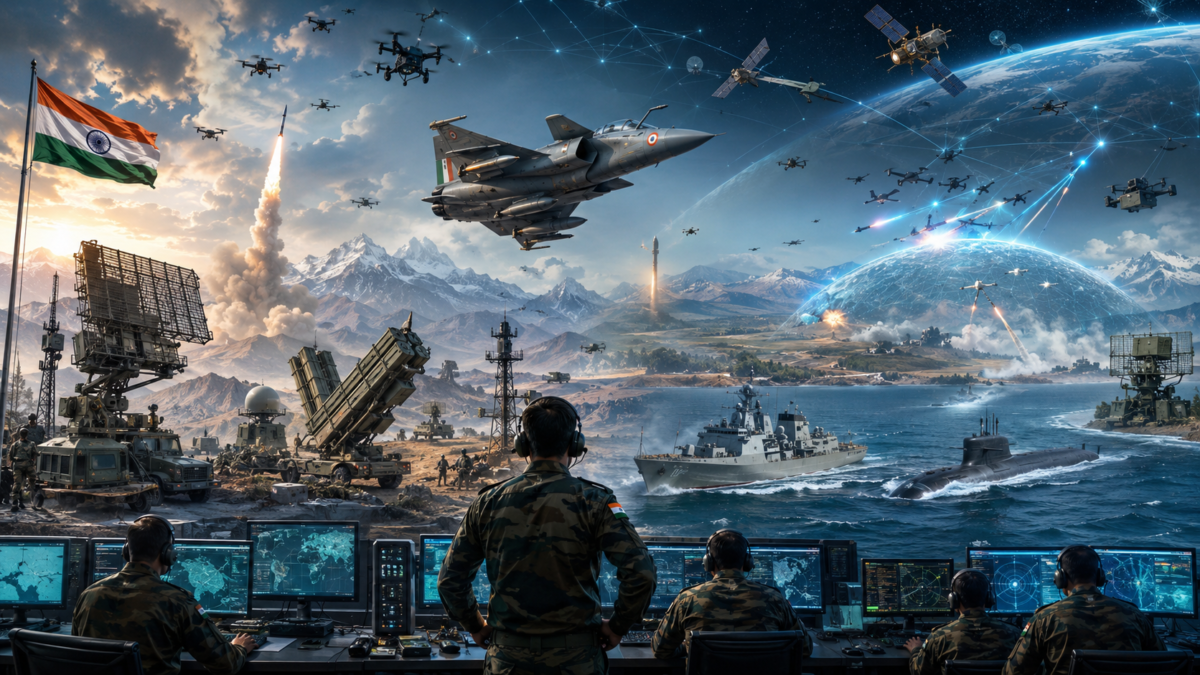
The next war will not wait for India to complete a tender. It may begin with algorithms scanning satellite images, hackers probing electricity networks and inexpensive drones searching for radars, ammunition depots and command posts.

Precision missiles will follow. Electronic warfare will attempt to blind sensors and corrupt navigation signals, while fabricated videos and automated propaganda seek to confuse the public.

Mass drone warfare has already moved from military theory to battlefield routine. Ukraine and West Asia have shown how relatively cheap unmanned systems can locate artillery, strike armour, harass ships and force an opponent to expend costly missiles. Artificial intelligence increasingly helps identify targets, fuse intelligence, plan logistics and coordinate swarms.

India faces an especially unforgiving strategic landscape: a volatile, nuclear-armed Pakistan to the west; a much larger and technologically formidable China along the northern and eastern frontier; and an Indian Ocean increasingly frequented by extra-regional navies.

The true test of readiness, therefore, extends beyond winning a sharp exchange. India must be capable of sustaining a multi-domain conflict while keeping its ports, power grids, communications, transport networks and economy functioning.

Operation Sindoor offered India its clearest recent preview of technology-intensive warfare.

On the night of 7-8 May 2025, Pakistan attempted to attack military targets across northern and western India with drones and missiles. According to the government’s official account of the operation, India’s Integrated Counter-Unmanned Aerial Systems Grid and layered air defences neutralised the attacks.

Legacy Pechora and OSA-AK systems operated alongside low-level air-defence guns, indigenous Akash missiles, electronic-warfare equipment and newer counter-drone weapons. The Indian Air Force’s Integrated Air Command and Control System connected sensors and shooters across a wide area.

India also used loitering munitions and precision weapons offensively. Its electronic-warfare capabilities helped penetrate or suppress Pakistani defences. Later, the Defence Ministry said the Air Force’s IACCS had worked with the Army’s Akashteer and the Navy’s Trigun to create a unified operational picture.

That performance should inspire confidence but not complacency. A short, controlled confrontation cannot fully simulate a prolonged war involving sustained missile attacks, satellite disruption, cyber sabotage, mounting equipment losses and interrupted foreign supplies.

India has built a formidable first punch and a credible shield. It must now build greater depth behind both.

One of the urgent revisions India needs is to accept that drones are ammunition, not equipment. India’s armed forces have clearly recognised the unmanned revolution. The Air Force’s Mehar Baba competition produced a ₹300-crore order for an Indian swarm-drone system, while the Army had manufactured 819 drones internally by early 2026. The Army has also committed to giving every soldier drone-related training by 2027.

Yet scale changes everything.

India recorded 791 drone intrusions along its international border in 2025, mainly in Punjab and Rajasthan; 237 were neutralised, according to PRS Legislative Research’s defence analysis. Wartime swarms would present a far more demanding challenge.

India needs reconnaissance drones, one-way attack drones, electronic-warfare drones, high-altitude logistics drones, naval unmanned aircraft, unmanned surface vessels and underwater systems in very large numbers. Procurement must treat many of these platforms as rapidly evolving, expendable munitions — not as aircraft expected to remain unchanged for 20 years.

Counter-drone economics matter just as much. Firing a sophisticated surface-to-air missile at every inexpensive quadcopter would soon become unaffordable. India requires layers of jammers, spoofers, automatic cannon, interceptor drones, micro-missiles and directed-energy weapons, reserving costly missiles for the threats that justify them.

Domestic assembly alone will not provide genuine security. Motors, batteries, thermal cameras, secure communication modules, navigation systems, chips and electronic components must remain available when foreign suppliers restrict exports or global supply chains seize up.

Artificial Intelligence must move from demonstrations to doctrine. Indeed, AI should become the nervous system of the armed forces, not another procurement category.

India possesses abundant software talent and has begun developing AI-enabled surveillance, autonomous systems, predictive maintenance and decision-support tools. The Armed Forces’ 2025 technology roadmap explicitly identifies AI, autonomy, hypersonic weapons, space, cyber capabilities and networked warfare as priorities.

The harder task involves deployment at scale. A useful military AI system must work at the edge, with weak connectivity, under electronic attack and amid deliberate deception. It must distinguish a tank from a decoy, recognise manipulated intelligence and continue operating when cloud access disappears.

India should concentrate on five immediate applications: multi-sensor intelligence fusion; drone and counter-drone coordination; cyber-threat detection; predictive maintenance; and logistics forecasting. A common defence-data architecture would allow the three services to train and operate compatible systems without dissolving necessary security boundaries.

Command responsibility must remain unambiguous. AI may recommend, prioritise and warn, but a human chain of accountability should govern lethal decisions. Speed cannot become an excuse for opacity.

Further, India’s air power needs numbers as well as sophistication. The Indian Air Force retired its final MiG-21s in September 2025, leaving it with about 29 fighter squadrons against an authorised strength of 42. Tejas represents a major indigenous achievement, but production delays have widened the gap between retirement and replacement.

India cannot indefinitely compensate for insufficient mass with the quality of its Rafales, upgraded Sukhoi-30MKIs and advanced missiles. Even an exceptional aircraft can fly only one mission at a time. Attrition, maintenance and the demands of two geographically separated fronts quickly consume available strength.

Fighter induction must accelerate, but fighters alone will not solve the problem. India also requires more airborne early-warning aircraft, aerial refuellers, long-range weapons, hardened shelters, rapid runway-repair units, realistic decoys and large stocks of precision munitions. Manned-unmanned teaming should allow fighters to send cheaper autonomous aircraft ahead as sensors, jammers or weapons carriers.

Off India’s long coastline, the undersea contest may decide who rules the waters of the Indian Ocean, the Arabian Sea and the Bay of Bengal. India’s Navy remains the region’s strongest indigenous naval force. Its shipyards now build aircraft carriers, destroyers, frigates, submarines and anti-submarine vessels. Yet the maritime balance is moving quickly.

India operated 137 ships and submarines in 2025, but 53 per cent of its vessels were more than 15 years old. Fifty-eight ships were under construction and another 62 had received approval. China, meanwhile, has been commissioning more than 15 naval vessels annually and regularly sending submarines into the Indian Ocean, according to a parliamentary assessment summarised by PRS.

India needs faster submarine construction, including conventional boats with air-independent propulsion and nuclear-powered attack submarines. It also needs stronger seabed surveillance, maritime patrol aircraft, anti-submarine helicopters, underwater drones, mine-countermeasure vessels and replenishment ships.

The debate over another aircraft carrier should not crowd out these less glamorous capabilities. An adversary’s submarines, long-range missiles and unmanned systems may pose a greater daily threat to sea lanes than its carrier fleet.

Diego Garcia deserves perspective. The atoll hosts a British-American facility that provides logistical support to US forces in the Indian Ocean and Persian Gulf. It is not a Chinese or Pakistani base, and India’s expanding strategic partnership with the United States makes it inaccurate to describe the installation as inherently hostile.

Its existence nevertheless demonstrates the decisive value of distant logistics hubs. Governments and alignments can change. Friends can turn enemies overnight. India must strengthen the Andaman and Nicobar Islands, Lakshadweep, coastal airfields, protected fuel storage and overseas access arrangements so that no external power can dominate its maritime lifelines.

China poses the more direct long-term basing concern. It already operates a military support base in Djibouti, and the US Department of Defense assesses that Beijing has considered additional military access in countries including Pakistan, Bangladesh, Myanmar and Sri Lanka.

Beside the women, men and conventional war machines, a new crop of combatants is fighting today’s battles — satellites, cyber networks and defence manufacturing units.

Modern forces cannot shoot accurately if they cannot see or communicate. India has dedicated military satellites, strong launch capabilities and proven anti-satellite technology. During Operation Sindoor, the ISRO chairman said at least 10 satellites were working continuously for national security.

A small number of valuable satellites, however, can become attractive targets. India needs proliferated constellations, protected communications, rapid replacement launches, alternatives to satellite navigation and the ability to combine military, commercial and allied imagery.

Cyber defence must extend beyond military networks. A successful attack on ports, railways, banks, telecommunications or the electricity grid could slow mobilisation without striking a single military formation. Regular national exercises should test how civilian and military systems operate under simultaneous cyberattack, misinformation and communications failure.

Industrial resilience presents an equally important challenge. India’s defence exports reached a record ₹38,424 crore in 2025-26, rising almost 63 per cent in one year. Indigenous missiles, radars, artillery, naval vessels and electronic systems represent genuine advances.

At the same time, SIPRI ranked India as the world’s second-largest arms importer during 2021-25, accounting for 8.2 per cent of global imports. Russia still supplied 40 per cent of those imports, although India has diversified towards France, Israel and the United States.

An Indian label on a platform means little if its engine, seeker, transmission, semiconductor or critical material becomes unavailable during a crisis. Self-reliance must be measured by the ability to repair, replenish and modify equipment without foreign permission.

Military factories and defence manufacturing lines must also possess surge capacity. A country prepared for 10 days of combat may not remain prepared after 100. India should maintain rotating war reserves, multiple qualified suppliers for critical components and production lines that can expand quickly. Long-term orders would give private companies a commercial reason to invest in capacity before an emergency.

The 2026-27 defence allocation reached a record ₹7.85 lakh crore, including ₹2.19 lakh crore under the capital head. Yet the total amounts to about 2 per cent of GDP, below the 3 per cent recommended by a parliamentary committee.

Only 29 per cent of defence expenditure goes towards capital outlay, against a previously recommended 40 per cent. Defence research accounts for an estimated 3.7 per cent of expenditure, down from 4.7 per cent in 2014-15. India’s own Defence Ministry has sought a gradual increase in R&D spending towards 10 per cent over the next decade.

More money will not automatically create readiness. Stable priorities, competitive development, realistic testing and faster decisions matter just as much. India’s procurement system must accept iterative improvement instead of waiting endlessly for a perfect indigenous system—or importing one after domestic delays become intolerable.

Jointness completes the equation. Operation Sindoor showed what integrated sensors and command networks can achieve. The next step must connect planning, logistics, airspace management, cyber operations, intelligence and long-range targeting across all three services. Organisational boundaries cannot be allowed to slow a kill chain that operates in seconds.

So, is India ready?

India can defend vital targets, impose serious costs and respond with precision. Few adversaries could treat its military power lightly. But prolonged, simultaneous conflict across two land fronts and the Indian Ocean—conducted under cyberattack, satellite disruption and supply-chain pressure—would expose important shortages.

Five priorities demand urgency: expendable drones and economical counter-drone systems; greater combat-air mass and its supporting enablers; undersea and anti-submarine power; resilient space and cyber networks; and an indigenous industrial base capable of replenishing losses at wartime speed.

India has fashioned an increasingly sharp spear. It now needs a much larger quiver, a more resilient shield and the industrial workshop capable of replacing both while the battle continues.


Categories
Counterpoint

A licence to hack criminals could become a licence to hack competitors

For years, the standard advice to a company under cyberattack has been curiously one-sided: defend yourself, preserve the evidence, call the authorities — and do not strike back.

There were good reasons for that. Giving companies a licence to invade someone else’s computer systems risks hitting the wrong target, destroying evidence, violating another country’s sovereignty or turning a commercial dispute into something much more serious.

But there is another risk that has received rather less attention: what if the old rules simply leave the criminals with the advantage?

President Donald Trump’s administration has now taken a significant step towards answering that question. Under a presidential memorandum issued on August 12, vetted American companies will be allowed to participate in offensive cyber operations against foreign transnational criminal organisations.

That sounds, at first hearing, like the legalisation of corporate “hack back”. It is more constrained than that.

The operations are to be carried out under federal supervision. Participating companies must be vetted and contracted by the Justice Department or Department of Homeland Security. Individual operations require written approval. Companies may be required to maintain a bond or escrow of at least $1 million that can be forfeited for non-compliance.

Most importantly, the companies are not being handed a general licence to attack anyone they believe attacked them. They will act on behalf of, and under the authority of, the US government.

That distinction matters.

But so does the reason Washington believes such a program is necessary.

Cybercrime is no longer a peripheral law-and-order nuisance committed by clever teenagers in bedrooms. Large criminal networks now resemble multinational enterprises. They have specialists, infrastructure, customer-service operations, money-laundering networks and supply chains. Some sell ransomware as a service. Others run industrial-scale fraud centres.

The money involved is extraordinary. The FBI’s 2025 Internet Crime Report recorded more than one million complaints and reported losses exceeding $20 billion. Cyber-enabled fraud alone accounted for about $17.7 billion.

And the economics favour the attacker.

A criminal group may operate from a country unwilling or unable to arrest it. Its servers can be scattered across jurisdictions. Its members can hide behind layers of infrastructure, cryptocurrency wallets and stolen identities. By the time traditional international law-enforcement mechanisms begin moving, the criminals may have disappeared, reconstituted themselves under a different name or shifted their systems elsewhere.

A victim, meanwhile, is expected to remain almost entirely defensive.

Imagine a burglar repeatedly entering homes from a fortress across the border. The homeowners may install stronger locks, cameras and alarms. The police are allowed and empowered to investigate. Diplomatic requests can be sent to the country hosting the fortress. But nobody is permitted to disable the burglar’s getaway vehicles. That is roughly the imbalance Washington is trying to address.

The argument for using private cyber companies is also practical. Some of the world’s deepest knowledge of malicious networks does not reside solely inside intelligence agencies. It sits inside cybersecurity companies, cloud providers, telecommunications companies and specialist threat-intelligence firms that encounter attacks every day.

Indeed, government already relies extensively on private companies to detect, understand and contain cyber threats. The new policy extends that partnership from seeing the attacker towards, in carefully approved circumstances, disrupting the attacker.

The idea is not as radical as it sounds. Governments routinely use private capability to fulfil public objectives. Defence contractors build weapons and operate sophisticated systems. Commercial satellite companies provide imagery used for national security. Private logistics firms support military operations. Banks help governments detect and freeze illicit finance.

The important question has never been whether private expertise may serve the state. It is who controls its use. And that is where the Trump plan deserves support — provided its safeguards survive implementation.

There must be a bright line between a company defending its own interests and a company carrying out an operation authorised by the United States. The presidential memorandum explicitly attempts to draw one: approved operations remain under government operational control, and each package must receive written authorisation before action is taken.

There are also obvious dangers. Cyber attribution is notoriously complicated. A server used by a ransomware gang may actually belong to an innocent business whose system has been compromised. Criminal infrastructure can share networks with legitimate users. An operation aimed at disabling a criminal network might have consequences in a third country.

And cyber operations can escalate. Destroying a criminal server sounds uncomplicated until the server sits inside a country that regards the intrusion as an infringement of its sovereignty. Matters become even more delicate when criminals enjoy informal protection from officials or operate in the grey space between organised crime and state interests.

These are reasons for strict government control, however — not necessarily reasons for permanent passivity.

An uncomfortable assumption rests behind much of the opposition to offensive cyber action: that restraint by the victim produces restraint by the attacker. However, there is little evidence that criminals operate according to that bargain.

A ransomware gang does not stop because its target obeys international cyber etiquette. A fraud compound does not close because investigators are waiting for paperwork to travel through several jurisdictions. Criminal organisations exploit precisely the gaps between national legal systems.

Deterrence requires consequences. The US government has already demonstrated how public-private cooperation can make criminal operations harder. During a recent US Justice Department “Disruption Week”, government agencies worked with private companies to disrupt scam accounts and financial infrastructure associated with transnational fraud operations.

The logical question is whether such cooperation should sometimes go further.

If intelligence identifies a foreign criminal network actively stealing millions of dollars from American citizens, and if an operation can disable its infrastructure without causing wider damage, should Washington really refrain merely because the technicians capable of carrying it out receive private-sector salaries?

That would confuse the identity of the operator with the legitimacy of the operation.

Legitimacy should instead come from lawful authority, defined targets, proportionality, oversight and accountability.

In all this is also a larger strategic lesson for other countries, including India.

Cybersecurity policy has traditionally been built around walls: stronger passwords, better authentication, improved backups, faster detection, safer software. All of these are indispensable. But walls alone have never been a complete security strategy.

Banks do not merely buy thicker vault doors; governments also pursue bank robbers. Countries do not merely reinforce their borders; they try to dismantle trafficking networks. Maritime security does not consist solely of making ships harder to hijack.

Yet in cyberspace, the victim has often been expected to absorb the attack, repair the damage and wait for a criminal justice system built around geography to catch an adversary who deliberately exploits geography’s disappearance.

Trump’s policy is an attempt to correct that asymmetry. It could go wrong. Poor oversight could turn a useful instrument into a dangerous precedent. Operations could be misdirected. Commercial incentives could distort judgement. Governments will therefore need exceptional transparency about the rules even when individual operations must remain secret.

But refusing to develop offensive options carries risks too. The deeper mistake would be to assume that the internet remains a place where governments can protect citizens using policing doctrines designed for crimes committed inside clearly defined territorial jurisdictions.

Cybercriminals have already moved beyond that world. The state must move beyond it as well. Private companies should never receive an unrestricted licence to wage cyberwar. But neither should governments refuse to use private capability simply because an old distinction between public authority and private expertise feels reassuring.

The proper principle is simpler: private capability, public authority and public accountability. If Washington can preserve all three, its experiment may prove not to be the beginning of a digital Wild West, but the beginning of a more credible form of cyber deterrence.

Categories
Counterpoint

Independence Day Special: From licence raj to global scale

On Independence Day, we usually measure India’s progress in roads, dams, harvests, technology and living standards. We should also measure what happened to the Indian company.

The transformation is extraordinary. India entered freedom with private enterprise operating alongside a powerful colonial commercial legacy. Within a few years, the new republic chose a heavily regulated model of industrial development. The Industries (Development and Regulation) Act of 1951 made government approval central to industrial expansion, and successive policies strengthened what eventually became known as the Licence Raj.

An entrepreneur with capital, customers and a good idea could still find that the most important question was whether New Delhi would permit him to produce more.

Then came 1991.

The New Industrial Policy of July 24, 1991 used unusually blunt language for an official document. It promised to “unshackle” industry from unnecessary bureaucratic control and abolished industrial licensing for all but a short list of sectors.

That change did something more profound than reduce paperwork.

It began shifting economic power from permission to competition.

The results can be seen on a stock-market screen. When the Sensex began on 2 January 1986, it stood at 549.43. On 30 December 2025, it closed at 84,675.08 — more than 150 times higher in nominal terms.

But the more revealing number is four. According to the BSE’s fascinating Sensex@40 study, only four companies have remained continuously in the 30-stock index since its inception: Hindustan Unilever, Larsen & Toubro, ITC and Reliance Industries.

Think about what that means.

India did not simply make its old corporate giants bigger.

It repeatedly created new giants.

Industries once considered the commanding heights lost their dominance. Information technology arrived. Private banking exploded. Telecom transformed itself. Pharmaceuticals went global. Consumer businesses multiplied. New financial companies, technology platforms, airlines, infrastructure developers and renewable-energy businesses emerged.

26 places in India’s best-known stock-market index eventually changed hands. That is not corporate instability. That is corporate Darwinism!

A healthy capitalist system should not guarantee immortality to yesterday’s champions. It should make room for tomorrow’s.

The machinery around companies changed almost as dramatically as the companies themselves. SEBI gained statutory powers in 1992. Screen-based trading replaced much of the noise and opacity of physical trading floors. The Depositories Act of 1996 helped turn the paper share certificate — with its transfer forms, signatures, delays and risk of loss or forgery — into an electronic record.

By March 2026, India had 22.5 crore demat accounts. Household participation has moved equally fast. SEBI’s latest annual report counts 10.45 crore active systematic investment plan accounts. The mutual-fund industry had 6.1 crore unique investors, with Tier-III cities accounting for an astonishing 55% of that investor base.

The Indian stock market, once the preserve of brokers and wealthy urban families, increasingly belongs to people investing a few thousand rupees a month from towns across the country.

Capital itself has become more Indian. Domestic institutional investors held a record 17% of Indian equities by March 2026, according to SEBI, while foreign portfolio ownership had fallen to a 15-year low of 15.8%. India’s aggregate stock-market capitalisation stood at ₹411.6 lakh crore, making it the world’s fifth-largest equity market.

Companies raised a record ₹2.3 lakh crore through public equity issues, including rights issues, in 2025-26. And the Ministry of Corporate Affairs now counts 21,55,827 active companies and another 5,13,790 active LLPs. In July 2026 alone, 26,407 companies were incorporated.

Governance changed too. No serious observer would claim that India has solved promoter dominance, conflicts of interest, boardroom failures or the protection of minority shareholders. Clearly, corporate governance remains unfinished work.

But compare the institutional architecture. Modern India has independent directors, audit committees, continuous disclosure requirements, takeover regulations, related-party transaction rules, electronic market surveillance and statutory securities regulation.

Even corporate failure has been institutionalised. Before the Insolvency and Bankruptcy Code, a failed business could remain trapped for years while creditors watched assets deteriorate. A decade after the IBC’s enactment in 2016, 8,987 corporate insolvency cases had been admitted and 7,102 closed by March 2026. Resolution plans in 1,419 cases had generated more than ₹4 lakh crore for creditors. Another 30,000-plus cases involving obligations estimated at nearly ₹14 lakh crore were settled before formal admission.

The system remains slower than it should be. Yet bankruptcy finally carries a consequence that Indian capitalism once struggled to impose: capital can change hands when its owner fails to use it well.

Technology has rewritten the corporate map as well. A country once associated with textile mills, steel plants and trading houses now exports software, designs pharmaceuticals, runs global capability centres, manufactures smartphones and finances vast renewable-energy projects. Mobile-phone production alone rose from roughly ₹18,000 crore in 2014-15 to ₹6.27 lakh crore in 2025-26 — a 33-fold increase. Mobile phones have become India’s single largest export item.

Yet one transformation fascinates me more than most because it involves the hardest form of enterprise: building things in the physical world.

Software can scale at extraordinary speed. Infrastructure cannot. A port needs land, dredging, cranes, rail links and years of execution. A power plant must actually produce electricity. Transmission lines must cross hundreds of kilometres. Airports must move passengers safely, hour after hour.

For my money, Gautam Adani has become India’s finest builder of large-scale private infrastructure in the post-liberalisation era.

His story also captures what changed in Indian capitalism. Adani did not begin with a century-old industrial inheritance. His business started in 1988, initially in commodity trading. What followed was a move into ports, logistics, power, transmission, renewable energy, airports and other hard infrastructure.

The scale of his expansion drive now deserves attention even from those who have little interest in corporate personalities.

In 2025-26, his ports and logistics company, Adani Ports and Special Economic Zone, handled 500.8 million tonnes of cargo and accounted for 27.1% of India’s port volumes. Its container share reached 45.5%. Its integrated network now stretches from ports into rail, warehousing, trucking, marine services and logistics parks.

His airport management arm, Adani Airport Holdings, handled 96.4 million passengers in FY26 — roughly a quarter of India’s air traffic — while facilitating 33% of the country’s air cargo. His renewables company, Adani Green Energy, operates 19.3 GW of renewable-energy capacity after adding more than 5 GW in a single year, while also building the world’s largest solar plant in Khavda, Gujarat. Adani Energy Solutions operates 27,949 circuit kilometres of transmission lines across 16 states. Adani Power, India’s largest private thermal-power producer, operates 18,150 MW.

These are jaw-dropping numbers for a country like India in a jaw-dropping variety of critical sectors. Ports. Airports. Solar. Wind. Transmission. Thermal. Logistics. Rail. Roads. Defence. Cement. Gautam Adani is unstoppable. Just like the India of today.

Infrastructure is unusually resistant to rhetoric: a port either moves cargo or it does not; a transmission line either carries power or it does not; an airport either handles passengers or it does not.

Measured that way, Gautam Adani’s achievement ranks among the greatest enterprise-building stories of not just independent India but of the whole wide world.

The larger story, however, belongs to India rather than to any one businessman. The Tatas, Birlas and other industrial families helped build early Indian industry. Public-sector enterprises supplied steel, energy, banking and heavy industrial capacity when private capital could not. Liberalisation unleashed Reliance, Infosys, HDFC, Bharti and a new generation of businesses. Today, startups, manufacturers, financiers and infrastructure developers compete for capital in markets unimaginable to the entrepreneur of 1947.

Every era produced its champions.

Every era also displaced some of the previous ones.

That may be the most encouraging fact of all.

India Inc’s achievement is not that particular companies became enormous. It is that India gradually constructed a system capable of creating new companies, financing them, regulating them, disciplining failure and allowing challengers to replace incumbents.

From industrial licences to competitive markets. From paper certificates to 22.5 crore demat accounts. From a few dominant business houses to more than 21 lakh active companies. From domestic capital scarcity to a ₹411.6-lakh-crore stock market. From a commodity trader founded in 1988 to an infrastructure group moving one-quarter of India’s port cargo and airport traffic.

Political independence arrived at midnight on August 15, 1947.

Economic freedom took much longer.

India Inc’s 79-year journey shows just how much can happen once enterprise is progressively allowed to breathe.