
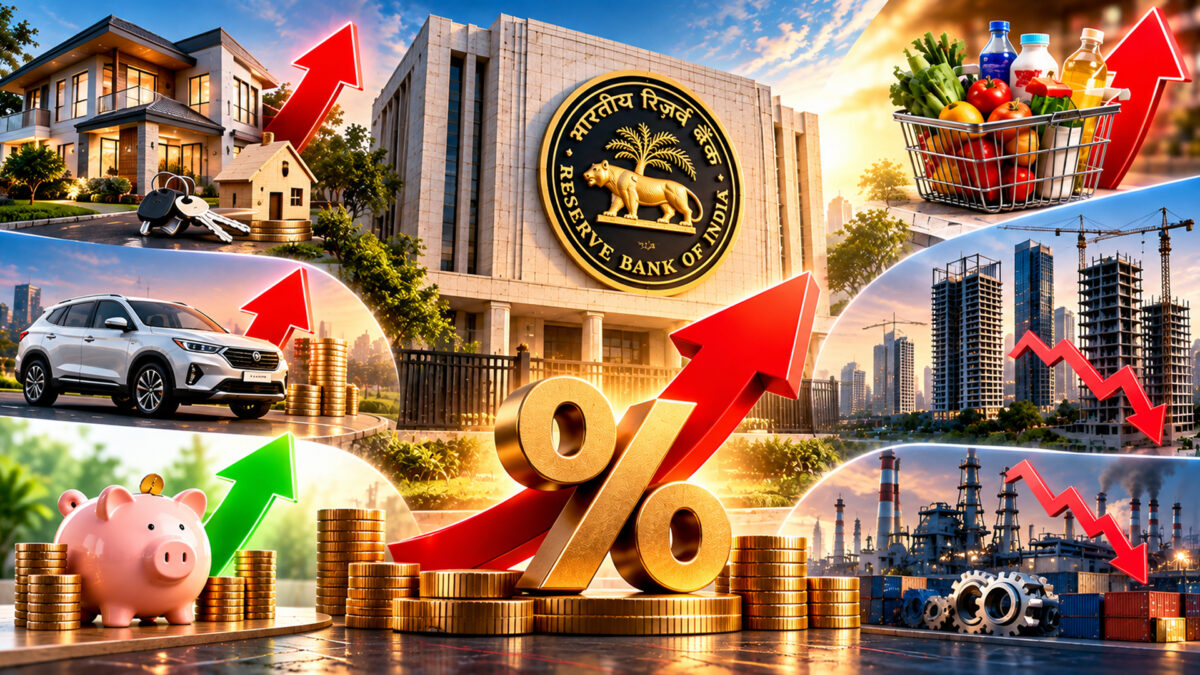
The Reserve Bank of India has raised the repo rate by 25 basis points to 5.50%, marking the first increase in the key policy rate since February 2023. The move is set to affect borrowing costs across the economy, with households, businesses and interest-rate sensitive sectors likely to feel the impact.
The decision by the Monetary Policy Committee (MPC) comes against a backdrop of renewed inflation concerns, higher crude oil prices and uncertainty in global markets. The central bank has also shifted its policy stance from “neutral” to “calibrated tightening”, signalling a greater focus on containing price pressures.
The most immediate impact will be felt by borrowers with floating-rate loans. Home loans linked to external benchmarks such as the repo rate are likely to become more expensive as lenders pass on the increase. New borrowers could also face higher interest rates as banks revise their lending rates.
The actual impact on a borrower’s monthly repayment will depend on the lender, loan benchmark, outstanding principal, existing interest rate and remaining tenure. A 25-basis-point increase may look modest, but even a small change can add considerably to the total repayment cost when applied to a large loan over several years.
A borrower with a ₹50 lakh home loan and 20 years remaining, for example, could see the monthly EMI rise by several hundred rupees if the full rate increase is passed through. The additional burden would be higher for someone with a ₹1 crore loan. The exact increase will vary depending on the existing rate and the lender’s reset mechanism.
Banks can respond to the rate increase in different ways. Some may raise the monthly EMI while keeping the repayment period unchanged. Others could keep the EMI broadly stable and extend the loan tenure. While the latter option may offer short-term relief, a longer tenure can increase the total interest paid over the lifetime of the loan.
Borrowers should therefore look beyond the EMI when assessing the impact of the rate hike. The revised interest rate, outstanding principal, remaining tenure and total interest payable will provide a clearer picture of the additional financial burden.
Existing fixed-rate borrowers are generally insulated from an immediate change in their loan rates. However, people seeking fresh fixed-rate loans or refinancing options could find borrowing costs less favourable as lenders adjust to the new interest-rate environment.
The effect will extend beyond housing. Auto loans and other floating-rate consumer loans could also become more expensive. Higher financing costs may make consumers more cautious about purchasing cars, two-wheelers and other high-value products, particularly if interest rates remain elevated for a prolonged period.
The stock market reaction has been mixed, reflecting the different ways sectors respond to higher rates. Banking shares have remained relatively resilient as investors assess the possibility of stronger lending yields.
Higher lending rates can support banks if loan rates rise faster than their funding costs, potentially improving net interest margins. The benefit, however, is not automatic. Banks may also have to pay more to attract deposits, particularly in a competitive environment where customers seek better returns on their savings.
The profitability impact will therefore depend on several factors, including loan growth, deposit costs, credit demand and asset quality.
Auto and real estate stocks face a different equation. The Nifty Auto index came under pressure as investors assessed the possibility of weaker vehicle demand resulting from higher financing costs. Automobiles, particularly two-wheelers and passenger vehicles, depend heavily on consumer credit.
Real estate companies are similarly sensitive to interest rates. Higher home-loan costs can affect housing affordability and cause potential buyers to postpone purchases. The impact could be more visible in segments where buyers are particularly dependent on mortgage financing.
Developers may also face higher borrowing costs when financing construction and expansion projects. This could influence project timelines, margins and new launches if rates remain high.
The latest policy decision also provides an important signal about the RBI’s approach to inflation. The move from a neutral stance to calibrated tightening suggests that the central bank is prepared to maintain tighter financial conditions if price pressures persist.
That shift could influence investor preferences. Companies with strong cash flows, manageable debt and resilient demand may be better placed to withstand a higher cost of capital. Highly leveraged businesses, meanwhile, could face greater pressure on profitability and expansion plans.
Despite the rate increase, the RBI remains confident about India’s growth prospects. The central bank has raised its FY27 growth forecast to 7.1%, indicating expectations of continued economic momentum even as monetary conditions become tighter.
The combination of strong growth and rising rates creates a mixed environment for businesses. Banks could gain from higher lending yields, while companies dependent on cheap credit may need to reassess investment and expansion plans. Consumers, meanwhile, may become more selective about large purchases.
The latest rate hike is also a reminder for home-loan borrowers to review their finances. Checking the revised interest rate, comparing refinancing options and considering partial prepayment can help reduce the long-term impact where financially feasible.
The key question now is whether the 25-basis-point increase will remain a one-time adjustment or become the beginning of a broader tightening cycle. Future decisions will depend largely on inflation, crude oil prices, global financial conditions and the strength of domestic demand.
Until those signals become clearer, borrowers and businesses will need to prepare for a financial environment where the era of steadily falling interest rates may be giving way to a period of higher borrowing costs.