
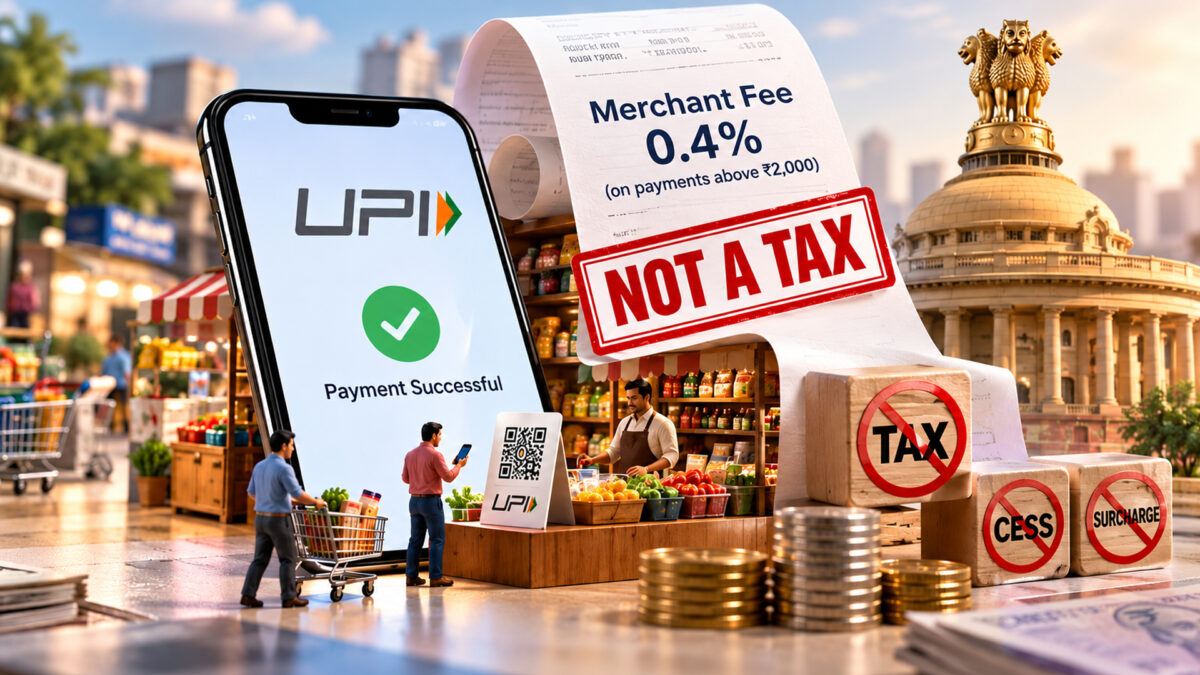
India’s digital payments ecosystem is preparing for a significant change as a new Merchant Discount Rate (MDR) is set to apply to certain high-value UPI payments from October 15. The move is aimed at creating a more sustainable revenue model for the payments industry, but it has also raised questions among merchants, traders and consumers.
Under the new framework, a 0.4% MDR will apply to person-to-merchant (P2M) UPI transactions above ₹2,000. The charge will be paid by merchants and will be capped at ₹300 for transactions of ₹75,000 and above. Person-to-person UPI transfers will continue to remain free, irrespective of the amount.
The government has also sought to clarify that the MDR is not a tax, cess or surcharge. The money collected will not go to the government but will be distributed among participants in the UPI ecosystem, including banks, payment gateways and UPI applications.
The change comes after years of zero-MDR transactions on UPI. Since January 2020, UPI transactions have carried no MDR as the government sought to accelerate digital payments and encourage merchants and consumers to move away from cash. The new framework is intended to provide another source of revenue for an ecosystem whose infrastructure and transaction-settlement costs continue to grow.
Most UPI payments remain outside the charge
The headline figure of a 0.4% fee may sound significant, but the impact will be limited to a relatively small portion of transactions.
Government data shows that only around 4% of P2M UPI transactions are above ₹2,000 and will attract the new MDR. However, these transactions account for about two-thirds of P2M payments by value, making them important for the overall economics of the UPI network.
The government has said about 96% of merchant transactions will remain unaffected. Payments of up to ₹2,000 will continue to carry zero MDR, while small merchants covered under the existing zero-MDR framework will also remain protected.
NPCI Managing Director Dilip Asbe has said around 75% of India’s more than 60 million digital-payment merchants have never recorded a UPI transaction above ₹2,000. This means a large majority of merchants are unlikely to see a direct impact from the new fee.
Certain essential categories, including railways, telecom, insurance, fuel and agricultural inputs, will also have a concessional MDR of ₹5 on eligible transactions above ₹2,000.
Will consumers pay more?
One of the biggest concerns surrounding the new UPI MDR is whether merchants will eventually pass the cost on to customers through higher prices.
Government sources have said the proposed fee will not be passed on to consumers. Authorities are also considering discussions with the Indian Banks’ Association and trader organisations to address concerns over merchants adding the charge to bills.
That distinction is important. The MDR is a fee for payment processing and settlement, rather than a charge imposed directly on the person making the UPI payment.
The government has also rejected concerns that the fee could push consumers back towards cash. Officials have argued that merchants already absorb MDR on other payment methods, particularly credit cards, where merchant fees are generally much higher than the proposed UPI rate.
Still, the response from businesses will be closely watched once the new system becomes operational. UPI has become deeply embedded in everyday commerce, from small shops and restaurants to large retailers and service providers. Any change in the cost of accepting digital payments could influence how businesses manage their payment mix.
GST adds another layer
The treatment of GST on the new merchant fee has emerged as another important issue.
Since MDR is considered a payment-processing service, an 18% GST applies to the merchant fee. This means the GST would be charged on the MDR amount rather than on the underlying UPI transaction value.
The GST Council is expected to take a view on the issue. Its next meeting is scheduled for October 7, ahead of the October 15 implementation of the MDR. Government sources have expressed hope that the Council will review the 18% GST on UPI merchant fees.
For GST-registered businesses, the additional tax may be partly offset through Input Tax Credit (ITC), provided they meet the eligibility conditions. Businesses dealing with exempt supplies may not receive the same benefit and could therefore face a higher effective cost.
A new revenue model for UPI
The broader objective is to make India’s digital payments infrastructure financially more sustainable.
Government estimates suggest the annual cost of running and settling UPI transactions is around ₹20,000 crore. While the new MDR could generate substantial revenue, officials have indicated that collections may still fall short of the full cost of maintaining the system.
The fee will be shared among different participants in the payments ecosystem rather than flowing into government coffers. The proposed structure is therefore less about creating a new consumer charge and more about introducing a revenue stream for banks, payment service providers and other entities that support UPI transactions.
The bigger test will begin on October 15, when India’s largest digital payments network moves from an almost entirely zero-MDR model towards a system in which high-value merchant transactions help fund the infrastructure behind the country’s digital payments growth.