
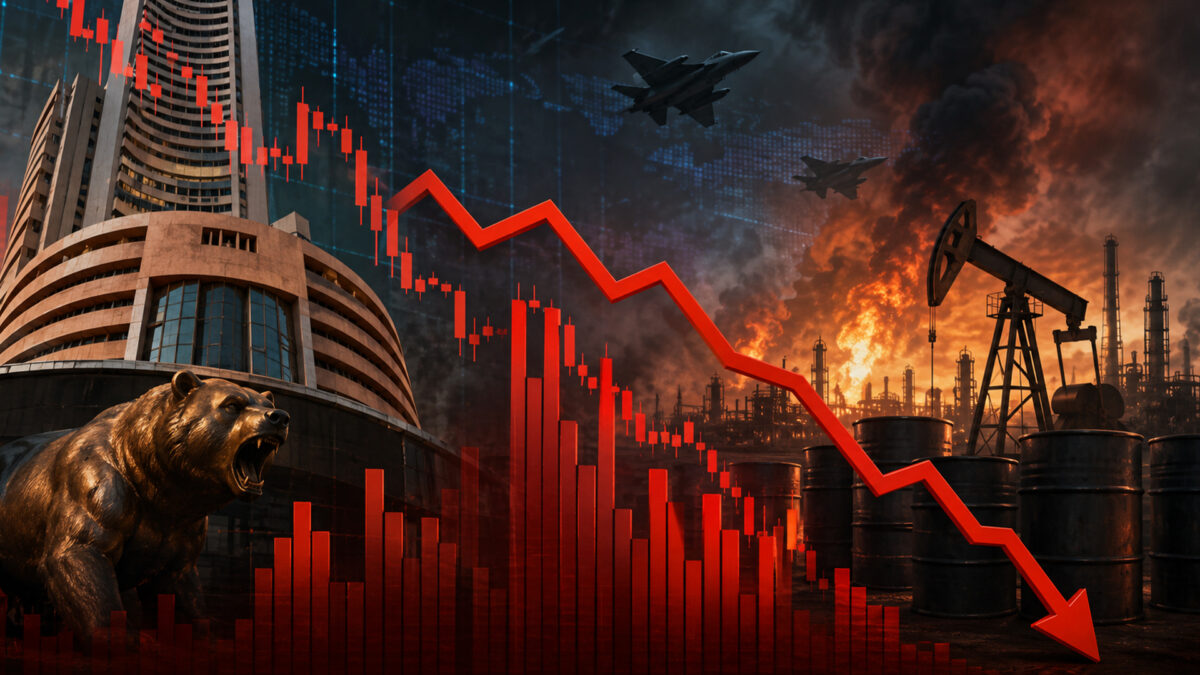
The equity markets came under heavy selling pressure on Wednesday, with the Sensex sliding more than 650 points and the Nifty 50 falling below the 23,850 mark. Rising crude oil prices, renewed US-Iran tensions and weak global market cues weighed heavily on investor sentiment, triggering broad-based selling across sectors.
The BSE Sensex fell 685.47 points, or 0.89%, to 76,258.81, while the Nifty 50 declined 224.75 points, or 0.93%, to 23,831.05 in early trade. The sharp fall came a day after domestic equities had already struggled to hold on to gains amid concerns over escalating geopolitical tensions and higher oil prices.
The latest sell-off was largely driven by renewed military action between the United States and Iran. Fresh US airstrikes on Iranian targets and Iran’s retaliatory response increased fears that the conflict could worsen and disrupt oil supplies from the Middle East. The possibility of further disruption around the Strait of Hormuz has become a major concern for global markets.
Crude oil prices moved higher as investors assessed the potential impact of the conflict on global energy supplies. Brent crude rose above $95 a barrel, while US West Texas Intermediate crude also climbed. The sharp rise in oil prices is particularly important for India, which imports a large share of its crude requirement.
A sustained increase in crude prices could raise India’s import bill and put additional pressure on inflation. It could also affect the rupee and increase operating costs for several industries, including airlines, tyre manufacturers, paints and other businesses that depend heavily on fuel or petroleum-based inputs.
The impact was visible across the Indian stock market. All major sectoral indices were trading under pressure, while mid-cap and small-cap stocks also declined. Investors appeared to be reducing risk exposure as uncertainty increased in global financial markets.
Among individual stocks, Coal India emerged as one of the strongest gainers. The stock rose around 3.6% after the company reported a 5.5% increase in total coal supplies in August. The company’s plans for an initial public offering of its subsidiary Mahanadi Coalfields also supported sentiment around the stock.
Sun Pharmaceutical Industries was another notable gainer, rising around 0.5%. The stock found support after the company entered into a favourable pricing agreement in the US, reducing some concerns over the impact of tariffs on its business.
These gains, however, were not enough to offset the broader market weakness. On the losing side, Infosys, Eicher Motors and Shriram Finance were among the major stocks under pressure. Other technology, automobile and financial stocks also witnessed selling as investors turned cautious.
IT stocks were particularly vulnerable amid weak global cues. Rising US bond yields and concerns about tighter monetary conditions added to pressure on technology companies. Higher crude prices also raised concerns about global inflation and economic growth, making investors more selective about high-valuation and growth-oriented stocks.
Auto stocks also remained weak. Higher fuel prices can affect consumer sentiment and raise transportation and input costs. At the same time, uncertainty over global economic growth can weigh on expectations for automobile demand.
Oil-sensitive companies faced additional pressure as crude prices climbed. Airlines, tyre makers, paint companies and oil marketing firms were among the businesses closely watched by investors. Higher crude prices can squeeze margins for companies that are unable to immediately pass increased costs on to customers.
The rupee was another area of concern. The Indian currency had closed at around Rs 94.95 against the US dollar on Tuesday, after recently gaining support from Reserve Bank of India intervention and foreign currency inflows. However, the sharp rise in crude prices and higher US Treasury yields are creating fresh pressure on the currency.
Global markets also set a weak tone for Indian equities. Asian shares fell sharply after Wall Street ended lower, with investors reacting to the escalation in the US-Iran conflict and a rise in global bond yields. Japan’s Nikkei and South Korea’s Kospi were among the major markets to decline, while the broader MSCI Asia-Pacific index also fell.
The US 10-year Treasury yield climbed sharply, adding to concerns that persistent inflation could keep interest rates higher for longer. Higher US yields can make emerging-market assets less attractive and encourage investors to shift money towards dollar-denominated assets.
The combination of rising crude prices, a weaker rupee and higher global yields creates a difficult short-term environment. Investors are likely to closely track developments in the Middle East, movements in crude oil prices and foreign institutional investor flows in the coming sessions.
Despite the sharp market decline, India’s domestic economic outlook remains relatively resilient. The country’s economy recorded strong growth in the April-June quarter, supported by domestic demand and economic activity. However, Wednesday’s trading showed that global geopolitical risks can quickly overshadow positive domestic fundamentals.
The immediate focus for investors will remain on whether tensions between the US and Iran escalate further and whether crude oil prices continue to rise. Any signs of easing tensions could provide relief to equities, while further disruption to oil supplies could keep volatility elevated.
The Sensex is struggling around the 76,250 level, while the Nifty is attempting to hold above 23,800. With Coal India and Sun Pharma among the notable gainers and Infosys, Eicher Motors and Shriram Finance facing selling pressure, the market remains firmly in risk-off mode.