
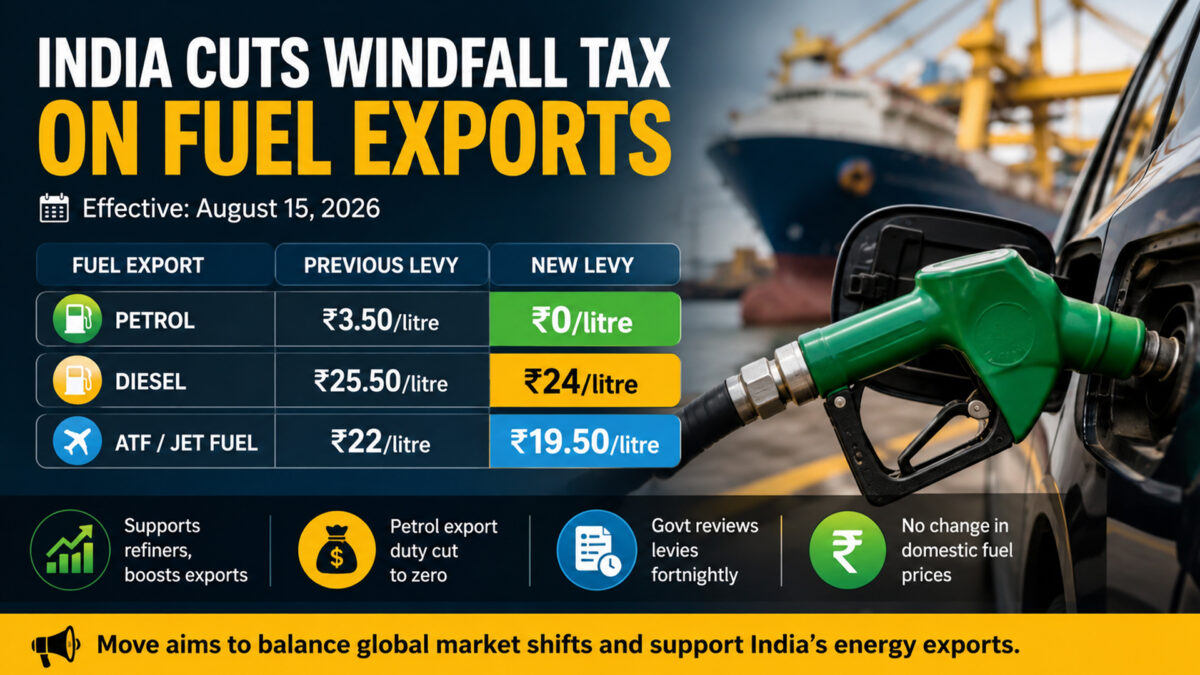
The government has eased the windfall tax burden on petroleum exports, cutting levies on diesel and aviation turbine fuel (ATF) while removing the charge on petrol exports altogether.
The changes took effect on August 15, with the government bringing the export levy on petrol down to zero from ₹3.5 per litre. The duty on diesel has been reduced to ₹24 per litre from ₹25.5, while the levy on ATF has been lowered to ₹19.5 per litre from ₹22 per litre.
The latest move comes less than two weeks after the government sharply raised these levies, highlighting how quickly its petroleum tax policy is responding to movements in the global oil market.
The windfall tax was introduced as a way to capture unusually high earnings from the oil sector when international crude prices surge. For refiners and producers, the levy effectively reduces the gains they can make from exporting petroleum products when global prices and refining margins rise sharply.
The government has been reviewing the tax every fortnight, giving it flexibility to change the rates depending on international crude prices, fuel margins and domestic market conditions.
The latest reduction is particularly significant for petrol exporters. The government has completely removed the ₹3.5-per-litre levy imposed earlier this month. This could improve export realisations for refiners selling petrol into overseas markets, although the actual impact will depend on global fuel prices, freight costs and the rupee-dollar exchange rate.
Diesel exporters will also see a smaller tax burden, with the levy reduced by ₹1.50 per litre. The ATF export duty has been cut by ₹2.50 per litre.
The changes come at a time when international energy markets remain highly sensitive to geopolitical developments. Crude prices have faced repeated swings because of concerns over supply disruptions, shipping routes and tensions in the Middle East.
India, as one of Asia’s largest refining centres, is closely exposed to these global movements. Indian refiners import crude, process it into products such as petrol, diesel and ATF, and sell a portion of those products in international markets.
That makes the level of export taxation important for refinery economics. When duties rise, overseas sales become less attractive. When they fall, refiners have greater flexibility to take advantage of international demand and favourable refining margins.
The government’s decision also comes after a substantial increase announced earlier in August. On August 3, the petrol export levy was raised to ₹3.5 per litre from ₹2.5. The diesel levy jumped to ₹25.5 per litre from ₹15.5, while the ATF levy increased to ₹22 per litre from ₹14.5.
The reversal now gives exporters some relief and reflects the government’s willingness to recalibrate the tax as market conditions change.
The windfall tax itself has been used intermittently in response to international oil prices. It was first introduced in July 2022, when crude prices surged following disruptions in global energy markets. As prices subsequently moderated, the levy was withdrawn.
It returned in March 2026 amid another sharp rise in global oil prices and concerns over disruptions linked to tensions involving Iran and the Strait of Hormuz.
At that time, the government was also focused on protecting the domestic market from the impact of expensive crude. The tax structure was adjusted alongside measures aimed at limiting the impact of higher international energy prices on Indian consumers.
The latest decision, however, is more favourable to the refining and export side of the industry. Lower duties mean companies retain a larger share of the revenue generated from overseas sales.
That does not necessarily translate into cheaper petrol or diesel for Indian consumers. The latest notification concerns export taxation and does not directly change the retail prices of petrol, diesel or ATF in the domestic market.
Domestic fuel prices depend on several factors, including international crude prices, refining costs, taxes, margins and the pricing policies followed by oil marketing companies.
The broader significance lies in the government’s approach to managing the petroleum sector during a period of considerable uncertainty. Such changes in economic policy and global market conditions can affect government revenue, export competitiveness and the earnings of refiners and producers. A high windfall tax can increase government revenue when refiners and producers benefit from elevated international prices, but it can also reduce export competitiveness.
A lower levy, on the other hand, can support the economics of exports while potentially reducing revenue collected through the tax.
For Indian refiners, the latest move therefore provides some breathing room. Companies will now be able to export petrol without the additional ₹3.5-per-litre charge and will face lower levies on diesel and ATF.
The reduction in petrol export duty, along with lower diesel and ATF export levies, is likely to be watched closely by refiners and traders as they assess export economics for the weeks ahead.