
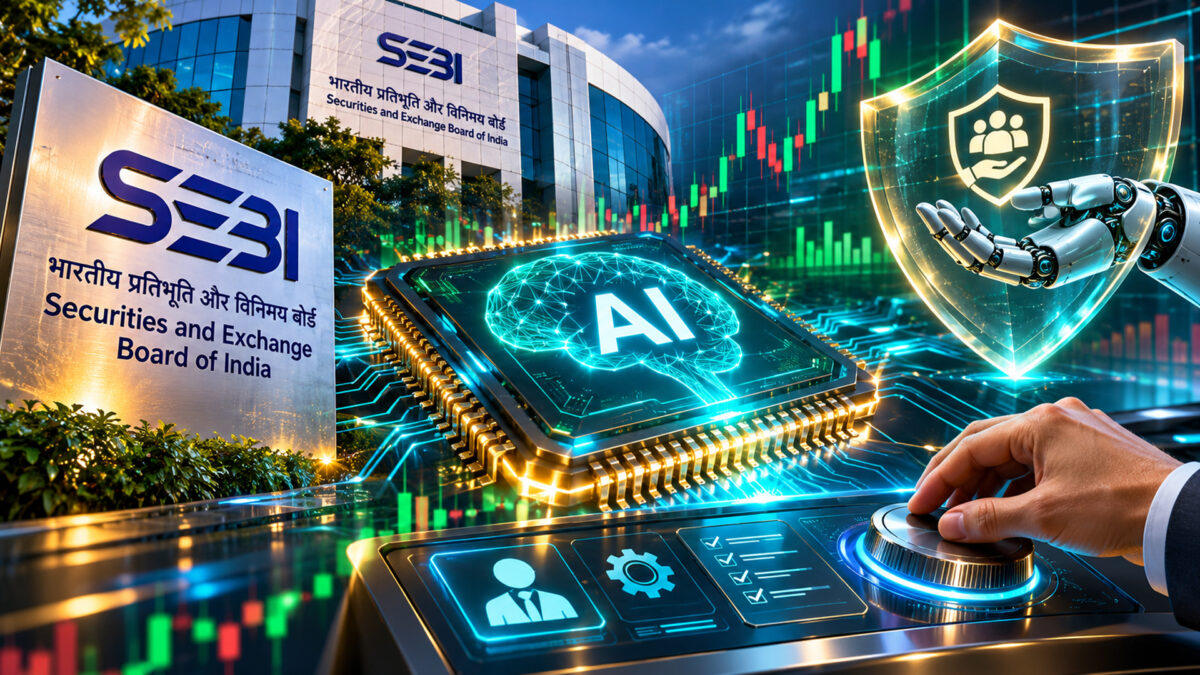
The Securities and Exchange Board of India (SEBI) is preparing to introduce detailed guidelines governing the use of artificial intelligence (AI) in the country’s capital markets, with investor protection, transparency and human oversight expected to be at the centre of the proposed framework.
SEBI chairman Tuhin Kanta Pandey said the regulator would issue the guidelines soon, underlining the need to ensure that the growing use of AI does not compromise investor interests or the integrity of financial markets.
The proposed rules are expected to establish clear safeguards for market participants adopting AI-based technologies. These will include disclosure requirements, accountability of regulated entities and a human-in-the-loop approach, ensuring that important decisions supported by artificial intelligence remain subject to human supervision.
The move comes at a time when AI and machine learning (ML) are increasingly finding applications across the financial services industry. From investment research and trading systems to risk assessment, surveillance and customer services, technology is changing how financial market participants operate.
While these developments offer opportunities to improve efficiency and decision-making, they also raise concerns about inaccurate outputs, algorithmic errors, data security and the possibility of automated systems making decisions without adequate human intervention.
SEBI’s proposed framework is aimed at addressing these challenges while allowing the securities market to benefit from technological innovation.
The groundwork for the proposed guidelines was laid in June 2025, when SEBI released a consultation paper outlining guiding principles for the responsible use of AI and machine learning in Indian securities markets. The document sought feedback from stakeholders and members of the public on how these technologies could be adopted without exposing investors and the wider financial system to unnecessary risks.
The consultation paper recognised that AI applications were becoming increasingly common in financial markets because of improvements in computing power, software and the availability of data. The emergence of generative AI and large language models has also expanded the range of possible applications.
According to the paper, market participants were already using AI and machine learning for investment advisory and support services, risk management, client identification, transaction monitoring, market surveillance, pattern recognition, internal compliance and cybersecurity.
However, SEBI also highlighted several risks associated with the technology. These include unreliable AI-generated information, difficulties in understanding how certain models arrive at decisions, data privacy concerns and the possibility of errors spreading across interconnected financial systems.
The regulator’s proposed approach is intended to ensure that firms using AI remain accountable for the decisions and services supported by these technologies. The emphasis on human oversight is particularly important because automated systems may produce incorrect or misleading results, even when they appear convincing.
Under the proposed human-in-the-loop approach, AI tools may assist with analysis and decision-making, but responsibility for critical decisions cannot be left entirely to automated systems. Human supervision is expected to remain an important safeguard.
For investors, the proposed framework could provide greater clarity about how AI is being used by financial institutions and market intermediaries. It could also strengthen accountability when technology-driven services affect investment decisions, financial transactions or the handling of sensitive customer information.
The guidelines are also part of SEBI’s wider effort to maintain market integrity as India’s financial ecosystem becomes increasingly digital.
Alongside AI regulation, Pandey highlighted the growing cybersecurity challenges facing financial institutions, cryptocurrency platforms and other technology-driven businesses.
He pointed to the increasing frequency of cyberattacks and digital fraud, including fraudulent activities involving social media influencers. The growing use of online platforms to promote financial products and investment opportunities has created additional challenges for regulators seeking to protect retail investors.
To strengthen its response, SEBI introduced a structured incident response mechanism in May 2026. The system is aligned with the Financial Stability Board’s Financial Incident Reporting Exchange (FIRE) template, which provides a framework for reporting and responding to financial-sector cyber incidents.
The mechanism is intended to improve the way cybersecurity incidents are identified, reported and addressed. SEBI is continuing to strengthen its cybersecurity infrastructure to deal with emerging threats and protect the stability of the securities market.
Pandey’s remarks also underline that responsible AI adoption cannot be separated from broader questions of data protection, operational security and regulatory supervision. The chairman also drew attention to the potential cybersecurity risks posed by advances in quantum computing.
SEBI is undertaking an inventory of cryptographic systems used across its ecosystem and identifying areas where encryption technologies are deployed. The exercise is intended to help the regulator assess vulnerabilities and understand which systems may need to be strengthened as computing technology advances.
Quantum computing could eventually challenge some of the encryption methods currently used to protect sensitive financial information and digital transactions.
Pandey said these risks could become more pronounced between 2032 and 2035, making early preparation important. Financial markets worldwide are assessing the potential implications, as weaknesses in existing cryptographic systems could expose institutions and investors to new forms of cyber threats.
The regulator wants to identify potential vulnerabilities well ahead of time rather than wait until the technology creates immediate security concerns.