
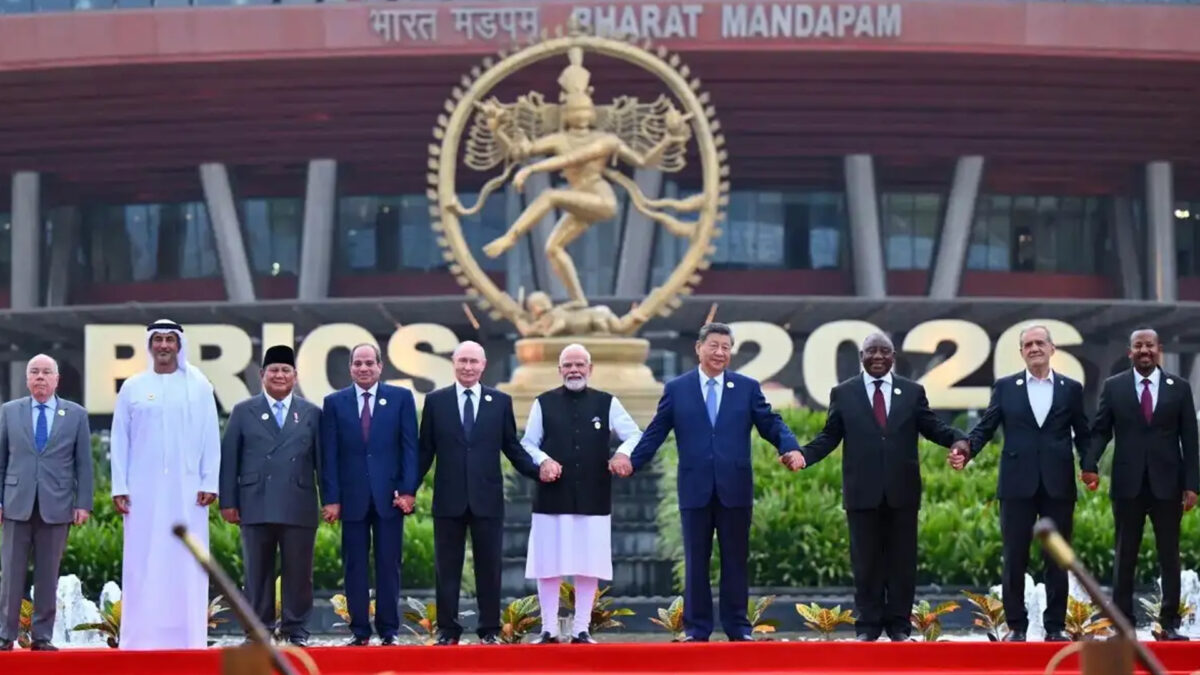
BRICS leaders have adopted the New Delhi Declaration 2026, bringing the expanded grouping together on issues ranging from terrorism and global trade to artificial intelligence, West Asia and reform of international institutions.
The declaration was adopted unanimously at the 18th BRICS Summit in New Delhi, despite differences among member countries over several geopolitical issues. India, which held the BRICS chair this year, pushed for a broader focus on practical cooperation and a stronger voice for developing countries.
The 45-page declaration does not create a common BRICS currency, one of the most closely watched possibilities surrounding the grouping. Instead, members agreed to deepen the use of local currencies for trade and investment and work towards making their payment systems more compatible.
Strong condemnation of Pahalgam terror attack
Terrorism was one of the clearest areas of agreement at the summit. BRICS leaders strongly condemned the April 22, 2025 terror attack in Jammu and Kashmir’s Pahalgam, in which 26 people were killed.
The declaration called for zero tolerance towards terrorism and rejected double standards in dealing with terrorist groups. It also highlighted the need to tackle cross-border movement of terrorists, terrorist financing and safe havens.
The grouping called for all those involved in terrorist activities and their support networks to be held accountable. It also backed faster progress towards the long-pending Comprehensive Convention on International Terrorism at the United Nations.
The reference to Pahalgam is significant for India, which has repeatedly sought stronger international action against cross-border terrorism.
BRICS takes aim at tariffs
Trade emerged as another major issue. BRICS expressed serious concern over the growing use of unilateral tariffs and non-tariff barriers, saying such measures can distort global trade and are inconsistent with World Trade Organization rules.
The declaration called for a stronger and more responsive WTO, particularly one that takes into account the interests of emerging markets and developing economies.
The grouping also opposed unilateral economic sanctions that are not authorised by the UN Security Council. Such measures, it said, can have wider effects on food security, healthcare, development and vulnerable populations.
The declaration did not directly name the United States or President Donald Trump. Its criticism of unilateral tariffs, however, comes against the backdrop of growing global trade tensions and the US use of tariffs as an economic policy tool.
No common BRICS currency
Talk of a common BRICS currency has gained attention in recent years, particularly as members explore ways to reduce their dependence on the US dollar.
The New Delhi summit stopped short of such a move. Instead, members agreed to promote local-currency settlements, improve cross-border payment systems and continue work through the BRICS Payment Task Force.
The New Development Bank was encouraged to increase financing in local currencies and diversify its funding sources. A phased and consensus-based New Investment Platform will also be developed.
India’s proposal to establish a BRICS Risk Lab at GIFT City in Gujarat received support, adding another element to the bloc’s financial cooperation agenda.
AI gets bigger role
Artificial intelligence has also become a major part of the BRICS agenda.
Leaders recognised AI as an important driver of economic growth and sustainable development but stressed that its benefits should be accessible to developing countries. The declaration called for AI systems that are safe, secure, inclusive and reliable.
The grouping also highlighted the need for international cooperation on AI research, innovation, energy efficiency and responsible use.
India’s AI Impact Summit, held in February 2026, was recognised as an important contribution to discussions on global AI governance.
China also proposed deeper cooperation in the field, including an AI Open Source Zone. The growing focus on AI reflects how technology is becoming closely linked with economic competitiveness, development and national security.
West Asia remains a concern
The continuing conflict and instability in West Asia also featured prominently in the declaration.
BRICS called for dialogue and diplomacy to resolve international disputes and stressed the importance of preventing further escalation. The grouping backed a two-state solution for Palestine, based on the 1967 borders with East Jerusalem as the capital of a Palestinian state.
The declaration also supported Palestine’s full membership of the United Nations and called for greater humanitarian assistance.
The wording was significant because BRICS now includes countries with very different positions and interests in the region. Iran and the UAE, for example, are both members but have had differing positions on regional issues.
India’s ability to secure a common declaration despite these differences was an important diplomatic outcome of the summit.
Push for UN reforms
The BRICS leaders also renewed their call for reform of the United Nations and other global institutions.
India has long argued that developing countries need greater representation in bodies such as the UN Security Council. The declaration backed a more representative and inclusive global governance system.
The summit also highlighted the need to give the Global South a stronger role in international decision-making.
India’s BRICS presidency focused heavily on development issues, including digital public infrastructure, healthcare, food security, skills, industrial cooperation and sustainable development.
Focus on practical cooperation
Several India-led initiatives received support during the summit. These included a BRICS digital public infrastructure repository, a Training Hub Network and greater cooperation in Industry 4.0.
The grouping also backed the creation of a BRICS-NDB Knowledge Portal and a Task Force on Growth and Development.
Health and human development were also part of India’s wider agenda. An early warning system for infectious diseases was among the initiatives highlighted during the summit.
The expanded BRICS now brings together 11 member countries, giving the grouping a much larger geographical and economic footprint across Asia, Africa, the Middle East and Latin America.
The New Delhi summit therefore produced fewer dramatic institutional changes than some had expected but delivered consensus on several important issues.