Categories
Corporate

Sensex gains 300 points, Nifty rises 110 points

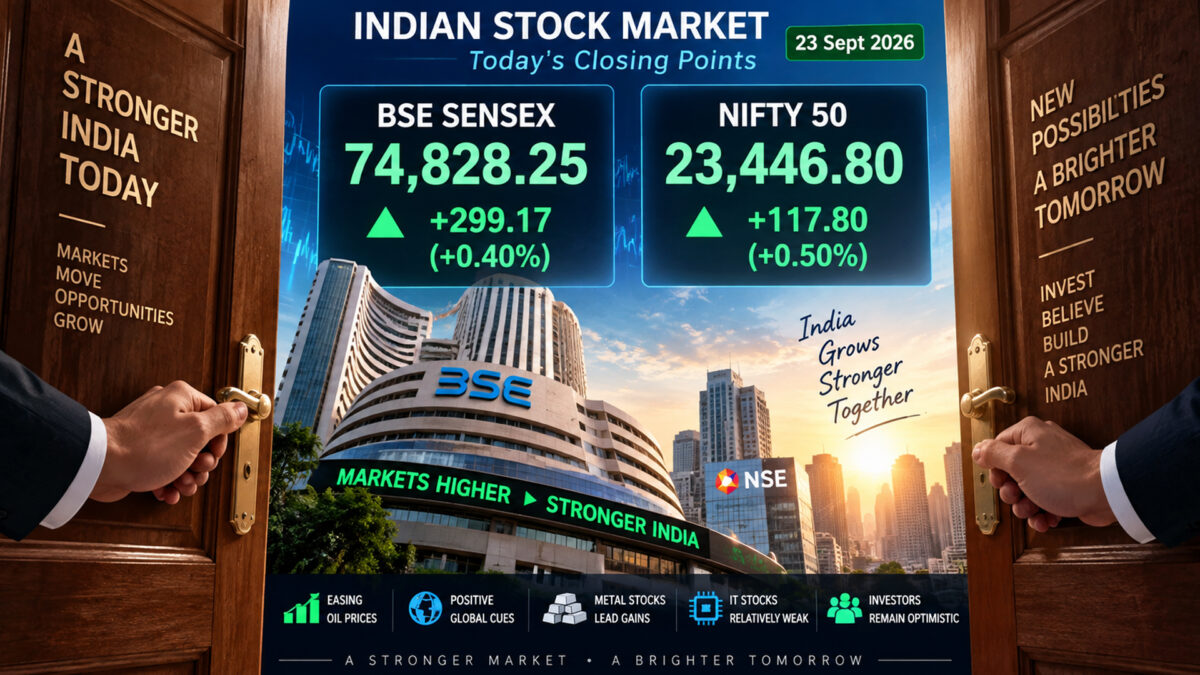
The stock markets bounced back on Wednesday, with the Sensex gaining nearly 300 points and the Nifty rising more than 110 points as softer crude prices, stronger domestic economic data and easing concerns over the US-Iran conflict lifted investor sentiment.

The BSE Sensex climbed 299.17 points, or 0.40%, to close at 74,828.25. The NSE Nifty 50 gained 117.80 points, or 0.50%, to end at 23,446.80. The recovery came a day after both benchmarks had fallen sharply during the closing session.

The Nifty opened at 23,352.15 and moved between 23,349.55 and 23,466.90 during the session before settling near the day’s higher levels. Market breadth was positive, with 36 of the 50 Nifty stocks ending in the green and 14 closing lower.

The rebound was supported by a combination of domestic and global factors. Investors took some comfort from September’s flash Purchasing Managers’ Index data, which pointed to continued strength in India’s economic activity without a matching rise in inflation pressures.

The data helped shift attention back to domestic growth after markets had been weighed down by geopolitical uncertainty and oil-price swings. Analysts said investors were also watching crude prices closely because any sustained rise in oil could put pressure on India’s import bill, inflation and the rupee.

Brent crude remained below the $100-a-barrel mark on Wednesday, providing some relief to Indian equities. Oil prices had earlier risen sharply because of concerns about supply disruptions linked to the conflict involving the US and Iran. Hopes of diplomatic progress helped ease some of those concerns.

Metal stocks were among the biggest drivers of the day’s gains. The Nifty Metal index rose more than 2%, with buying seen across several metal companies. Nifty FMCG gained 1.27%, Nifty Pharma rose 0.72%, Nifty PSU Bank advanced 0.97% and Nifty Auto added 0.25%.

Bajaj Finance emerged as the biggest Nifty 50 gainer, rising 3.41%. Hindalco Industries gained 3.17%, while Tata Steel advanced 3.16%. The strength in these stocks helped the broader market recover after Tuesday’s sharp sell-off.

Other stocks that supported the Sensex included Bajaj Finserv, Larsen & Toubro, Power Grid, UltraTech Cement and Reliance Industries. Economic Times market data showed several of these stocks among the leading Sensex gainers during the session.

The IT sector, however, remained a weak spot. The Nifty IT index fell more than 1%, making it the biggest sectoral laggard. Nifty Media also declined, slipping 0.63%.

Among individual Nifty stocks, HCL Technologies was the biggest loser, falling 1.08%. Titan Company declined 0.98%, while Infosys slipped 0.86%. These losses limited the overall rise in the benchmark indices.

TCS was also among the weaker Sensex constituents, while HCL Tech, Infosys and Titan remained under pressure. Economic Times data showed TCS, Infosys and HCL Tech among the major Sensex losers during the day.

The broader market also showed signs of recovery. Buying was not limited to a handful of large companies, with participation across several sectors helping improve overall market breadth. The positive advance-decline ratio suggested that investors were willing to return to stocks after the previous day’s volatility.

The rupee and foreign fund flows remained important factors for investors. The Indian currency has been under pressure from elevated crude prices, a firm US dollar and foreign investor selling. Lower oil prices provided some relief, although analysts continued to flag sustained foreign institutional investor outflows as a risk for Indian equities.

Global markets also offered some support. Asian equities were mixed, with Japan’s Nikkei, Taiwan’s benchmark and South Korea’s Kospi ending higher, while Hong Kong’s Hang Seng declined. The positive performance of several Asian markets helped improve the overall risk mood.

Investors are now likely to keep a close watch on crude oil, US-Iran developments, global bond yields, foreign institutional flows and upcoming corporate earnings. The market’s recovery on Wednesday showed that buyers were willing to step in after the previous session’s decline, but volatility remains high.

Gold and silver also moved lower during the session. Gold fell 0.54% to ₹1,52,889 per 10 grams for 24-carat purity, while silver declined more than 1% to ₹2,37,341 a kg at the time of reporting.

The Wednesday session therefore brought some stability back to Dalal Street. The Sensex regained ground above 74,800 and the Nifty moved back above 23,400, with metals, banks and consumer stocks leading the recovery. However, global geopolitical developments and crude prices remain key factors that could influence the next market move.

 

Categories
Uncategorized

Sensex falls 330 points, Nifty slips below 23,350

The markets ended lower on Tuesday, September 22, snapping a four-session winning run as selling pressure returned in the second half of the session. The Sensex fell nearly 330 points, while the Nifty 50 closed below the 23,350 mark.

The BSE Sensex dropped 329.91 points, or 0.44%, to settle at 74,529.08. The NSE Nifty declined 85.30 points, or 0.36%, to close at 23,329. The market had started the day on a stronger note, but early gains faded as investors turned cautious.

Selling was particularly visible in information technology, FMCG and banking stocks. The Nifty IT index fell 0.86%, extending its decline for a third straight session. Mphasis, Persistent Systems, TCS, Infosys, HCL Technologies and Tech Mahindra were among the IT stocks that ended lower.

The broader market remained relatively mixed. The Nifty Midcap 100 ended 0.08% higher, while the Nifty Smallcap 100 slipped 0.23%. On the BSE, 2,171 shares advanced and 2,181 declined, showing a broadly weak market at the close.

Coal India emerged as the strongest performer among Nifty 50 stocks, gaining 3.21%. The stock benefited after Morgan Stanley upgraded the company, according to Reuters. Eternal rose 1.82%, while InterGlobe Aviation, popularly known as IndiGo, gained 1.80%. Titan Company and Dr Reddy’s Laboratories also finished higher, rising 1.10% and 1.06%, respectively.

On the other side, Tata Consumer Products was the biggest Nifty loser, falling 1.65%. Nestle India declined 1.52%, while Bajaj Finserv and Bajaj Finance dropped 1.43% and 1.22%, respectively. Sun Pharmaceutical Industries also fell 1.20%.

The IT sector remained one of the main drags on the market. Investors continued to remain cautious about demand and earnings prospects for technology companies. The Nifty IT index has now fallen for three consecutive sessions, adding to the pressure on the broader market.

Foreign fund flows also remained a concern. Foreign institutional investors sold shares worth ₹576.20 crore on Monday, while domestic institutional investors bought equities worth ₹2,797.27 crore. Continued foreign selling has been an important factor keeping investors cautious in recent sessions.

Crude oil prices provided some relief during the session but remained an important factor for Indian markets. Brent crude had fallen sharply on Monday and was trading around $100 a barrel on Tuesday. Investors were watching developments in West Asia, including signs of possible diplomatic engagement between the US and Iran.

Lower oil prices can support Indian equities because India imports a large share of its crude requirements. A sustained rise in crude, on the other hand, can increase inflationary pressure and put pressure on the country’s trade balance and corporate costs.

Global markets offered a mixed backdrop. Asian stocks largely ended higher after Wall Street posted strong gains on Monday. The Dow Jones Industrial Average rose 0.71%, while the S&P 500 gained 1.49%. The Nasdaq climbed 2.26% to a record closing level, helped by strong gains in technology and semiconductor stocks.

Despite these positive global cues, Indian markets struggled to hold their early gains. The upcoming derivatives expiry also added to the day’s volatility, with traders closely watching movements in futures and options positions.

Several individual stocks also remained in focus. Transrail Lighting jumped 14.52% after completing the first phase of a brownfield expansion that increased its conductor manufacturing capacity. Pace Digitek gained 9.11% after its subsidiary received a ₹488.46-crore order from NTPC GE Power Services for a battery energy storage system project.

Garden Reach Shipbuilders and Engineers gained 1% after its board approved a ₹2,896-crore capital outlay for a new greenfield shipyard in West Bengal.

The market’s four-day winning streak has now come to an end, with investors balancing global gains against domestic concerns such as foreign outflows, IT weakness, geopolitical uncertainty and crude oil prices.

The focus is likely to remain on global oil prices, foreign fund flows, the rupee, US bond yields and upcoming corporate developments as investors assess the next direction for the Sensex and Nifty.


Categories
Corporate

Sensex jumps 560 points, Nifty closes above 23,400

Indian benchmark indices ended higher on Monday, September 21, as easing crude oil prices, fresh foreign fund buying and positive global cues gave investors some relief after weeks of market pressure.

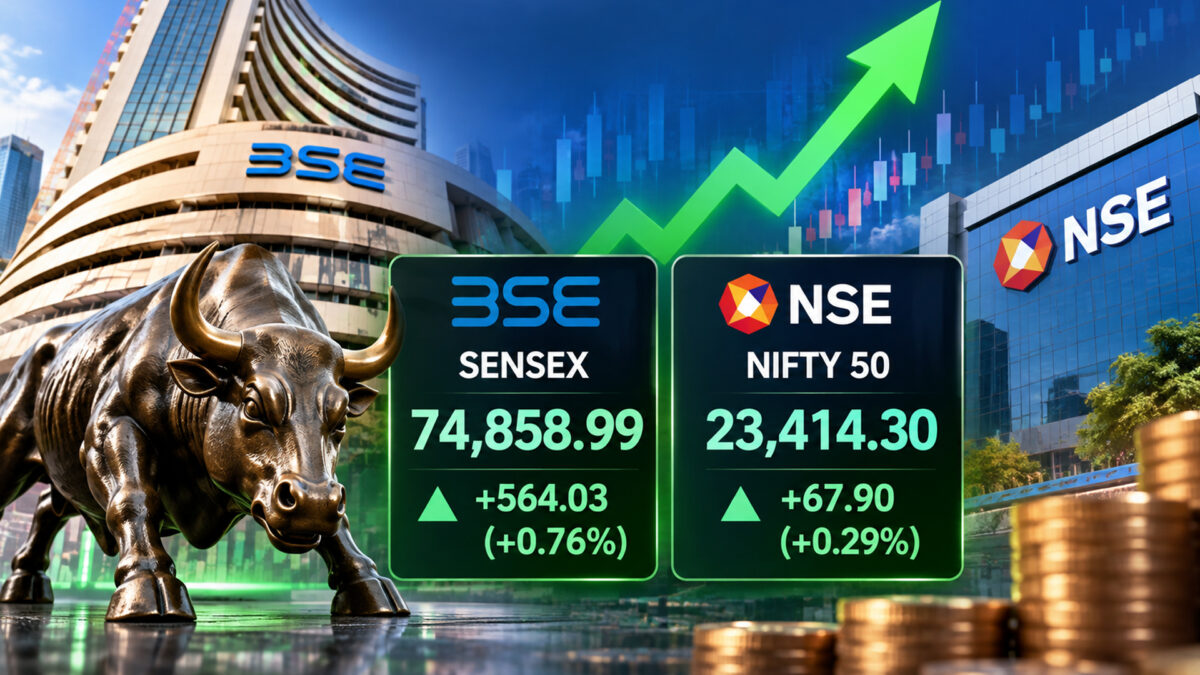
The Sensex climbed 564.03 points, or 0.76%, to close at 74,858.99, while the Nifty 50 gained 67.90 points, or 0.29%, to settle at 23,414.30. The Nifty extended its winning run to four sessions and closed above the 23,400 mark for the first time since September 10.

The recovery came after both benchmarks had recorded six consecutive weekly losses, their longest such losing streak in six years. Monday’s rise reflected renewed buying in heavyweight stocks, particularly after crude oil prices eased from recent highs.

The Sensex moved sharply higher during the day, touching an intraday high of 74,987.40, a gain of more than 690 points from its previous close. The Nifty also briefly crossed 23,450 before giving up some of its gains towards the close.

UltraTech Cement was among the strongest performers on the Sensex, rising more than 4%. HCL Technologies, Eternal and Titan Company were also among the major gainers. HCL Tech and Eternal were among the top performers on the Nifty as well, while ITC, Sun Pharma and Reliance Industries also ended higher.

On the other side, Bharti Airtel was among the biggest laggards, followed by Adani Ports, Bajaj Finance, Power Grid Corporation and Adani Enterprises. Airtel fell around 3% on the Nifty, while Adani Ports declined about 2%.

The broader market did not move in line with the benchmark indices. The Nifty Midcap 100 slipped 0.29%, while the Nifty Smallcap 100 remained broadly flat. This showed that Monday’s recovery was driven more by buying in large companies than by a broad-based rally across the market.

One of the biggest supports for the market was the fall in crude oil prices. Brent crude dropped to around $101.4-$101.7 a barrel, easing concerns over the impact of expensive oil on India’s inflation, corporate costs and trade deficit. India imports a large share of its crude requirements, making oil prices an important factor for the domestic stock market.

The decline in oil prices came despite continuing tensions in West Asia. Investors were watching developments involving the US and Iran, while hopes of diplomatic progress at the United Nations meeting helped ease some concerns about further disruption to oil supplies.

Foreign institutional investors also provided some support. FIIs bought Indian equities worth ₹599.54 crore on Friday, reversing six consecutive sessions of selling. Domestic institutional investors were also net buyers, purchasing equities worth more than ₹1,000 crore, according to exchange data.

Global markets offered another positive signal. Several Asian markets ended higher, while European equities also traded firmly. US stock futures were in positive territory during Indian market hours as investors looked ahead to developments in US-China trade and artificial intelligence talks and a planned meeting between US President Donald Trump and Chinese President Xi Jinping.

Investors were also keeping an eye on the National Stock Exchange’s IPO, which was scheduled to close for subscription on Monday. The issue had already been fully subscribed before the final day, adding to the activity in India’s primary market.

The banking sector also supported the recovery. HDFC Bank and ICICI Bank gained during the session, while Reliance Industries added to the broader market’s strength. These large companies carry significant weight in the benchmark indices, so their movement can have a sizeable impact on the Sensex and Nifty.

The rupee and bond markets also remained on investors’ radar as global monetary policy, oil prices and geopolitical tensions continued to influence sentiment. Elevated crude prices remain a concern even after Monday’s decline, particularly because a prolonged rise in oil could increase inflationary pressure and affect corporate earnings.

Monday’s rebound therefore offered some breathing room to Dalal Street after a prolonged period of selling. But the market remained selective, with large-cap stocks attracting buying while parts of the broader market stayed under pressure.

Investors will now watch crude oil movements, foreign fund flows, developments in the US-Iran conflict, global interest rates and upcoming corporate developments for further direction. After four straight sessions of gains, the ability of the Nifty to hold above 23,400 will remain an important level for market participants in the coming sessions.


Categories
Corporate

Sensex slips marginally, Nifty holds above 23,300

The markets ended mixed on Friday as a late recovery in select heavyweight shares helped the Nifty 50 finish higher, while the Sensex closed marginally lower. The Nifty 50 gained 75.80 points, or 0.33%, to close at 23,346.40. The index moved above the 23,300 mark during the session and touched an intraday high of 23,389. The Sensex, after gaining as much as 414 points in early trade, lost momentum and ended 19.63 points, or 0.03%, lower at 74,294.96.

Easing crude oil prices, positive Asian market cues and buying in banking and infrastructure stocks supported sentiment. However, continued foreign investor selling and weakness across several Tata Group and information technology stocks limited the gains.

The recovery came after several sessions of weakness in the Indian stock market. Investors found some comfort in lower crude prices, which eased concerns over inflation and India’s import bill. Brent crude remained above $100 a barrel but declined during the session, offering some relief to oil-sensitive sectors and the broader market.

Adani Ports emerged as the biggest Nifty gainer, rising 4.93% in late trading. Adani Enterprises gained 3.31%, while Bharti Airtel climbed 3.12%. HDFC Bank and Bajaj Finance were also among the strong performers, advancing 2.52% and 2.49%, respectively. The gains showed that buying interest was not limited to one sector, with infrastructure, telecom and financial stocks attracting investors.

The losing side was led by Tata Consultancy Services, which fell 3.88%. Tata Motors Passenger Vehicles and SBI Life Insurance were also among the prominent laggards. Coal India and Maruti Suzuki declined as well, adding to the pressure on selected large-cap shares.

Tata Group stocks remained under particular pressure during the session. TCS, Tata Motors Passenger Vehicles, Tata Investment Corporation and Tata Chemicals were among the group companies that recorded sharp declines. The selling came amid continuing uncertainty around Tata Sons, including questions surrounding its leadership and a possible listing of the holding company.

Information technology stocks were another weak spot. Selling in TCS weighed on the Nifty IT index and offset gains in banking and other sectors. The divergence between financial and technology stocks highlighted the selective nature of Friday’s buying rather than a broad-based market recovery.

The broader market, however, showed better participation. Mid-cap and small-cap stocks advanced during the session, with investors using the recent correction to pick up selected counters. The rise in market breadth indicated that domestic buyers remained active even as foreign investors continued to reduce their exposure to Indian equities.

Foreign institutional investor flows remained a concern. Overseas investors have been selling Indian shares amid elevated global bond yields, high US interest rates and uncertainty surrounding the Middle East. Domestic institutional investors have provided some support, helping absorb part of the foreign selling.

Crude oil remained a key factor behind the market’s movements. Prices above $100 a barrel continue to be a concern for India because the country relies heavily on imported crude. A sustained rise in oil prices can increase the import bill, put pressure on the rupee and raise concerns about inflation and corporate costs. The decline in crude on Friday therefore provided some breathing room for investors.

Global market cues were also supportive. Asian equities largely gained, helping improve risk appetite in Indian markets. Lower US bond yields and the easing in oil prices added to the positive tone, although concerns about global monetary policy and geopolitical tensions remained.

The Nifty’s close above 23,300 will be closely watched by traders after the index recovered from recent losses. Friday’s move, however, came against a backdrop of continued caution. The Sensex and Nifty have faced pressure in recent weeks as investors weighed high crude prices, foreign fund outflows, weak global cues and Middle East tensions.

The weekly picture remained weak despite Friday’s recovery. The Nifty declined about 0.22% during the week, while the Sensex lost around 0.65%. This marked the sixth consecutive weekly decline for Indian equities, the longest such losing streak since 2020.

Investors will now track crude oil prices, foreign institutional flows, the rupee and global bond yields for the next market cues. Developments in the Middle East and movement in large-cap stocks, particularly Tata Group and IT shares, are also likely to influence trading. Friday’s gains in the Nifty offered some relief, but the market remains sensitive to global risks and the direction of foreign investment flows.


Categories
Corporate

Sensex slips 20 points, Nifty rises to 23,270

Indian stock markets ended on a mixed note on Thursday, with the Nifty closing higher while the Sensex slipped marginally as investors remained cautious after the latest US Federal Reserve rate decision. The 30-share BSE Sensex fell 21.86 points, or 0.03%, to settle at 74,314.59, while the NSE Nifty50 gained 53 points, or 0.23%, to close at 23,270.60.

The session was marked by sharp swings. The Sensex climbed as much as 341 points during the day to touch 74,677.56, while the Nifty also moved above 23,300 before giving up part of its gains. Profit booking at higher levels and concerns over global interest rates kept the recovery in check.

Investors were assessing the impact of the US Federal Reserve’s latest decision to raise interest rates by 25 basis points. The move, along with indications that further tightening could remain possible, kept global markets cautious. Higher US rates can affect foreign investment flows into emerging markets such as India by making dollar assets relatively more attractive.

Crude oil prices remained another concern for domestic investors. Elevated oil prices are particularly important for India because the country imports a large share of its crude requirements. A sustained rise in crude can increase the import bill, put pressure on the rupee and complicate inflation management. Market participants therefore continued to watch oil prices closely.

Despite the cautious mood, buying emerged in several sectors. Auto, metal, media and pharmaceutical stocks were among the stronger performers, while banking and oil and gas stocks faced pressure. The broader market also remained firm, with mid-cap and small-cap indices gaining during the session.

HDFC Life emerged as the standout Nifty gainer, rising around 5%. Tata Motors Passenger Vehicles also gained more than 4%, while SBI Life Insurance advanced over 4%. Bharat Electronics, Dr Reddy’s Laboratories and InterGlobe Aviation were among other stocks that attracted buying interest.

The gains were not broad enough to lift all major stocks. ONGC was the biggest Nifty loser, declining around 1.9%. Titan Company fell about 1.4%, while HDFC Bank dropped around 1.2%. Hindustan Unilever, Coal India and Nestle India also ended lower.

Banking stocks were among the key drags on the market. HDFC Bank and ICICI Bank featured among the major losers, while the Nifty Bank index declined 236.70 points, or 0.42%, to close at 56,055.75. Weakness in heavyweight banking stocks limited the impact of gains in insurance, auto and metal counters.

Tata group stocks, meanwhile, provided support to the broader market. Tata Motors, Tata Steel and Tata Investment gained during the session, with the auto and metal segments benefiting from buying interest. The Nifty Auto index was among the stronger sectoral performers.

Market breadth remained positive despite the subdued headline indices. The gains in mid-cap and small-cap shares indicated that investors were still willing to take selective positions, particularly in stocks that had corrected during the recent market decline. This value buying helped prevent a deeper fall in the benchmark indices.

The National Stock Exchange’s initial public offering also remained a major focus. The ₹22,569-crore NSE IPO opened for subscription on Thursday, adding another layer to the market’s liquidity picture. Strong interest in new issues can divert some investor funds from the secondary market, particularly when several IPOs are open at the same time.

Foreign institutional investor activity continued to be closely watched. Overseas investors have remained sellers in Indian equities, while domestic institutional investors have provided some support. This divergence has helped cushion the impact of foreign selling but has also contributed to volatility in the benchmark indices.

The rupee and global bond yields were also important market indicators. A stronger dollar following the US rate decision could add pressure to emerging-market currencies, including the Indian rupee. Investors are also assessing how higher US borrowing costs could affect global liquidity and capital flows into Indian stocks.

Thursday’s trading showed that investors were not taking a broad-based position in either direction. Instead, buying remained concentrated in selected sectors and stocks, while heavyweight banking, oil and consumer shares faced selling pressure.

The Nifty’s close above 23,250 offered some support after recent volatility, but the index remained below the 23,300 level that investors were watching closely. The Sensex, meanwhile, ended near 74,300 after failing to hold its intraday gains.

Markets are likely to remain sensitive to movements in crude oil, the rupee, foreign fund flows and global interest-rate expectations in the coming sessions. Investors will also track the progress of the NSE IPO and other primary-market offerings.

The mixed close reflected the current mood on Dalal Street: selective buying is providing support, but global monetary policy, elevated oil prices and continued foreign selling are keeping investors cautious.


Categories
Corporate

Sensex gains 333 points, Nifty reclaims 23,200

Markets recovered on Wednesday after two straight sessions of losses, with the Sensex gaining around 333 points and the Nifty 50 reclaiming the 23,200 mark. Buying returned to banking, financial, FMCG and selected heavyweight stocks, although persistent concerns over crude oil prices, US interest rates and geopolitical tensions kept investors cautious.

The BSE Sensex ended 332.63 points, or 0.45%, higher at 74,336.45. The NSE Nifty 50 advanced 99 points, or 0.43%, to close at 23,217.60. The recovery came a day after both benchmarks suffered losses of more than 1%, with the Nifty closing at its lowest level in about five months.

The market opened on a positive note, helped by relatively better global cues and a mild easing in crude oil prices. The Sensex climbed more than 400 points in early trade, while the Nifty moved above 23,250. Gains, however, moderated through the session as investors remained focused on the US Federal Reserve’s interest-rate decision and developments in the Middle East.

Banking and financial stocks provided much of the support. HDFC Life emerged as the top gainer among the Nifty stocks in the afternoon snapshot, rising 2.73%. SBI Life gained 2.65%, while State Bank of India climbed 2.42%. ITC advanced 2.38% and Nestle India added 1.65%.

Other strong performers included Axis Bank and Bharat Electronics. Axis Bank gained about 2.24% in afternoon trade, while BEL rose 2.11%. SBI also remained among the key contributors to the market recovery. The broader strength in financial stocks helped offset weakness in information technology shares.

The biggest pressure came from IT stocks. TCS was the top loser in the Nifty snapshot, falling 2.76% to ₹2,188.80. Wipro declined 1.83%, while Infosys slipped 1.58%. Tech Mahindra and Larsen & Toubro also ended lower, falling 1.14% and 1.12%, respectively.

The weakness in technology stocks came as investors continued to assess the impact of elevated US Treasury yields and the outlook for interest rates. The US 10-year Treasury yield remained around the 5% level, keeping pressure on equity valuations and adding to concerns for companies with significant exposure to overseas markets.

Crude oil remained another major concern for Dalal Street. Brent crude was trading around $108 a barrel despite edging lower during Wednesday’s early trade. Oil prices have remained elevated amid concerns over supply disruptions and continuing tensions in the Middle East. India, as a major crude importer, remains particularly sensitive to a sustained rise in global oil prices.

The rupee also remained under pressure. The Indian currency had closed at around ₹95.96 against the US dollar on Tuesday. A weaker rupee combined with expensive crude can raise concerns about imported inflation and corporate costs, adding another layer of uncertainty for investors.

Foreign institutional investors continued to sell Indian equities. FIIs offloaded shares worth ₹2,977.86 crore on September 15, while domestic institutional investors bought equities worth ₹2,686.05 crore. The divergence highlights the continued support from domestic investors even as overseas flows remain cautious.

The rebound was broad-based, with 12 of 16 major sectoral indices ending higher. FMCG and PSU bank stocks were among the stronger sectors, while IT and pharma were the only major sectoral indices to finish in negative territory.

Wednesday also saw activity in the IPO market. Kanohar Electricals made its stock market debut at ₹685.50 on the NSE against an issue price of ₹632, representing an 8.47% premium. Glass Wall Systems also listed at a premium, opening at ₹194 on the NSE against its issue price of ₹182. Prasol Chemicals, however, made a weaker debut and listed at a discount.

Market participants are now turning their attention to the US Federal Reserve’s policy decision and its guidance on the interest-rate outlook. Any indication of tighter monetary policy could influence global equity flows, bond yields, the dollar and emerging-market currencies, including the Indian rupee.

The market’s Wednesday recovery therefore offered some relief after the sharp sell-off seen earlier in the week, but it did not remove the larger concerns hanging over Indian equities. High crude prices, elevated US yields, foreign selling and geopolitical uncertainty remain key factors investors are watching.

The Sensex and Nifty may have regained some lost ground, but the market remains sensitive to global developments. The next moves in oil prices, the Fed’s policy signals and foreign fund flows are likely to remain central to the direction of the Indian stock market in the near term.


Categories
Corporate

Sensex plunges 777 points, Nifty slips below 23,150

The markets reversed early gains sharply on Tuesday, with the Sensex falling 778 points and the Nifty slipping below the 23,150 mark as rising crude oil prices, higher US bond yields and Middle East tensions weighed on investor sentiment.

The Sensex closed at 74,003.82, down 777.94 points, or 1.04%. The Nifty 50 declined 279.05 points, or 1.19%, to end at 23,118.60. The Nifty closed at its lowest level in nearly five months.

The session began on a positive note. The Sensex gained more than 400 points in early trade, while the Nifty moved above 23,500. The gains, however, quickly faded as selling pressure intensified across most sectors. The Sensex eventually lost more than 1,400 points from its intraday high.

Investor wealth fell by around ₹9 lakh crore during the session as concerns over inflation, crude oil prices and global interest rates increased.

Rising crude oil prices remained one of the biggest concerns for Indian investors. Brent crude climbed around 2% to nearly $108 a barrel as tensions in West Asia continued to disrupt energy markets. Reports of damage to Saudi energy infrastructure added to fears of tighter global oil supplies.

Higher oil prices are particularly worrying for India because the country relies heavily on crude imports. A sustained rise in crude prices can increase the import bill, put pressure on the rupee and make it harder for inflation to ease.

Global bond markets also added to the pressure. The US 10-year Treasury yield recently moved above 5%, raising concerns that borrowing costs could remain high for longer. Investors are also reassessing expectations around the US Federal Reserve as higher energy prices could keep inflation elevated.

Higher US yields tend to make dollar-denominated assets more attractive and can encourage foreign investors to reduce exposure to emerging markets such as India. Continued foreign portfolio investor selling has already been a concern for domestic equities.

The sell-off was broad-based. Fifteen of the 16 major sectoral indices ended lower. Nifty Financial Services fell around 1.8%, while the auto index dropped about 2%. Mid-cap and small-cap stocks also faced heavy selling, declining around 2.1% and 2.4%, respectively.

Information technology stocks were the notable exception. The Nifty IT index gained about 2.2%, helped by expectations that a weaker rupee and stronger demand for technology services could support the sector.

HCL Technologies emerged as the biggest gainer among major Nifty stocks, rising 3.95% to ₹1,253.70. Infosys climbed 3.79% to ₹1,077, while Tata Consultancy Services gained 2.28% to ₹2,251. Tech Mahindra rose 2.26% to ₹1,575.90 and Wipro added 1.55% to ₹170.

HDFC Bank also finished higher, gaining about 1.2%. The private lender had submitted two candidates to the Reserve Bank of India for consideration for its next chief executive officer.

The broader market, meanwhile, remained under pressure as investors moved away from riskier assets. Bharat Electronics was the biggest loser among the major stocks, falling 5.30% to ₹382.90. Shriram Finance declined 4.74% to ₹979.80, while Adani Enterprises dropped 4.29% to ₹2,928.60.

InterGlobe Aviation fell 3.96% to ₹4,776 and Grasim Industries declined 3.38% to ₹3,171.

Market participants are also keeping an eye on the rupee, crude prices and upcoming US economic signals. Any further escalation in West Asia could push oil prices higher and add to inflationary pressure.

The large pipeline of initial public offerings in India is another factor being watched by investors. A busy IPO market could absorb some domestic liquidity at a time when foreign fund flows remain uncertain.

The sharp reversal on Tuesday highlights the fragile mood in Indian markets. Investors are balancing strong domestic economic fundamentals against a difficult global backdrop marked by geopolitical tensions, expensive crude oil and higher interest rates.

The immediate direction of the Sensex and Nifty is likely to depend on movements in crude oil, global bond yields, foreign fund flows and developments in West Asia.


Categories
Corporate

Sensex falls 120 points, Nifty ends below 23,400

Indian stock markets ended lower on Friday as rising crude oil prices, weak global cues and continuing tensions in West Asia kept investors cautious. The Sensex fell 120.83 points, or 0.16%, to close at 74,781.76, while the Nifty 50 declined 79.70 points, or 0.34%, to settle at 23,398.10.

The decline came after a highly volatile session. The benchmarks opened sharply lower, with the Sensex falling more than 700 points and the Nifty dropping below 23,250 in early trade. The market later recovered much of the morning losses as buying emerged in selected heavyweight stocks.

Friday’s fall extended the recent weakness in the Indian stock market. Both benchmark indices recorded their fifth straight weekly decline. The Nifty ended the week more than 2% lower, while the Sensex also lost over 2%. Over the past five weeks, both indices have fallen nearly 4.8%, reflecting the growing pressure from global risks and expensive crude oil.

The biggest concern for investors remained crude oil. Brent crude prices rose sharply during the week and moved above $100 a barrel as tensions in the Middle East disrupted supply expectations. The latest rise followed attacks and threats affecting shipping routes around the Strait of Hormuz and the Red Sea.

Higher crude prices are particularly worrying for India because the country imports a large share of its oil requirements. A prolonged increase in oil prices can raise India’s import bill, put pressure on the rupee and increase inflation risks. It can also squeeze the profits of companies that depend heavily on fuel and other energy inputs.

The impact was visible across several sectors. Metal stocks came under pressure as investors worried about higher input costs and weaker global economic conditions. Tata Steel was among the biggest Sensex losers, falling 1.67%. Reliance Industries declined 1.33%, while Sun Pharmaceutical Industries, Bajaj Finance and NTPC also ended lower.

HDFC Bank was the strongest performer among Sensex stocks, gaining 2.02%. Tech Mahindra rose 1.38%, while HCL Technologies advanced 0.85%. Eternal also finished higher. The gains in these stocks helped the broader market recover from its steep early decline.

Among Nifty stocks, HDFC Life Insurance, Power Grid Corporation, ONGC, Bharti Airtel and Tech Mahindra were among the notable gainers. On the other side, HCL Technologies, Hindalco Industries, Tata Steel, Adani Enterprises and Mahindra & Mahindra were among the leading losers.

The IT sector remained under pressure during the week. The Nifty IT index recorded a sharp weekly decline as investors worried that higher US inflation and bond yields could limit the Federal Reserve’s room to ease monetary policy. The sector fell about 5.8% for the week, making it the weakest major sectoral index.

Financial stocks also faced pressure. The Nifty financial services sector declined during the week, while HDFC Bank and ICICI Bank remained under watch. HDFC Bank had fallen for six consecutive weeks before Friday’s recovery, with investors also tracking uncertainty surrounding its future leadership.

The broader market was not spared either. Small-cap and mid-cap stocks recorded weekly losses as investors reduced exposure to riskier assets. Fourteen of the 16 major sectors recorded losses during the week, showing how widespread the selling pressure had become.

The rupee also added to market concerns. The Indian currency recorded its sharpest weekly decline since May, falling about 1% against the US dollar. A weaker rupee can make imported crude oil more expensive, adding another layer of pressure on India’s inflation and current account outlook.

Bond yields have also risen as investors assess the inflation impact of higher oil prices. The rise in global yields has made equities less attractive and increased concerns that central banks may keep interest rates higher for longer.

Foreign investor activity remains another concern for Dalal Street. Foreign institutional investors sold shares worth ₹438.24 crore on Thursday, while domestic institutional investors bought equities worth ₹1,025.85 crore. The domestic buying provided some support but was not enough to completely offset the broader negative sentiment.

Investors are now closely watching crude oil prices, developments in the Middle East and upcoming US inflation data. The US data could influence expectations around the Federal Reserve’s next interest-rate decision and, in turn, determine the direction of global markets.

With the Sensex and Nifty already coming off five consecutive weekly losses, investors are likely to remain cautious. Any easing in geopolitical tensions or crude prices could provide relief, but another spike in oil prices could put fresh pressure on Indian equities.

Indian markets will remain closed on Monday for a local holiday, giving investors an additional day to assess global developments before trading resumes.


Categories
Corporate

Sensex climbs 130 points, Nifty settles above 23,450

Indian stock markets managed to break a three-session losing streak on Thursday, September 10, as buying in key heavyweight stocks helped the benchmarks recover from a weak afternoon session. The Sensex ended 138.36 points, or 0.19%, higher at 74,902.59, while the Nifty 50 gained 46.30 points, or 0.20%, to close at 23,477.80.

The session was far more volatile than the final numbers suggested. The Sensex and Nifty moved between gains and losses through most of the trading day as investors remained cautious about rising crude oil prices and continued geopolitical tensions. The real turnaround came during the closing auction session, when heavy buying pushed both indices sharply higher before they settled with modest gains.

The Sensex had slipped around 135 points and the Nifty was down more than 40 points shortly before the closing auction. The sharp late recovery was particularly notable because Thursday also marked the weekly derivatives expiry for the Sensex, adding to intraday volatility and sudden swings in stock prices.

Power Grid emerged as the top Sensex gainer, rising 1.82%. Tech Mahindra followed with a gain of 1.14%, while Bharti Airtel advanced 0.85% and Axis Bank added 0.61%. State Bank of India, ITC and Infosys were also among the stronger names during the session.

HDFC Life was another notable gainer, with its shares rising around 2%. The broader market also saw interest in several individual stocks. Molbio Diagnostics climbed 16% during the day, extending its two-day gain to nearly 30%. IRB Infrastructure also advanced after reporting a 25% year-on-year increase in August toll revenue, while Dilip Buildcon gained after receiving a letter of intent for a major petroleum pipeline project.

On the losing side, Tata Steel was the biggest Sensex laggard, falling 1.62%. IndiGo declined 1.27%, while ICICI Bank slipped 1.01%. Mahindra & Mahindra, Adani Ports, Reliance Industries, Sun Pharma, InterGlobe Aviation and Bharat Electronics also featured among stocks under pressure at different points during the session.

The recovery in Indian equities came despite continued pressure from the global crude oil market. Brent crude remained above the $100-a-barrel mark and crossed $102 during the day, as concerns over supply disruptions linked to the Iran-US conflict continued to weigh on investor sentiment. Higher oil prices are particularly important for India because the country relies heavily on imports to meet its energy needs.

A sustained rise in crude can put pressure on India’s inflation outlook, corporate margins and the rupee. The Indian currency had already weakened to around ₹95.08 against the US dollar on Wednesday, adding another concern for investors.

Global markets also remained cautious. Asian equities fell during the morning session, with Japan’s Nikkei and South Korea’s Kospi coming under pressure. Wall Street had also ended lower in the previous session as rising oil prices revived worries about inflation and interest rates. Investors are now watching upcoming US inflation data, including the Producer Price Index and Consumer Price Index, for clues about the Federal Reserve’s next policy move.

The previous day’s heavy sell-off had left investors on edge. On Wednesday, the Sensex had plunged 813.35 points to 74,764.23, while the Nifty dropped 203.60 points to 23,431.50. IT stocks were among the worst hit, with HCL Technologies, Infosys, Tech Mahindra and TCS posting sharp declines. The fall came as crude crossed $100 and tensions in West Asia intensified.

Thursday’s rebound therefore offered some relief, but it did not completely change the cautious mood in the market. The Nifty remains below key levels seen earlier in the year, while the Sensex has also faced repeated selling pressure in recent sessions.

Foreign investors have remained a source of pressure. On Wednesday, foreign institutional investors sold Indian equities worth ₹583 crore, while domestic institutional investors bought shares worth ₹1,509 crore. The stronger domestic buying provided some support to the market amid continued foreign selling.

Another development during Thursday’s session was a brief outage at the BSE. The exchange said an issue affecting one partition of the cash segment began around 9:42 am and was resolved by 10:08 am, while other parts of the exchange continued to operate normally.

The market is now heading into another session with crude prices, geopolitical developments, global bond yields and US inflation data likely to remain key drivers. Thursday’s late recovery showed that buyers are still willing to step in after sharp declines, but the sharp swings also underline how sensitive Indian equities remain to global risks.

With oil above $100 and September already proving difficult for equities, investors are likely to remain selective.


Categories
Corporate

Sensex settles 555 points lower, Nifty below 23,650

Indian benchmark indices ended sharply lower on Tuesday, as rising crude oil prices and renewed tensions in the Middle East made investors more cautious. The Sensex slipped 555.23 points, or 0.73%, to close at 75,577.58, while the Nifty 50 fell 144.05 points, or 0.61%, to settle at 23,635.10.

The sell-off gathered pace during the session as concerns over expensive oil weighed on sentiment. With Brent crude moving closer to the psychologically important $100-a-barrel mark, investors worried about the possible impact on India’s import bill, inflation and the rupee.

Banking stocks were among the biggest drags on the benchmarks. ICICI Bank, Axis Bank, SBI Life Insurance, Reliance Industries and UltraTech Cement featured among the prominent Nifty losers. ICICI Bank was down around 2%, while HDFC Bank and other heavyweight financial stocks also remained under pressure.

The weakness in large-cap stocks played a major role in Tuesday’s decline. Because several of these companies carry significant weight in the Sensex and Nifty, their losses had a noticeable impact on the headline indices.

There were, however, some bright spots. Bharat Electronics (BEL), ONGC, Hindustan Unilever, Eicher Motors and Adani Ports were among the notable Nifty gainers, providing limited support to the broader market.

Defence stocks were particularly active after the government cleared military acquisition proposals worth around ₹1.10 lakh crore. The announcement boosted expectations of fresh orders for domestic defence manufacturers and lifted investor interest in the sector.

Outside the benchmark indices, several stocks also moved sharply on company-specific developments. GE Vernova T&D India gained strongly after emerging as the lowest bidder for a major Power Grid transmission project. PVR INOX advanced following its announcement of a ₹300-crore share buyback, while Hindustan Copper benefited from firm copper prices.

The broader market held up better than the frontline indices. Mid-cap and small-cap stocks showed resilience, suggesting that investors were not selling indiscriminately. Instead, much of the pressure remained concentrated in large-cap banking, energy and other heavyweight counters.

Crude oil remained the biggest concern through the session. Brent prices rose as continuing uncertainty in the Middle East, including tensions involving Iran and concerns over key shipping routes, raised fears of supply disruptions.

This development matters for India because the country relies heavily on imported crude. A prolonged rise in oil prices could increase the cost of imports and put pressure on inflation. It can also hurt companies with high fuel and transportation costs and make it harder for the Reserve Bank of India to manage inflationary pressures.

The Indian rupee also weakened, ending around ₹94.82 against the US dollar, compared with ₹94.49 in the previous session. A weaker rupee makes dollar-priced commodities such as crude oil more expensive and can add to the pressure created by higher global oil prices.

Investors are also watching developments in global bond markets and expectations surrounding the US Federal Reserve’s interest-rate policy. Higher US bond yields and a stronger dollar can reduce the appeal of emerging-market assets and influence foreign portfolio investment flows into India.

The latest fall adds to a recent period of weakness on Dalal Street. The Sensex and Nifty have both faced selling pressure over the past several sessions as investors assess the possible impact of geopolitical risks, higher energy prices and global monetary policy.

Yet the market’s performance also showed that investors continue to look for opportunities in sectors with strong domestic triggers. Defence stocks benefited from government spending plans, while individual companies such as GE Vernova T&D India and PVR INOX found buyers on the back of corporate developments.

The immediate focus for investors is likely to remain on crude oil prices, Middle East developments, the rupee, foreign fund flows and global interest rates. Any further rise in oil prices could keep pressure on Indian equities, particularly sectors sensitive to fuel costs and inflation.

At the same time, an easing of geopolitical tensions or a retreat in crude prices could provide some breathing room for the market.
Tuesday’s session left the Sensex at 75,577.58 and the Nifty at 23,635.10, reflecting a cautious mood across Dalal Street. With global risks still influencing domestic markets, investors are likely to remain selective until there is greater clarity on oil prices and the geopolitical situation.