
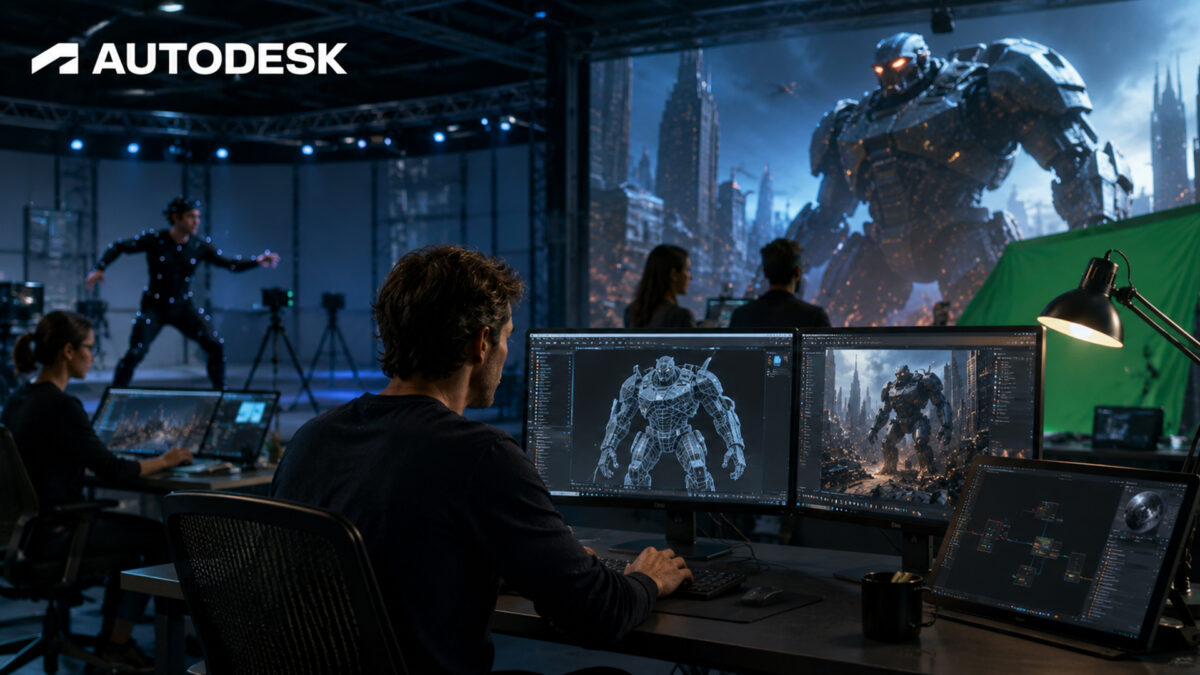
Autodesk has announced a major expansion of its AI-powered creative technologies at SIGGRAPH 2026, introducing new tools designed to improve productivity across animation, visual effects (VFX), game development and virtual production. The latest updates reinforce the company’s strategy of using artificial intelligence to simplify complex production workflows while enabling artists to create high-quality digital content more efficiently.
The centrepiece of the announcement is Autodesk Assistant, an intelligent AI assistant integrated into Autodesk’s creative ecosystem. Using conversational prompts, artists can automate repetitive production tasks, generate workflow suggestions and quickly access software features without navigating multiple menus. The tool aims to reduce technical barriers and accelerate creative work.
Autodesk has also enhanced Maya, one of the industry’s leading 3D animation platforms, with AI-assisted rigging and smarter animation workflows. Character setup, traditionally one of the most labour-intensive stages of production, can now be completed faster through automation while still allowing artists to make creative adjustments.
Another key announcement involves improvements to Flow Studio, Autodesk’s cloud-based production platform. New AI-powered motion-capture processing tools automatically clean and optimise captured performance data, helping VFX studios reduce manual editing and deliver projects faster.
The company also unveiled stronger support for OpenUSD (Universal Scene Description), the open-source framework increasingly adopted across the animation and VFX industry. Enhanced OpenUSD integration allows multiple creative applications to exchange complex 3D assets more smoothly, improving collaboration between studios working on large-scale productions.
Autodesk’s Arnold rendering engine has also received performance enhancements. Faster rendering speeds and improved efficiency allow artists to generate photorealistic images in less time while reducing computing costs. These improvements are expected to benefit film production, advertising and architectural visualisation projects alike.
Cloud collaboration remains another major focus. Autodesk introduced expanded cloud-based workflows that allow geographically distributed production teams to work simultaneously on the same projects. This reduces version conflicts and supports the increasingly global nature of animation and VFX production.
Game developers are expected to benefit from AI-assisted asset creation, workflow automation and improved interoperability between Autodesk tools and modern game engines. These updates enable studios to create larger, more detailed virtual worlds while reducing repetitive production tasks.
Autodesk emphasised that artificial intelligence is intended to support, not replace, creative professionals. The company said artists remain in full control of design and storytelling decisions, while AI handles repetitive and technically demanding processes.
The announcements come as demand for digital content continues to grow across streaming platforms, gaming, advertising and immersive experiences such as augmented and virtual reality. Studios are under increasing pressure to produce more content within shorter timelines, making workflow automation a key competitive advantage.
Industry analysts view Autodesk’s latest product updates as part of a broader transformation taking place across the creative technology sector. AI, cloud computing and open standards such as OpenUSD are rapidly becoming essential building blocks for next-generation content creation pipelines.
By combining artificial intelligence, cloud collaboration and advanced rendering technologies, Autodesk aims to help studios deliver projects more efficiently while maintaining creative quality. The new capabilities are expected to benefit filmmakers, VFX artists, game developers and digital creators looking to manage increasingly complex productions without sacrificing artistic control.
With these announcements at SIGGRAPH 2026, Autodesk has strengthened its position as a leading provider of creative software, offering a technology ecosystem that enables faster production, smarter collaboration and more efficient digital storytelling for the entertainment industry.